
Low Interest, Airlangga Urges Stock Exchange to Boost IPO Pipeline
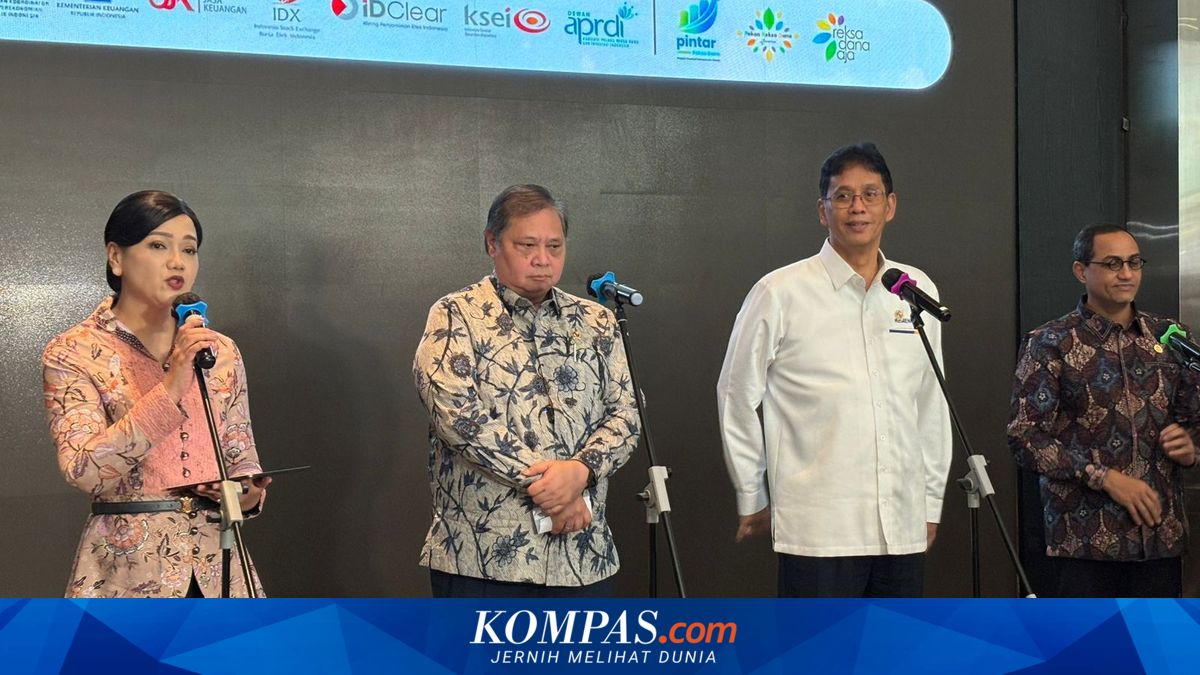
JAKARTA, KOMPAS.com - Coordinating Minister for the Economy Airlangga Hartarto is pushing for increased fundraising through the capital markets, particularly via initial public offerings (IPOs), to support the expanding needs of economic financing.
Airlangga revealed that investment in the real sector in the first quarter of 2026 reached Rp 498.79 trillion, marking a growth of 7.22%, with job absorption reaching 706,000 people.
“And from a financial perspective, the capital market’s function is to attract funds for IPOs, which may face high uncertainty in this first quarter period, so they are still in the pipeline. The pipeline hasn’t materialised yet; this needs to be pursued going forward because it is also an important sector,” said Airlangga at the Inauguration of the Planned and Periodic Investment Programme (PINTAR) for Mutual Funds at the Indonesia Stock Exchange (BEI) Building, Jakarta, on Monday (27/4/2026).
In meeting these needs, the roles of the private sector, the public, and the financial services sector are deemed increasingly important.
Therefore, Airlangga views that the capital market must play a greater role as a source of long-term fund mobilisation, including through IPOs.
According to data from PT Indonesia Stock Exchange (BEI), as many as 16 companies are currently queuing to conduct initial public offerings (IPOs). This figure is recorded up to 17 April 2026.
However, amid the long queue, the realisation of IPOs throughout this year remains minimal.
Only one issuer has officially listed on the exchange, namely PT BSA Logistic Indonesia Tbk (WBSA), raising funds of Rp 0.30 trillion.
Based on the BEI 2026 pipeline document, the majority of prospective issuers come from large-asset companies.
As many as 11 companies have assets above Rp 250 billion, while the other five are in the medium-asset category ranging from Rp 50 billion to Rp 250 billion.
In terms of sectors, the IPO pipeline shows dominance by the consumer sector.
Three companies each come from the consumer cyclicals and consumer non-cyclicals sectors.
In addition, there are four companies from the health sector, two from infrastructure, two from technology, and one each from the energy and financial sectors.