
Low Excise Burden Makes E-Cigarettes Easily Accessible to Children
The relatively affordable price of e-cigarettes is considered a key factor driving the increasing prevalence of electronic cigarette use in Indonesia. This condition is influenced not only by product design, promotion, and technological advancements but also by the low tax burden compared to conventional cigarettes.
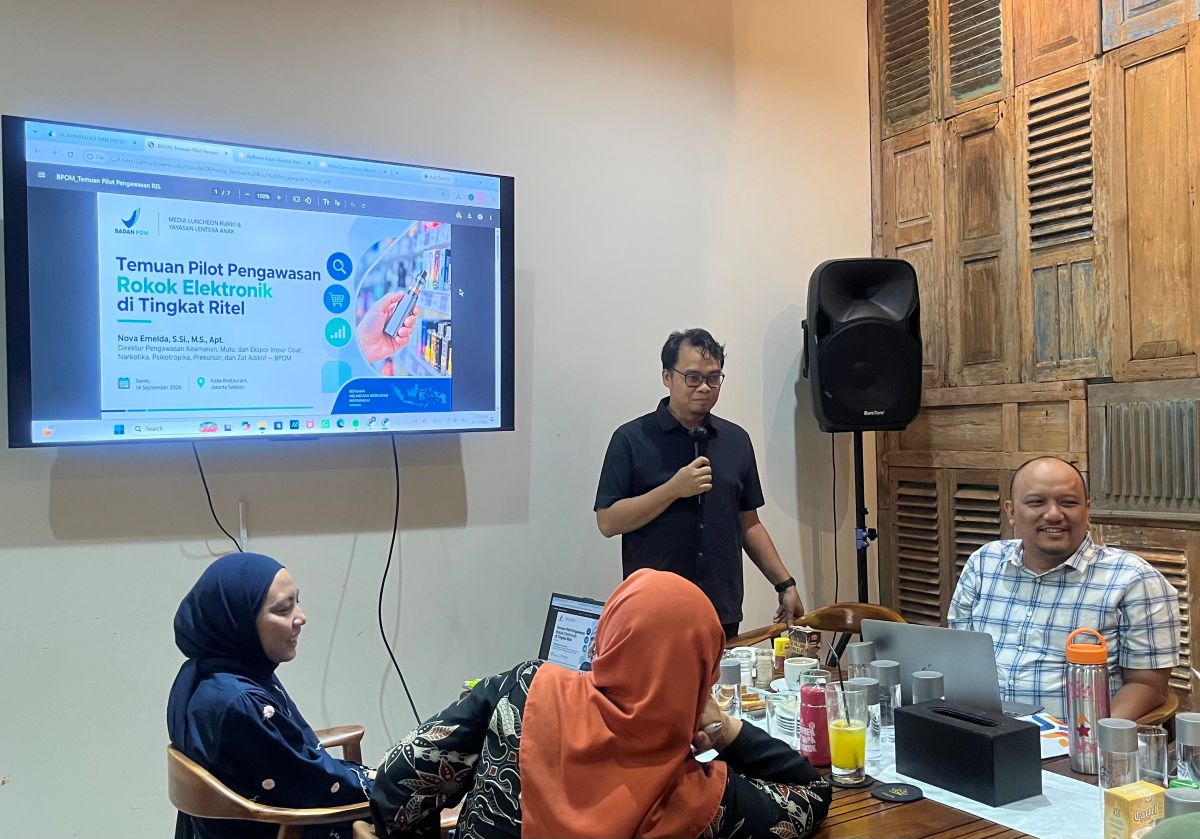
Ridhwan Fauzi, a researcher at the Indonesian Health Policy Space (RUKKI), stated that an analysis of sales data from Euromolitor International reveals a significant gap in the tax burden between e-cigarettes and other tobacco products. “Based on sales data analysis from Euromonitor International, the total tax burden on e-cigarettes is only about 24.2 per cent of the selling price, while conventional cigarettes reach 72.8 per cent and heated tobacco products (HTP) stand at 51.2 per cent,” Ridhwan said during a Media Luncheon in Jakarta on Monday.
This tax burden reflects the proportion of the price paid by consumers that originates from taxation components. In RUKKI’s study, the calculation includes excise duty, Value Added Tax (VAT), and regional tobacco taxes. Consequently, a product with a 24.2 per cent tax burden means approximately Rp24.20 of every Rp100 paid by the consumer is a tax component.
RUKKI also compared the prices of conventional cigarettes, e-liquid, and solid e-cigarettes using equivalent units. In the study, 1 millilitre of e-liquid is assumed to be equivalent to 13 conventional cigarettes. According to Ridhwan, product affordability should not be judged solely on the selling price. RUKKI uses the Relative Income Price (RIP) indicator, which compares product prices to the economic capacity of the population. “The lower the RIP value, the more affordable the product is,” he added.
Based on the study, e-cigarettes consistently maintain an RIP value below 1 per cent. Meanwhile, the RIP for conventional cigarettes ranges between 3–5 per cent, and heated tobacco products (HTP) are around 6–8 per cent. These findings show that e-cigarettes remain highly affordable, even for those with limited economic means. This situation persists despite e-cigarette prices reportedly increasing nearly threefold since 2013, as rising public income has kept the products relatively easy to purchase.
This issue of affordability is becoming more serious as it coincides with the ease of access for adolescents. An investigation by Lentera Anak conducted between April and May 2024 found that e-cigarette devices were owned by students in 7 out of 10 schools surveyed in Jakarta. Rama Tantra Solikin, Project Officer at Lentera Anak, stated that access to these products can be achieved through various channels, both directly and via digital platforms.
“From our interviews, we found that students can access e-cigarettes by buying directly from vape shops, online, or purchasing second-hand products through social media buying groups using Cash on Delivery (COD) mechanisms,” said Rama. He noted that some students even attempt to make purchases by saving money or pooling funds with friends. “This shows that the problem is not merely whether children use e-cigarettes in school, but how these products have entered their lives so closely, confirming how easily e-cigarettes are accessible to teenagers.”
Regarding oversight, the Indonesian Food and Drug Authority (BPOM) has also identified several issues in the regulation of e-cigarettes at the retail level. Nova Emelda, Director of Supervision for KMEI Drugs, Narcotics, Psychotropics, Precursors, and Addictive Substances at BPOM, stated that pilot supervision shows low compliance with product labelling. Oversight also uncovered e-cigarette products camouflaged to resemble everyday items, which could deceive regulators and increase appeal to children and adolescents.
“Based on Government Regulation (PP) 28/2024, starting from late July 2024, BPOM has begun supervising e-cigarettes. Monitoring includes graphic health warnings, labels, nicotine levels, and additives,” said Nova. She noted that supervision is supported by several regulations, including BPOM Regulation No. 18/2025 regarding the supervision of tobacco and e-cigarette products. Additionally, BPOM provides the BPOMWatch application for producers and importers to report nicotine levels and packaging samples.
Consequently, RUKKI and Lentera Anak believe that e-cigarette control needs to be more comprehensive. They argue that excise policy must go hand-in-hand with distribution monitoring and child protection. Both organisations are urging the government to significantly increase e-cigarette excise rates to impact pricing and reduce affordability. Furthermore, the government is encouraged to use affordability as a primary indicator in evaluating excise policy, rather than merely measuring nominal rate increases. Supervision of sales access to children must also be tightened, including in physical stores, online trade, the use of adult accounts, and second-hand product transactions through various channels.