
Low-Carbon Economic Transition Driven to Become New Engine of Economic Growth
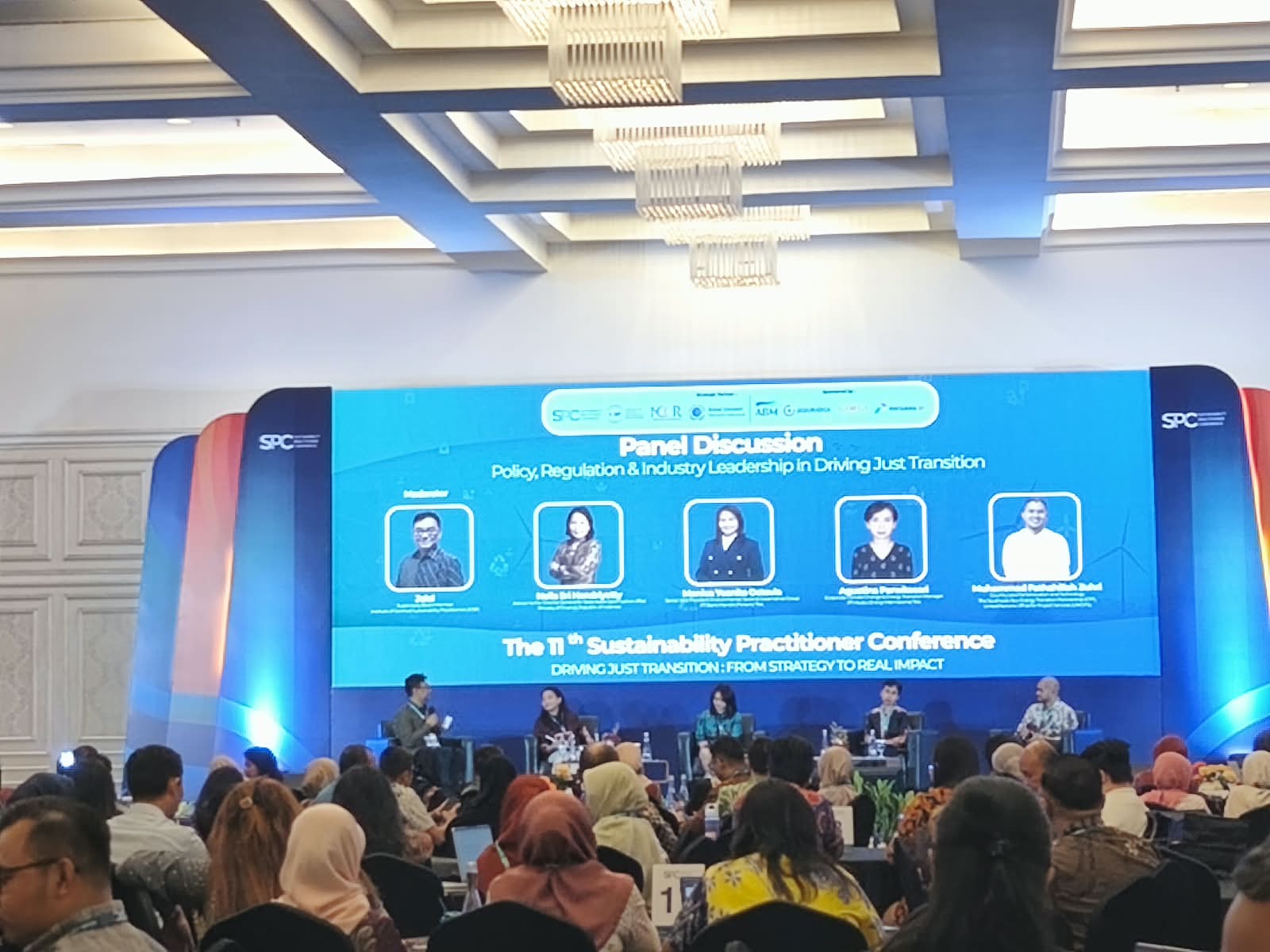
The transition towards a low-carbon economy in Indonesia is viewed as needing to move from mere commitment to tangible implementation that is integrated with government policy, investment decisions, industrial transformation, financing, and the protection of affected communities. This step is considered vital so that the sustainability agenda does not only pursue emission reduction targets but also generates economic and social benefits.
This message emerged during the opening of The 11th Sustainability Practitioner Conference (SPC) 2026, themed ‘Driving Just Transition: From Strategy to Real Impact’ in Jakarta on Wednesday (16/9/2026). The forum, organised by the Institute of Certified Sustainability Practitioners (ICSP) alongside the National Center for Corporate Reporting (NCCR) and supported by the UN Global Compact Network Indonesia (IGCN), brought stakeholders together to discuss the implementation of a just transition.
Sylvia Veronica N P Siregar, Chairperson of the ICSP Board of Directors, stated that a just transition cannot be viewed merely as an environmental programme with added social aspects. According to her, the concept is directly related to how economic transformation is managed, where capital is directed, and how institutions account for their impacts. “The main challenge today is no longer about commitment, but rather the implementation gap,” said Sylvia.
She assessed that the sustainability agenda needs to be embedded within corporate governance and capital allocation. Financing must also be directed towards credible activities, while reporting and assurance must be able to provide information that is trustworthy to stakeholders.
NCCR Executive Director Ali Darwin added that the low-carbon transition is occurring amidst various global challenges, ranging from climate change and geopolitical conflicts to social inequality and biodiversity loss. Therefore, the shift towards a low-carbon economy cannot rely solely on technology and investment.
According to Ali, workers and affected communities must be part of the planning from the outset. Corporate strategies need to include emission reduction targets, investment requirements, and the impact on labour and society. The involvement of workers, trade unions, local communities, government, investors, and educational institutions is considered essential to ensure the process is inclusive and transparent.
MAIN CHALLENGES OF THE TRANSITION
Robin Hodess, Chief Executive Officer of the Global Reporting Initiative (GRI), stated that the primary challenge of the transition is no longer about the direction of change, but rather how to ensure that change occurs fairly. A transition that is too rapid without planning can trigger social unrest, whereas a transition that is too slow increases climate, market, and investment risks.
This situation is relevant to Indonesia, as there are still workers and communities dependent on the coal sector and energy-intensive industries. Therefore, the transition towards a sustainable economy needs to create new opportunities without leaving behind affected groups.
From a reporting perspective, Emily Pierce, Director of Regulatory Implementation at the IFRS Foundation, highlighted the increasing importance of ISSB standards as a foundation of information for capital markets. More than 45 jurisdictions have used or taken steps to adopt ISSB standards, which cumulatively cover more than 60% of global gross domestic product.
Through IFRS S1 and IFRS S2, companies are encouraged to disclose climate-related risks and opportunities, including physical and transition risks, strategies for achieving climate targets, changes in business models, resource allocation, and transition plans.
This agenda aligns with Indonesia’s commitment to net-zero emissions by 2060 or sooner and the implementation of the Just Energy Transition Partnership (JETP). As of January 2026, approximately US$3.4 billion of the total US$21.8 billion JETP funding commitment has been realised.
SPC 2026 subsequently discussed the interconnectedness of policy, regulation, finance, industrial leadership, human rights, and sustainability reporting. The forum encouraged the application of a just transition within business strategies, investment decisions, risk management, and financing, so that the low-carbon economic transition does not remain merely a target but produces a measurable impact on society.
Source: jawawa.id (https://jawawa.id/newsitem/low-carbon-economic-transition-driven-to-become-new-engine-of-economic-growth-1789552365)
Originally published by Media Indonesia (https://mediaindonesia.com/nusantara/934027/transisi-ekonomi-rendah-karbon-didorong-jadi-mesin-pertumbuhan-ekonomi-baru), translated from Indonesian