
Lost Ancient City Discovered, Unveiling Story of Human Civilisation
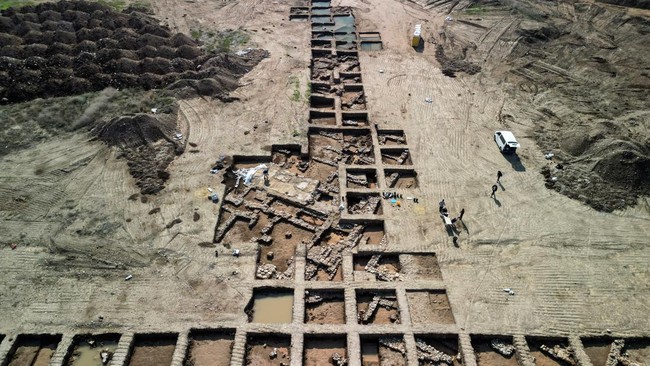
Archaeologists in Egypt have discovered an ancient city from the Byzantine Empire era in the western desert region. The settlement, dating back to the 4th century AD, encompasses residential and religious buildings, including a basilica-style church in the Dakhla Oasis. The archaeologists also found coins, pottery shards, and various tools. In a separate discovery, another archaeological team found 18 ancient tombs in Marina el-Alamein, located near Alexandria. The finds consist of rock-hewn tombs, limestone tombs, pottery, and a granite sarcophagus. Egypt’s Ministry of Tourism and Antiquities stated that the first discovery provides a detailed picture of daily life, urban development, and economic activity when Egypt was still part of the Byzantine Empire. The discovered settlement features a main road running north to south intersecting with an east-west road, forming an open square and public space, according to Hisham el-Leithy, Secretary-General of Egypt’s Supreme Council of Antiquities. In the main part of the settlement stands a basilica-style church dating from the mid-4th century, facing the city’s main streets. Remains of two watchtowers, thought to have been used to guard the city’s outskirts, were also found in the area, according to Mahmoud Massoud, head of the archaeological mission. The Dakhla Oasis, located in the New Valley Governorate in western Egypt, is currently on UNESCO’s tentative list as a potential World Heritage Site. Massoud added that his team also discovered a building with strong defensive fortifications featuring thick walls, as well as many houses equipped with reception rooms and arched roofs. One of the buildings found was the home of Tisous, a church deacon, believed to date from the second half of the 4th century. Archaeologists believe the building was used as a house church before the city’s main basilica was built. Additionally, bread ovens, kitchens, grinding tools, and bronze coins depicting portraits of Byzantine emperors, Latin inscriptions, and Christian symbols were discovered. A group of gold coins found is known to be from the reign of Roman Emperor Constantius II, who ruled between 337 and 361 AD. Diaa Zahran, Head of the Islamic, Coptic, and Jewish Antiquities Department, said his team found around 200 pottery shards, or ostraca, which were used as writing media in the past. The shards contain records of trade transactions, correspondence, and various aspects of daily life at the time. Meanwhile, at the Marina el-Alamein archaeological site, about 100 kilometres west of Alexandria, archaeologists discovered 18 ancient tombs. Regarding the tomb finds, the Ministry of Tourism and Antiquities said 11 tombs were carved into rock at an average depth of eight metres, along with seven surface tombs, built using limestone. A total of 48 tombs have been found. In the burial area, the team also found various artefacts such as jugs, amphorae, oil lamps, plates, altars, and limestone containers. The head of the archaeological mission, Eman Abdel-Khaliq, said they found a granite sarcophagus about 2.5 metres long, still containing human skeletal remains, which is now being further studied. Near the sarcophagus, remains of a plaster sphinx statue were also found. Four gold flakes were also discovered, placed in the mouths of some of the deceased. This practice, known as ‘golden tongues’, was a burial tradition believed to help the dead speak with the gods in the afterlife. Marina el-Alamein is an archaeological site near the city of Alamein on Egypt’s northern coast. The site was first discovered in 1986. Archaeologists believe the area was an ancient Greco-Roman port city named Leukaspis, built in the 2nd century AD and flourishing until the 4th century.