
Losses from Forest and Land Fires Could Persist for Decades
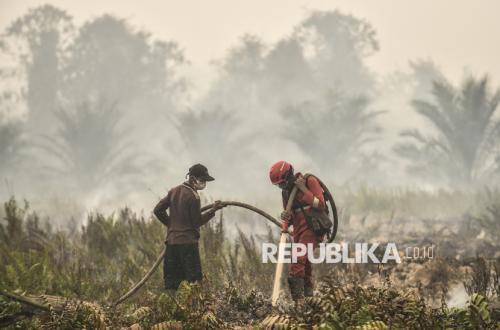
JAKARTA — Forest and land fires can cause economic losses of up to hundreds of trillions of rupiah, with long-lasting impacts on the environment and public health. Damage to peatland ecosystems could even result in the loss of carbon reserves that would take thousands of years to form again.
Berton Penjaitan, director of early warning at the National Disaster Mitigation Agency (BNPB), said the effects of forest and land fires extend beyond damage to forests and land. Fires can also affect public health, endanger lives, disrupt transport and interrupt a range of essential services.
“These risks are very significant, and some of the impacts are long-term, particularly those affecting health. Smoke from forest and land fires contains fine PM2.5 particles and various pollutants that can remain in the human body for a long time,” Berton said during a webinar entitled “Assessing the Economic Losses from Forest and Land Fires” on Thursday (22 October 2026).
The event was organised by the IPB LRI i-MAR Centre for Coastal and Marine Resources Studies, alongside the Indonesian Association of Economic Valuation Experts (MAVEIN), Jenggala and the Kama Institute.
Berton said exposure to fine particles in fire smoke can cause eye irritation and respiratory problems. It may also worsen heart and lung disease and, in certain circumstances, increase the risk of premature death.
Benny Osta Nababan of the IPB LRI i-MAR Centre for Coastal and Marine Resources Studies said economic assessments of fire losses should cover damage to assets, lost production and ecosystem services. Other components include healthcare costs and spending on firefighting and environmental recovery.
“Economic losses from forest and land fires can be calculated. However, the accuracy of the estimates depends on the completeness of the data, the scope of the impacts, the valuation methods and the period covered,” Benny said.
Benny cited the major fires in Indonesia in 2015. According to World Bank calculations he presented, the losses from those fires amounted to US$16.1 billion, or around Rp221 trillion.
That estimate covered losses in agriculture, forestry, trade, tourism, transport, short-term healthcare, firefighting and the environment. A study published in Nature Communications put the losses at US$28 billion after including additional factors, such as carbon emissions and long-term health impacts.
Benny said loss estimates could provide a basis for calculating the economic benefits of prevention. By understanding the potential scale of losses, the government and other stakeholders can assess what measures are needed before fires occur.
“By calculating these potential losses, we hope to answer not only how much damage has been done, but also how much could be avoided if preventive action is taken now,” Benny said.
Nisa Novita, a climate change and forestry specialist at the Nature Conservancy Indonesia (YKAN), said the challenge in controlling forest and land fires lies in turning early-warning information into preventive action. Scientific advances have made it possible to monitor climate conditions and identify fire-prone areas more accurately, she said.
“If high-risk fire events can be predicted, the important question is why we still struggle to turn those early warnings into effective preventive action on the ground. This points to a continuing gap between early warning and early action, as well as inadequate coordination and a lack of timely responses from the stakeholders involved,” Nisa said.
Nisa said the losses from fires also need to be considered in terms of their impact on peatland ecosystems. Repeated fires in drained and dried-out areas can reduce peatland’s ability to recover.
“If an area continues to be drained, dry out and burn repeatedly, peatland may lose its ability to recover. We risk permanently losing carbon stored over thousands of years. That is why peat fires are so serious. What is lost is not only vegetation that may regrow over several decades, but also ancient soil carbon reserves that took thousands of years to form,” Nisa said.
Controlling forest and land fires therefore requires prevention measures that go beyond extinguishing fires once they break out. Strengthening early-warning systems, managing peatland water levels and improving coordination among stakeholders are considered essential to reducing potential long-term economic, health and environmental losses.
Source: jawawa.id (https://jawawa.id/newsitem/losses-from-forest-and-land-fires-could-persist-for-decades-1792738375)
Originally published by Republika (https://esgnow.republika.co.id/berita/tncd1h416/kerugian-akibat-karhutla-bisa-berlangsung-puluhan-tahun), translated from Indonesian