
Longing for Ibu Pertiwi: A Perspective on Dual Citizenship for the Governance of the Indonesian Diaspora
“I was deeply moved when Bung Willy mentioned the figure of two million Indonesians in the Netherlands and elsewhere, which means Bung is counting every head that loves and longs for the homeland of their ancestors. Not just one or two thousand people considered talented.”
That message came from Herman Syah, a member of the Indonesian diaspora living and working in the Netherlands, a few days after President Prabowo addressed the House of Representatives (DPR) on 14 August 2026. He expressed both emotion and hope for the ‘recognition’ they had long awaited, following the President’s statement on limited dual citizenship.
When the writer had the opportunity to make a working visit to the ‘Land of Windmills’ a year ago, Herman spoke of his love for the homeland. “We want dual citizenship because of our love for Indonesia. We still want to be here, we earn our living and pursue our studies, but we can never forget Indonesia. The way we can grow and contribute to Indonesia is when we hold dual citizenship.”
Such voices come not only from Herman or other members of the diaspora in the Netherlands. In general, the same voice comes from our diaspora across the world.
AWAITING A BROADER SPACE
Bung Karno once said: my nationalism is my internationalism. That is a sentence born of the conviction that love for the homeland should never stand opposed to openness to the world. That being Indonesian does not mean closing oneself off, but rather finding oneself through encounters with others. After all, the foundation of our nationhood, from the beginning, was one of plurality that transcended narrow divisions.
That spirit has lately revived our national discourse following President Prabowo’s address. The President proposed to the DPR that exceptional Indonesian talents — scientists, engineers, doctors, technology experts and world-class athletes — be given the freedom to hold two citizenships at once. The DPR responded positively and the draft of the Citizenship Bill has been completed.
That is a step to be grateful for. After decades of rigidly adhering to the principle of single citizenship, the state has finally opened the door, albeit still in a limited form. It is an important acknowledgement that the world has changed, and that the children of the nation who achieve abroad are not people to be kept at arm’s length by law, but assets worthy of being embraced once more.
The Indonesian diaspora is estimated at between 6 and 9 million people, spread across more than 65 countries. Some are migrant workers seeking their fortune in other people’s fields and kitchens; others are professionals working in laboratories and boardrooms of multinational corporations; students pursuing knowledge; and those who married and settled because love carried them to distant lands. They differ in profession, in reason, in fate, but one common thread unites most of them: the longing to return home and receive ‘recognition’ from Ibu Pertiwi.
The concrete form of that longing is the wish to own land in their hometown without being treated as foreigners; the wish to return home without visa complications; the wish that their children born abroad have a clear legal path home, not merely an emotional one. Many of them never truly wanted to relinquish their Indonesian identity. They were forced — by career demands, by the rules of the countries where they live, or simply for the survival of their families — to become members of the diaspora.
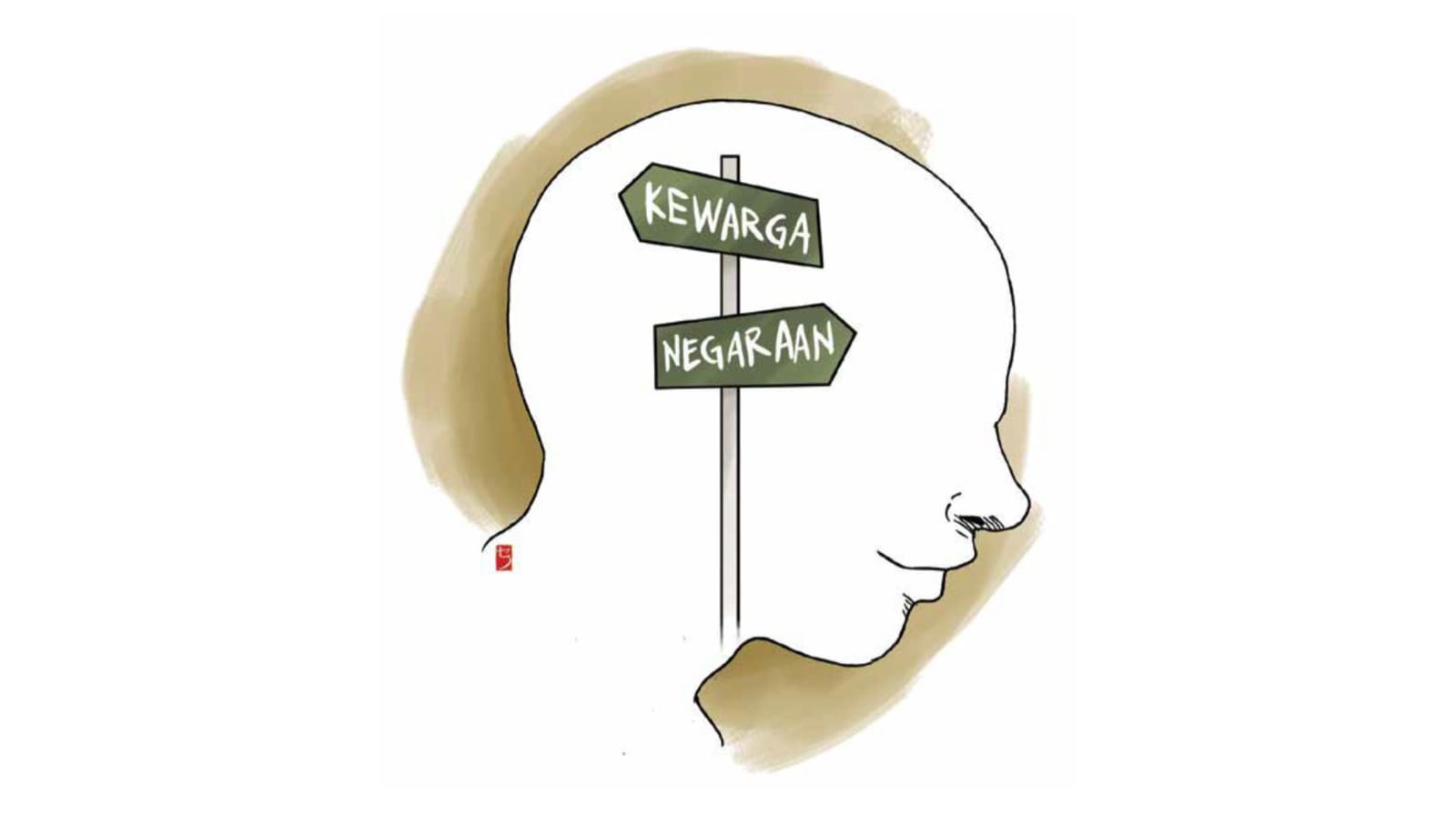
What the President has offered is a step forward. However, through this piece, the writer invites us all to broaden our perspective by making the idea of dual citizenship more inclusive. The matter of citizenship is not merely administrative. More than that, it becomes a larger issue of national interest. Better still if it can become a national order.
The most strategic basis for dual citizenship, arguably, lies in how we build comprehensive diaspora governance. The policy will be more progressive and meaningful if its foundation is holistic diaspora governance, not merely a list of professions deemed strategic. There is a fundamental difference between the two. A policy born of diaspora governance will view every child of the nation abroad, whatever their profession, as part of the long-term national interest. They have networks, knowledge, capital, and — no less important — an emotional attachment to the homeland that deserves the state’s protection.
On the other hand, the right to remain legally bound to one’s birthplace is also part of fundamental human rights. Recognising that right more widely does not mean sacrificing the national interest. On the contrary, it is the most complete expression of that national interest itself: the ability of the state to embrace the full potential of its children.
LEARNING FROM THE WORLD
The experience of other nations confirms that such expansion is a realistic goal. In 1966, South Korea under Park Chung-hee established the Korea Institute of Science and Technology (KIST). With help from Donald Hornig (then science adviser to the US President) and the Battelle Memorial Institute, they compiled a list of Korean scientists and engineers scattered across various countries. For the selected candidates, the head of KIST himself, Choi Hyung-sup, flew around to meet them one by one. On campuses, in laboratories and workplaces in the US and Europe, he explained KIST’s vision and persuaded them to return. Such personal approaches reportedly left a deep impression. One of Choi’s famous invitations ran roughly: “If your target is the Nobel Prize, stay there; but if you want to build a nation, come home!”
India chose a middle path through the status of overseas citizen of India, a special citizenship status granting lifelong rights to live, work and do business without a visa to anyone of Indian descent, not limited to certain professional groups. The Philippines went further by allowing its citizens naturalised elsewhere to reclaim their full citizenship, whoever they are, whatever their profession. So too Vietnam.
Germany, which in 2024 reversed its single-citizenship policy entirely, also did not limit that openness to an elite. The policy applied universally, precisely because it was recognised that a nation’s greatest potential comes from breadth of coverage, not exclusivity.
The consistent pattern from these experiences is that the nations most successful in maximising their diasporas’ contributions are those bold enough to move from limited policies towards more inclusive ones. A limited starting point, as Indonesia is taking today, is entirely sensible as a beginning. But the direction should be clear from the outset: continually expanding the scope.
Turkey offers a lesson from another angle on how a diaspora, with strong institutions, can become a real force on the world stage. Turkey’s diaspora in Europe, numbering 5–6 million people, has been embraced through specialised agencies, cultural programmes and neatly organised business networks. The results are tangible. Their presence has strengthened Turkey’s global bargaining position. There are certainly cautionary lessons to draw from that experience, but the main point remains: viewing the diaspora as a strength, not a burden.
SECURITY ALONGSIDE OPENNESS
The government’s caution in designing the policy — maintaining single citizenship as the main principle, applying selection and integrity checks, ensuring an orderly process — is a wise stance that remains relevant even if the scope is widened. National security is a legitimate interest that must not be sacrificed for openness alone. That said, expanding the scope does not mean abolishing selection or oversight. It only means the door is not determined by a person’s profession, but by a fair verification system applied equally to all.
Today’s world is no longer a bipolar one dividing humanity into ideologically suspicious blocs. The mobility of people, capital and knowledge moves far more fluidly than the founding generation ever imagined. The government’s courage to take the first step, and the courage to keep widening it, is the self-confidence of a nation no longer trapped in viewing the outside world merely as a source of threat. Instead, that reality is seen as a space of encounter that can strengthen us.
A ROADMAP FOR THE FUTURE
Therefore, the limited dual citizenship step the government is preparing will grow stronger and more progressive if placed upon a broader roadmap: coherent and inclusive diaspora governance. Citizenship status is one important instrument in the life of a state, but it will be more powerful when accompanied by complementary instruments: economic incentives for investment and capital repatriation, easier property ownership, political representation or channels for diaspora aspirations, and strengthened institutions bridging the state with diaspora organisations that have so far operated independently on a voluntary basis.
Ultimately, the step the government is taking today is a good beginning for the long journey of re-embracing the children of the nation scattered across the world. Bung Karno taught that true nationhood never fears the outside world, just as it never feared embracing plurality at home. Our diaspora, with all their longing and potential, is part of the body of the nation that must be embraced once more. Our task is to ensure that embrace is open to all, not only to the few deemed exceptional. There lies the fullest expression of the just and civilised humanity we pledged when this Republic was born.
A LONGING THAT MUST BE GIVEN VOICE
Along the canals of Amsterdam, Javanese dialect whispers softly amid chatter in small coffee shops. The song Sai Anju Ma Au drifts softly from the earphones of an elderly-care nurse working far from the Batak lands. The lyrics of Ambon Manise echo faintly in many football academies there. All of that is a longing that knows not where to voice itself except in melody and hope.
Among the fallen chunks of the Berlin Wall lies knowledge once built by sojourners of the Nusantara. In the corridors of Al-Azhar in Cairo are the traces of Nusantara students who once helped persuade Egypt to become the first nation to recognise our independence. Proof that this nation’s struggle never stopped at territorial borders.
In America, in laboratories and campuses, our young engineers and scientists light the lamps of discovery. Yet their path home remains held back by status and documents.
Now is the time to repeat that history. No longer through letters crossing the ocean, but through policy that stretches out its arms to receive them as fellow countrymen. It is time to join hands, to weave again the shawl of Ibu Pertiwi, so that it is wide enough to embrace anyone who longs to return to the homeland. So that the dedication scattered along the canals of Amsterdam, amid the ruins of the Berlin Wall, in the alleys of Cairo, and in the laboratories of America can once again become part of this Republic’s progress.