
Lockheed Contract Worth Rp969 Trillion; JPMorgan Highlights US Dependence on China
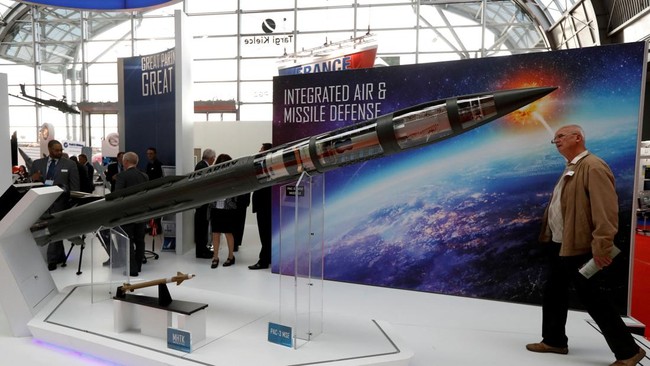
Wars may last only days, but their impact on the defence industry can persist for years. Once ammunition is expended on the battlefield, a need arises to replenish stocks, expand factory capacity, and secure raw materials. A recent signal has emerged from the United States, where Lockheed Martin has obtained a contract modification valued at US$53.86 billion (approximately Rp969.5 trillion) to increase the production of Patriot Advanced Capability-3 Missile Segment Enhancement (PAC-3 MSE) interceptor missiles.
This modification transforms a one-year contract into a seven-year multi-year procurement programme. Following this addition, the total cumulative value of the Lockheed Martin PAC-3 contract has reached US$58.62 billion (approximately Rp1,055.2 trillion). The contract covers hardware, equipment, and all manufacturing activities required to scale production, with work expected to continue until March 2035 across Lockheed Martin facilities and its US supplier network.
However, this figure does not represent an immediate cash payment. US defence authorities stated that no funds have been obligated at the time of the announcement; rather, the amount serves as a ceiling and provides long-term procurement visibility. For Lockheed Martin, multi-year procurement provides the certainty needed to expand facilities, add machinery, retain skilled workers, and secure contracts with component and material suppliers.
The scale of the Lockheed contract becomes increasingly relevant when viewed alongside a J.P. Morgan report titled ‘Pandora’s Bog: The Global Energy Shock of 2026’. Using a hypothetical conflict scenario, the report illustrates the rapid consumption of ammunition in high-intensity warfare and estimates the critical minerals embedded in US munitions used during the first 96 hours of conflict. Significant volumes of ammonium perchlorate, tungsten, and cobalt were identified as key materials.
While these volumes are relatively small compared to total US annual consumption, the risk to the defence industry is not determined solely by tonnage. Supplier concentration, refining capacity, product purity, and the difficulty of substitution are critical to supply security. J.P. Morgan noted that the US remains dependent on imports for several strategic minerals, with China’s position being most prominent in rare earth metals used for high-performance electronics, sensors, and motors. China supplies neodymium, samarium, and dysprosium at levels equivalent to approximately 48% of annual US consumption, as well as significant portions of tantalum, gallium, tungsten, and germanium.
This dependency represents a vulnerability as Washington seeks to ramp up weapons production. While Lockheed Martin may have contracts through 2035, production cannot increase through machinery and labour alone; the company requires specific materials in the right quantity, quality, and timeframe. Furthermore, because these contracts use a firm-fixed-price structure, rising costs in labour, energy, or materials that exceed initial calculations may not be easily passed on to the government. Consequently, investors must monitor obligated funds, backlog growth, and production margins. Ultimately, the Lockheed Martin contract serves as a test of the US’s ability to expand its defence industry without being held hostage by global mineral supply chains.