
Local 'Servants' Smooth the Path for Mining in Beutong
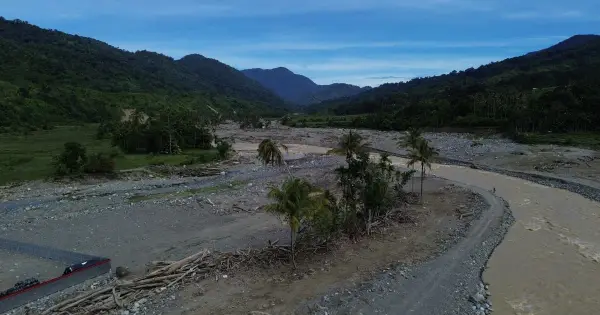
The Beutong Ateuh Banggalang region has never been truly free from the threat of mining. Each time one permit is revoked, a new company name emerges. Residents once again take to the streets, carrying banners, prayers, and the same anxieties about their contested land.
“If it’s a mine, there’s no story of acceptance, whatever the reason,” said Saudah during a protest with hundreds of Beutong Ateuh residents and students last week at the Nagan Raya Regent’s Office. During the action, they demanded the government halt all mining activities and plans in the mountainous area that serves as the community’s source of life.
For the residents, rejecting the mine is not a momentary movement. The resistance has lasted for years. They have blockaded the Beutong Bridge, held mass prayers, protested against village officials, and pursued a lawsuit against PT Emas Mineral Murni (EMM), which resulted in a victory at the Supreme Court. This resistance is born from the conviction that mining is not merely an investment issue, but a matter of survival. “We are ready to die to protect our ancestral lands,” a resident told the crowd.
For the community, the Beutong area is not just a landscape holding gold beneath the earth. The forest is a source of food, water, and living space, as well as the last bastion supporting the local economy. They fear mining activities will completely alter a way of life inherited for generations.
Behind the emergence of new permits, the Indonesian Forum for the Environment (Walhi) Aceh sees a repeating pattern. Afifuddin Acal, Head of Advocacy and Campaigns for Walhi Aceh, stated that most Mining Business Permits (IUP) in Aceh are not held by the actual capital owners. He said the companies that appear on the surface mostly act as initial permit holders before transferring them to large investors. “Based on General Legal Administration (AHU) documents, it is clear that behind PT Alam Cempaka Wangi and PT Hasil Bumi Sembada, there is a network of larger capital owners, including links to the Green Power Group,” Afifuddin said on Friday, 26 June 2026.
He noted that the mining industry requires massive investment, high technology, and skilled labour, casting doubt on the financial capacity of local IUP holders to bring projects to the exploitation stage. “Once exploration is complete, it is very likely the permit will be transferred to the real capital owner.” Afifuddin described this pattern as a mining brokerage practice. However, he said, large capital owners cannot operate alone; they need local people who understand the social structure of Acehnese society. “National players do not understand the character of Acehnese society. Therefore, they need local people who understand the customs, culture, and how to build communication. We call them ‘jongos’ or local agents.”
According to him, the presence of local agents is crucial to facilitating the investment process, especially in building social acceptance within the community. He estimated the number of such local agents to be small, possibly fewer than ten people, though he admitted to not having exact data. Afifuddin observed a significant shift after the enactment of the Omnibus Law on Job Creation. During the permitting process for PT EMM around 2014–2015, community approval was a critical factor in issuing permits. “After the Omnibus Law, whether or not there is community approval, the permitting process can still proceed according to regulations.” He argued this regulatory change distinguishes the current dynamics of mining investment from those of a few years ago and questioned the government’s allegiance. “If the government sides with investors, the policies will favour IUP holders, but if it sides with the people, then the people’s aspirations must be heard.” Afifuddin assessed that Aceh is far more suited to developing sustainable investments based on agriculture, plantations, forest products, and local commodities rather than the extractive sector. Citing 2023 data from the Central Statistics Agency (BPS), the mining and quarrying sector absorbs only about 0.96 percent of the workforce in Aceh, far below agriculture and trade. “For indigenous communities, the forest is a supermarket. All their life needs are available there. As long as people can live from the forest, the area should not be disturbed.” As far as he knows, at least four companies have tried to enter the Beutong Ateuh Banggalang area: PT EMM, BMA, PT Alam Cempaka Wangi, and PT Hasil Bumi Sembada. He believes almost all mining activities have the potential to trigger social conflict. “That is why companies always need local power or local agents to minimise conflict.”
Syukur Tadu, Director of APEL Green Aceh, views the emergence of two new mining permits in Beutong Ateuh Banggalang as more than just a change of company name. “It’s like a person changing clothes. The person is the same, only the clothes are different.” He suspects the concession areas of PT Alam Cempaka Wangi and PT Hasil Bumi Sembada are located in areas that were previously the operational territory of PT Emas Mineral Murni (EMM). He therefore questioned why the government is reopening space for mining activities in an area that was previously the subject of a legal dispute up to the Supreme Court level. Syukur argued that the issuance of these new permits contradicts the spirit and legal considerations of Supreme Court Decision Number 277 K/TUN/LH/2020, which granted the lawsuit filed by Walhi Aceh and residents against PT EMM’s mining business permit.