
Local Oranges Abundant, Yet Indonesia Continues to Increase Imports
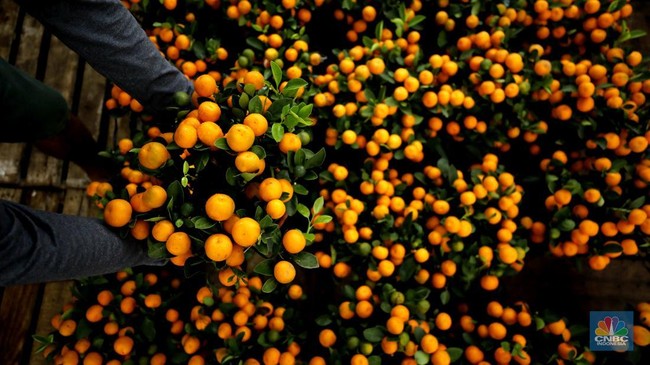
Indonesia is one of the largest orange producers in Southeast Asia, yet its import figures continue to climb. In 2025, Indonesia imported approximately 208,000 tonnes of oranges, while its export volume was only around 1,900 tonnes. The gap between imports and exports is more than a hundredfold. National production actually increased again in 2025, but most of the fruit never leaves the domestic market.
Based on the 2025 Horticulture Statistics, national orange production reached approximately 2.46 million tonnes, up from 2.41 million tonnes the previous year. The increase was supported by a rise in the number of productive plants to around 13.65 million trees. The highest production throughout 2025 occurred in the second quarter, reaching 702.41 thousand tonnes. East Java remains the primary production hub, contributing around 1.17 million tonnes, or 47.42% of the national total, followed by North Sumatra with 356.55 thousand tonnes and West Kalimantan with 131.91 thousand tonnes. The steadily increasing production indicates that domestic supply remains robust, but this has not automatically translated into larger export volumes.
Data from the Central Statistics Agency shows household consumption of oranges remains at around 1.4 million tonnes per year. After a dip in 2023, consumption rose again to approximately 1.46 million tonnes in 2025. The large domestic market means producers are not entirely dependent on exports, but it also means they must compete directly with imported fruit in the same market.
Despite rising production and strong domestic consumption, the trade balance for oranges remains heavily skewed. In 2025, Indonesia imported around 208.47 thousand tonnes of oranges, while exports reached only about 1.90 thousand tonnes. In value terms, orange exports in 2025 were recorded at approximately US$1.38 million, a 1.86% decline from the previous year. Meanwhile, the value of imports reached US$384.80 million, a 28.71% increase from 2024. Both exports and imports are dominated by fresh oranges. Export volume of fresh oranges reached around 1,439 tonnes, compared to processed products at just 461 tonnes. On the import side, fresh oranges accounted for 185,761 tonnes, far exceeding processed products at 22,711 tonnes. Over the past five years, both the volume and value of imports have consistently dwarfed exports.
The direction of Indonesia’s orange trade is also highly concentrated. The three main export destinations in 2025 were France, Malaysia, and Australia. Meanwhile, imports primarily originated from China, Australia, and Pakistan. This trade map illustrates that large production volumes do not automatically make Indonesia a major player in the global orange trade. As long as imports far outstrip exports, the challenge for the orange industry is no longer just about increasing harvest yields, but about strengthening the competitiveness of its products in the international market.