
Local Government Stunting Prevention Budgets Primarily Allocated to Service Logistics
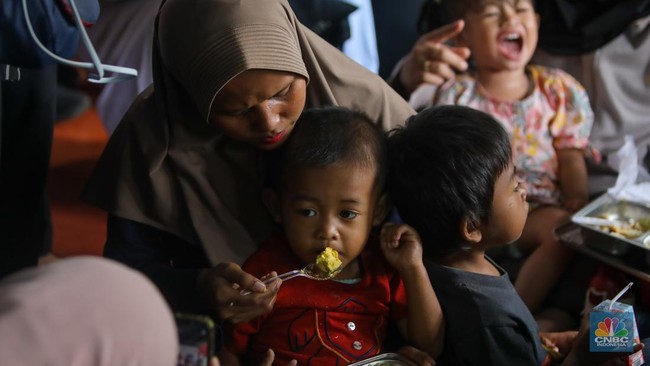
Local governments have recorded a continuous decline in stunting prevention budget allocations since 2024. This situation affects spending related to specific nutritional interventions, such as pregnancy check-ups, iron supplementation tablets, malnutrition management, medical equipment for quality service provision, as well as growth monitoring and promotion.
“There is a significant shift in the proportion between budget and realisation from 2023 to 2025,” according to the Report on Marking, Tracking, and Evaluation of Nutritional Intervention Budgets in Regional Budgets (APBD) prepared by the Ministry of Finance and the Ministry of Home Affairs for 2026, published on Monday (28/09/2026).
The Ministry of Finance and the Ministry of Home Affairs noted that the budget allocation for nutritional interventions in the regional budget (APBD) is left with only Rp 20.2 trillion. The 2026 budget is significantly lower than the 2025 figure of Rp 26.3 trillion. In 2024, the allocation for nutritional interventions in the APBD reached its highest point at Rp 28.4 trillion, growing from Rp 22.2 trillion in 2023.
In terms of budget realisation, local governments have consistently failed to reach the target allocations for nutritional interventions year after year. For instance, in 2023, only Rp 21.5 trillion was realised. In 2024, realisation stood at Rp 22.1 trillion, and in 2025, it was Rp 22.4 trillion.
“This requires serious attention, especially as it occurs following the budget surge in 2024. The rate of nutritional intervention budget realisation is declining, and expenditure growth has contracted in almost 50% of regencies/cities based on 2024 realisation,” stated the report from the Ministry of Finance and the Ministry of Prime Affairs.
The budget proportions per type of specific intervention are as follows:
Service provision logistics: 7.30% in 2026, down from 8.40% in 2025
Iron Supplementation Tablets (TTD): 6.67%, down from 5.86% the previous year
Pregnancy check-ups: 4.65%, up from 4.28%
Immunisation: 3.79% in 2026, up from 2.74% the previous year
Growth monitoring and promotion: 3.21% in 2026, up from 2.85%
Malnutrition management: 3.14% in 2026, up from 2.79%
Supplementary feeding (PMT) for at-risk pregnant women: 2.54% in 2026, up from 2.13%
Medical equipment for service provision: 2.40%, down from 4.99%
Service provision facilities: 2.03%, down from 3.65%
PMBA promotion and counselling: 1.80% in 2026, up from 0.81%
Recovery supplementary feeding (PMT) for undernourished children: 1.66% in 2026, up from 1.35%
Vitamin A supplementation: 1.61% in 2026, up from 1.57%
Nutritional powder supplementation (e.g., Taburia): 1.61% in 2026, up from 1.57%
Zinc supplementation for diarrhoea treatment: 1.61% in 2026, up from 1.57%
Integrated Management of Childhood Illness (MTBS): 1.61% in 2026, up from 1.57%
Worm prevention: 1.61% in 2026, up from 1.57%
Specific service provision: 0.80% in 2026, down from 0.88%
Exclusive breastfeeding promotion and counselling: 0.06%, down from 0.07%
Reviewing each type of intervention, the central government noted that several components contribute significantly to the total proportion.
Pregnancy check-ups were the highest proportion component in 2023 at 11.75%, but experienced a sharp decline to 7.80% in 2024, and continued to decrease to 4.28% in 2025, before slightly increasing again to 4.65% in 2026.
The medical equipment for service provision component also showed a consistent downward pattern, from 7.43% in 2023 to 6.21% (2024), 4.99% (2025), and 2.40% (2026), representing the most consistent decline in proportion compared to other components throughout the observed period.
Conversely, the Iron Supplementation (TTD) component showed a fluctuating pattern with a downward trend in 2024 (4.38%) compared to 2023 (6.85%), but increased again in 2025 (5.86%) and 2026 (6.67%), approaching the initial proportion seen in 2023.
A similar pattern was observed in the Immunisation component, which decreased from 2.89% (2023) to 2.03% (2024), then increased to 2.74% (2025) and reached 3.79% in 2026, the highest proportion for this component throughout the observed period.
It should be noted that data for the service provision logistics and specific service provision components were unavailable (N/A) in 2023, but began being recorded in 2024 with proportions of 5.54% and 2.19%, respectively.
The service provision logistics component subsequently increased to 8.40% in 2025, before decreasing to 7.30% in 2026, and was recorded as one of the largest contributors to the total proportion in the last two years.
Meanwhile, several components with relatively small proportions, such as Exclusive Breastfeeding promotion and counselling and PMBA promotion and counselling, showed an increasing trend in 2026, although their nominal contribution to the total proportion remains minor, at 0.06% and 1.80% respectively.
Source: jawawa.id (https://jawawa.id/newsitem/local-government-stunting-prevention-budgets-primarily-allocated-to-service-logistics-1790567629)
Originally published by CNBC Indonesia (https://www.cnbcindonesia.com/news/20260928092910-4-771350/anggaran-cegah-stunting-pemda-mayoritas-buat-logistik-layanan), translated from Indonesian