
Local Currency Transactions Jump 309% in 2026
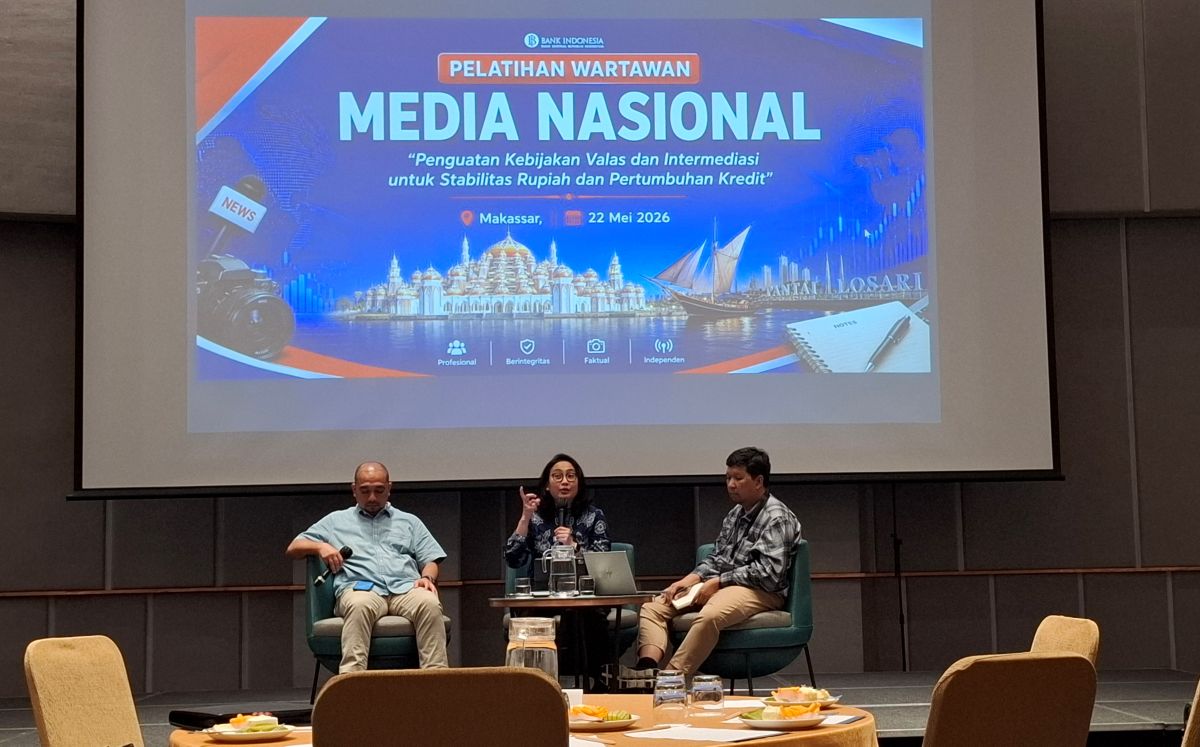
Local currency transaction (LCT) use in Indonesia continued to grow significantly through 2026. Bank Indonesia (BI) reported that LCT value up to April 2026 reached USD 22.61 billion, rising 309% year-on-year from USD 7.33 billion in the same period the previous year. The increase reflects a wider use of domestic currency in cross-border trade and investment. Ruth A. Cussoy Intama, Director of the Financial Market Deepening Department at BI, said the trend of rising transactions and the number of LCT participants was expected to continue. “We hope it continues to grow, both in volume and in the number of participants,” Ruth said during a Journalists’ Training in Makassar, South Sulawesi, on Friday (21 May).
Based on BI data up to April 2026, the average number of LCT participants per month was 5,265, a sharp rise from 497 in 2021 and 1,741 in 2022. The upward trajectory continued in 2023 with 2,602 participants, rising to 5,020 in 2024. In 2025, the average monthly LCT participants briefly surpassed 9,720.
In the LCT development briefing, China, Japan, and Malaysia were recorded as the main partner countries with the largest contributions to Indonesia’s LCT transactions. Ruth noted that the increased transactions with China were a major driver of LCT growth.
“Indeed, with China there has been a substantial increase. It is time to strengthen bilateral cooperation through the LCT scheme,” she explained.
According to Ruth, the LCT implementation not only broadens the diversification of currencies used in international economic and financial transactions, but also helps to cushion the impact of global volatility, particularly fluctuations in the US dollar, on cross-border activity. In addition, the use of domestic currencies is seen as capable of reducing transaction costs, expanding access for business actors, and deepening the domestic financial market.
“Not that we are avoiding the US dollar, because we know global transactions are still dominated by the US dollar. But for countries that do have large transaction volumes and can transact directly in their domestic currency, why go through dollars first?” she said.
Ruth explained that in the LCT mechanism, businesses engaged in exports or imports can transact using the domestic currency through banks designated as Appointed Cross Currency Dealers (ACCD). ACCD appointments are made based on agreements between BI and the central banks of partner countries.
Through this scheme, customers can open accounts at ACCD banks and conduct transactions directly in the local currency without USD conversion. BI also provides various supports, including funding in the partner currency and special account facilities to support LCT implementation.
Additionally, the strengthening of cross-border payment systems continues, including the use of cross-border QR transactions so that people can transact directly abroad without first converting to USD. (H-2)
BI expanded the DHE SDA instrument by allowing the use of non-US dollar currencies, including the Yuan, from 1 June 2026.
The 50 basis point increase in the BI Rate to 5.25% was not seen as automatically prompting banks to raise deposit or lending rates.
PT Bank Rakyat Indonesia (BRI) welcomed BI’s steps to maintain macroeconomic and financial system stability through the BI-Rate increase.
According to an official, fundamentally the rupiah should have room to strengthen supported by a low current account deficit.
BI Bali’s quarterly survey noted hotel room prices contracted by 5.85% in Q1-2026 due to geopolitical tensions and weaker tourist demand.
Copyright @ 2026 Media Group - mediaindonesia. All Rights Reserved