
Loans Race Ahead as Savings Lag, Fueling Banks’ Fight for Deposits
Jakarta, CNBC Indonesia – Banks face funding challenges ahead of 2027. Lending grew by 13.21% year on year in October 2026, while third-party funds (DPK) increased by only 8.13%.
The 5.08-percentage-point gap could prove difficult to narrow. Deposit growth is slowing, savings remain concentrated among large depositors, and competition to attract funds could push up banks’ interest expenses.
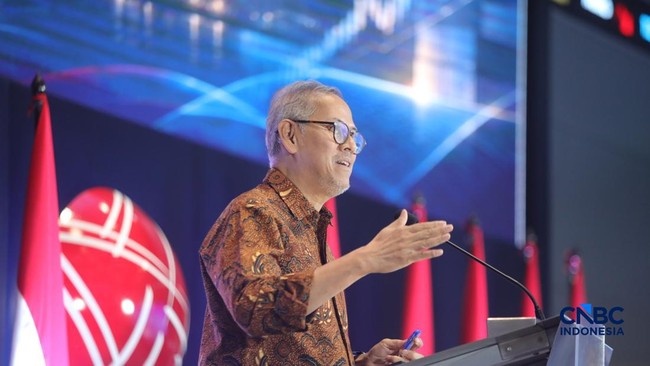
Anggito Abimanyu, Chairman of the Board of Commissioners of the Indonesia Deposit Insurance Corporation (LPS), highlighted the issue at the 2026 Financial Forum at the Indonesia Stock Exchange in Jakarta on Thursday (19 November 2026).
Anggito said industry liquidity remained adequate and the gap was manageable as long as it did not widen. The LPS and the Financial Services Authority (OJK) are monitoring individual banks, as their ability to raise funds varies.
“If this continues, of course we will have to do something,” Anggito said on the sidelines of CNBC Financial Forum 2026 on Thursday (19 November 2026).
For now, he said, the LPS was monitoring developments and needed to understand what was causing the gap before deciding on any action.
Why are deposits struggling to keep pace?
DPK growth slowed from 10.94% in August to 8.22% in September, then edged down to 8.13% in October. Anggito said savings growth had improved, while current accounts remained an important source of funding. In September, according to the OJK, current-account deposits grew by 12.64% and savings by 9.08%, while time deposits grew by 3.78%.
Meanwhile, credit demand from certain segments remained strong. In October, investment loans grew by 21.32% and working-capital loans by 12.99%, according to Bank Indonesia (BI).
Anggito also pointed to an uneven recovery in lending. OJK data for September showed corporate lending growing by 21.31%, compared with 2.68% for loans to micro, small and medium-sized enterprises (MSMEs). The industry’s rapid credit growth largely reflects expansion in segments that are already growing quickly.
The challenge also lies in who holds the money. Anggito said deposits remained concentrated among large depositors.
A single company can move a large sum quickly, while loans already disbursed are repaid gradually according to schedule. Banks with broad transaction-customer bases have more sources of funding to rely on if a major depositor withdraws funds.
What is a sustainable pace for credit and deposit growth?
The banking industry’s loan-to-deposit ratio (LDR) stood at 88.11% in September 2026. At that level, the Financial System Stability Committee (KSSK) considered industry liquidity adequate. However, lending had grown faster than DPK for five consecutive months, beginning in June.
The gap widened from around 2–3 percentage points in June–August to about five points in September and October. If this pattern continues, the funding available to support credit growth will become more limited.
OJK data show that pressure varies across bank groups. In August 2026, KBMI 3 banks recorded the highest LDR, at 90.10%, followed by KBMI 2 at 88.72%, KBMI 4 at 87.47% and KBMI 1 at 85.61%. The largest increase since September 2025 was among KBMI 2 banks, whose LDR rose by 8.32 percentage points from 80.40%.
Credit can continue to grow faster as long as banks’ LDR positions and liquidity leave room to do so. If the aim is to keep the LDR stable, the two growth rates need to be equal. For example, lending growth of 10% would need to be matched by DPK growth of 10%. To bring the LDR down, DPK must grow faster than lending.
Bank Mandiri offers an example from within the industry. In its third-quarter 2026 performance presentation, the company set a consolidated credit-growth target of 9–11% for 2026.
Mandiri said lending growth would follow deposit mobilisation, with its LDR kept below 95%. The bank’s guidance can be used as a benchmark for a simulation.
If credit grows by 13.21% and DPK by 8.13% over a year, a bank starting with an LDR of 88% would see it rise to 92.13%. A bank starting at 92% would see its LDR climb to 96.32%.
In the second example, DPK would need to grow by at least 9.64% to keep the LDR below 95% at that rate of credit growth. If DPK continued to grow by 8.13%, credit growth would be capped at 11.65% under the same LDR limit.
At industry level, Bank Indonesia scheduled a reduction in the rupiah reserve requirement for conventional commercial banks from 9% to 8% from 1 November 2026, and then to 7% from 1 December 2026.
This measure reduces the balance banks are required to hold at BI, giving them more room to use the funds they have raised.
The additional headroom will help banks in the short term. To sustain credit expansion, however, banks still need to attract stable deposits at affordable cost. If DPK growth continues to lag, competition for funds could intensify even while overall industry liquidity remains adequate.
Special rates can attract deposits but increase banks’ costs
Anggito cited special interest-rate offers as one consequence of competition to raise funds. KSSK data show that 36.06% of deposit value, equivalent to Rp3,791.34 trillion, earned interest above the LPS Deposit Insurance Interest Rate (TBP) in September 2026.
Higher deposit rates increase banks’ funding costs. If lending rates are difficult to raise, banks’ margins may narrow. If the higher costs are passed on to borrowers, loans could become more expensive. For depositors, an interest rate above the TBP means the deposit fails to meet one of the LPS’s requirements for insurance coverage.
Anggito sees scope to broaden the deposit base through a programme to provide one bank account for every person. The LPS estimates that around 25 million people of working age do not have a bank account.
New accounts could help broaden DPK sources if they are used regularly to receive income, make transactions and save. Their effect on deposits would build gradually, while banks’ funding needs have already risen alongside credit growth.
Anggito remains positive about the banking outlook for 2027, while identifying liquidity and funding costs as two issues to watch. Lending can continue to grow faster as long as LDRs leave room.
If the gap persists, that growth will need stronger, affordable DPK. Banks already nearing their internal limits will have to weigh accelerating the mobilisation of stable deposits against adjusting lending growth to keep funding costs under control.
Is DPK slowing because of ‘mantab’?
Winang Budoyo, Chief Economist of Perbanas, said the situation was linked to the ‘mantab’ phenomenon—people drawing down their savings—which is occurring across various groups in society. The biggest decline in savings by balance tier was in the middle-value category, between deposits below Rp100 million and those above Rp5 billion.
This may mean that customers who previously held large deposit balances have seen them fall and moved into a lower deposit-value category.
“So there has indeed been a decline. If the decline is substantial, that means there has been a shift from a higher category to a lower one,” Winang said at the PERBANAS CEO Forum in South Jakarta on Wednesday (25 November 2026).
Therefore, weak DPK growth cannot be attributed solely to small depositors or people with limited liquidity. Deposits have also fallen among middle-class customers and large fund holders, meaning pressure on banks’ fundraising is broad-based.
“So this is something that needs attention. The decline in DPK is not just an issue for small deposits; large deposits are experiencing the same thing,” Winang said.
Credit growth reached double digits, rising by 13.26% year on year as of September 2026. Over the same period, growth in third-party funds (DPK) was lower, creating a gap of around five percentage points with lending.
Winang said this showed that banks’ need to raise funds for lending was far greater than their capacity to absorb funds from the public.
Source: jawawa.id (https://jawawa.id/newsitem/loans-race-ahead-as-savings-lag-fueling-banks-fight-for-deposits-1795668652)
Originally published by CNBC Indonesia (https://www.cnbcindonesia.com/research/20261120140615-128-787025/kredit-ngebut-tabungan-seret-awas-bank-saling-berebut-dana-segar), translated from Indonesian