
LKPP strengthens integrity to prevent corruption in procurement sector
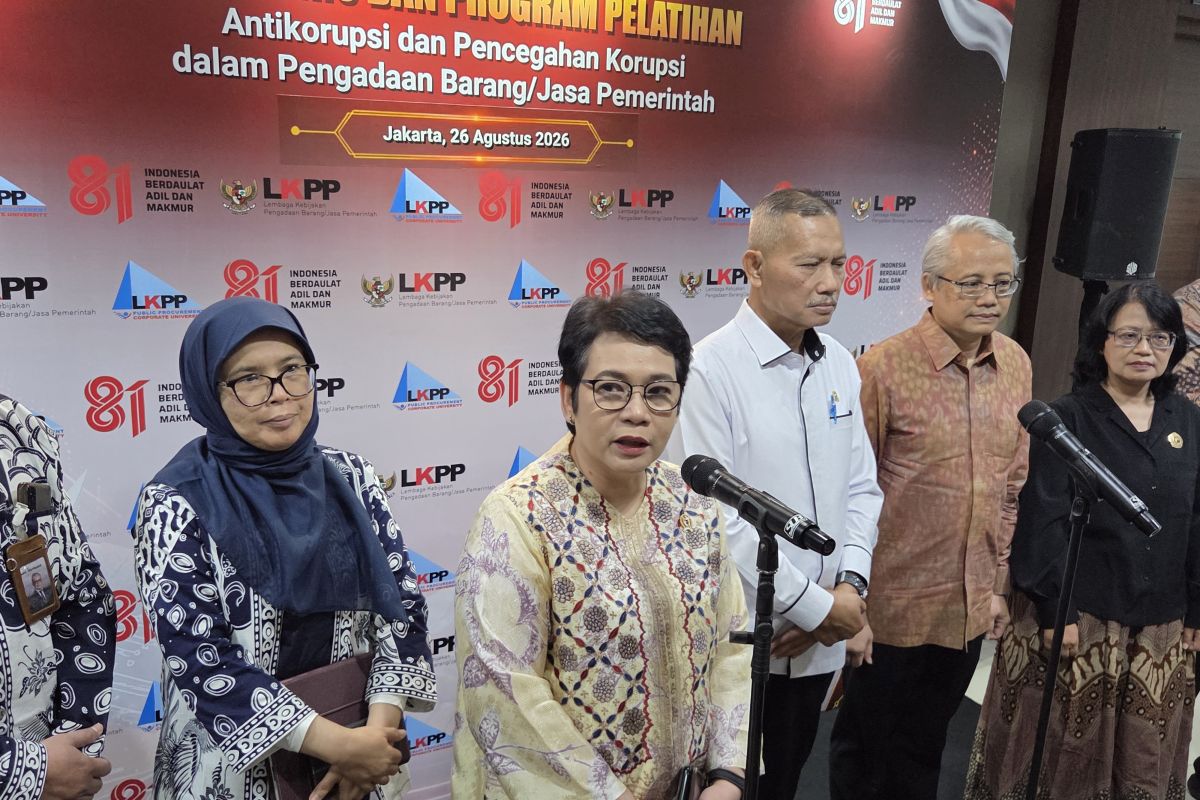
The Public Procurement Agency (LKPP) is working to break the practice of corruption in government procurement of goods and services (PBJP) by strengthening the integrity of procurement actors and their ecosystem. The effort is being pursued through the Anti-Corruption and Corruption Prevention Training Programme (AKPK) in Government Procurement of Goods and Services (PBJP).
LKPP Head Sarah Sadiqa said in a press conference in Jakarta on Wednesday that procurement of goods and services is one of the sectors that requires serious attention in efforts to eradicate corruption. Based on data from the Corruption Eradication Commission (KPK) for the period 2004 to the second quarter of 2025, there were 426 corruption cases related to procurement of goods and services. This figure places procurement as the second most common corruption offence after gratuities and bribery, which reached 1,068 cases.
“As conveyed by the KPK Deputy Chairman (Ibnu Basuki Widodo), corruption cases number two after bribery are procurement of goods and services. We do not want number two to have a bad connotation. We want number two to be the best,” said Sarah.
According to her, through the Anti-Corruption and Corruption Prevention Training Programme in PBJP, LKPP wants to encourage transformation so that procurement of goods and services is not only an object of corruption prevention, but also becomes an important part of efforts to eradicate corruption. “In essence, we want to carry out a transformation, not just compile modules or curricula or attend training, but we transform the people themselves,” she said.
Sarah said the programme does not only target procurement professionals, but also parties who have authority and control in the procurement process, such as Budget User Authorities (KPA) and heads of Procurement of Goods and Services Work Units (UKPBJ). LKPP has also prepared an ecosystem track pathway that can be followed by providers of goods and services, Government Internal Supervisory Apparatus (APIP), and community groups.
“So besides the two groups mentioned earlier, providers can participate, then the APIP, then from other ecosystems, community groups or the public can also take part. We provide that on the ecosystem track pathway,” she explained.
Meanwhile, Head of the LKPP Procurement Human Resources Training Centre Gusti Agung Aju Diah Ambarawaty said the training programme is targeted to be attended by ministries, institutions, and regional governments. In addition to face-to-face training and blended learning methods, LKPP provides a Massive Open Online Course (MOOC) to expand participant access.
After attending the training, participants are required to prepare an action plan for preventing corruption in procurement of goods and services in their respective ministries and institutions. LKPP will then conduct an evaluation to see the impact of the programme on the work environment and organisation.
“The action plans for preventing corruption in the procurement of goods and services environment in each respective institution are what we will monitor. So later we will conduct an evaluation at level 3, where we will see whether it has a positive impact on the work environment and also on the organisation,” she said.
The Anti-Corruption and Corruption Prevention Training (AKPK) in Government Procurement of Goods and Services (PBJP) has received support from the Corruption Eradication Commission (KPK) and the National Institute of Public Administration (LAN). The KPK will play a role in monitoring, while LAN supports strengthening the competence and integrity of apparatus involved in procurement.