
Living Epistemology as the Basis for Gontor's Holistic Education
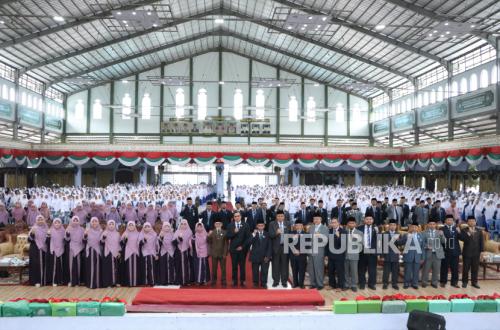
At four in the morning in Gontor, a student wakes up before the call to prayer. He queues for the bathroom, walks from the dormitory to the mosque in the dark, and sits in the rows for the dawn prayer. No one verbally teaches him what discipline is. He simply lives it, repeatedly, every day, for years; until discipline is no longer a rule to be obeyed, but something he knows, without needing to remember where that knowledge cames from.
A philosophical question arises from this point: where exactly does such knowledge originate? It clearly does not come from books, as there is no chapter on ‘how to wake up early’ in any text he has studied. It is also not merely a habit, because habits can fade once environmental pressures disappear; whereas truly ingrained values persist long after one has left their place of origin. Something deeper is occurring: knowledge that does not stop at information, but lives and continues to operate within an individual.
Prof. Dr. M. Amin Abdullah referred to this phenomenon as ‘living epistemology’ in his paper, “Beyond Tradition and Modernity: Reinterpreting Gontor’s Panca Jiwa as a Framework for Holistic Education”, presented at the Global Islamic Holistic Education Summit (GIHES) on 5–6 September 2026 at the Hotel Borobudur. His core argument is simple, yet carries heavy consequences: the holistic education many people pride themselves on—education that supposedly unites the mind, heart, and hands—will never truly occur without such an epistemological foundation. Without a living way of knowing, “holistic” becomes merely an empty adjective attached to a curriculum. This writing attempts to re-examine that argument in more accessible language for the general public.
Two Ways of Knowing
To understand what is meant by “living epistemology”, it is helpful to return to a more fundamental question: what is knowing?
Philosopher Michael Polanyi distinguished between two types of knowledge. First, knowledge that can be fully explained with words: mathematical formulas, the definition of honesty in a dictionary. This knowledge can be transferred from one head to another via lectures or books without much being lost in the process. Second, knowledge that can only be acquired through direct experience: how it feels to keep a promise despite the difficulty, how to restrain oneself when angry, how to recognise when someone is being honest even if their words are persuasive. Polanyi refers to this second type as tacit knowledge: we know more than we can tell.
A common error in modern education is treating all knowledge as if it belongs to the first type; as if character, honesty, or social sensitivity can be taught through definitions on a blackboard and then tested via multiple-choice questions. Living epistemology, within the framework offered by Prof. Amin, is when an educational institution takes the opposite approach: it deliberately designs its entire environment so that this second type of knowledge is continuously produced; not through words, but through life itself, hour by hour, day by day.
This is the philosophical position that needs to be emphasised: living epistemology is not merely a more enjoyable teaching method, but a claim about the very nature of knowledge itself; that some of the most important knowledge for humans cannot be known through memorisation, but can only be known through living it.
This claim is reinforced by the idea of ‘ta’dib’ from Prof. Syed Muhammad Naquib al-Attas. For him, being “civilised” is not merely about politeness, but the ability to place something in its correct and proper place; including placing oneself before God, others, and nature. In other words, being civilised is itself a way of knowing, not just a result of knowing. This reinforces what Prof. Amin stated: that education in Gontor moves “beyond merely knowing, towards becoming”. Knowing, in this framework, is not the end point. It is only complete when it has transformed into a person’s way of behaving.
Panca Jiwa as Five Pathways to Knowing
If living epistemology is knowledge brought to life through meaningful repetition, then Gontor’s Panca Jiwa (Five Souls)—Sincerity, Simplicity, Self-reliance, Islamic Brotherhood, and Freedom—can be read not just as five good moral values to possess, but as five different pathways towards the same way of knowing.
Sincerity functions as a kind of epistemic intention: the determinant of direction for what is sought through knowledge, not just what is found at the end of the process. Prof. Amin links this to the theory of spiritual leadership. In this theory, what drives people is not material incentive, but meaning. Someone who studies solely for a certificate and someone who studies as an act of devotion are, in the end, not studying the exact same thing, even if their exam questions are identical.
Source: jawawa.id (https://jawawa.id/newsitem/living-epistemology-as-the-basis-for-gontors-holistic-education-1789128123)
Originally published by Republika (https://analisis.republika.co.id/berita/tl70kv451/living-epistemology-sebagai-basis-pendidikan-holistik-ala-gontor), translated from Indonesian