
‘Live a good life’: Why these Singaporeans left the corporate world to be farmers in Johor
‘Live a good life’: Why these Singaporeans left the corporate world to be farmers in Johor
Drawn by lower costs and the dream of building something of their own, some Singaporeans have ventured into farming in Johor. They share their advice and experiences with CNA.
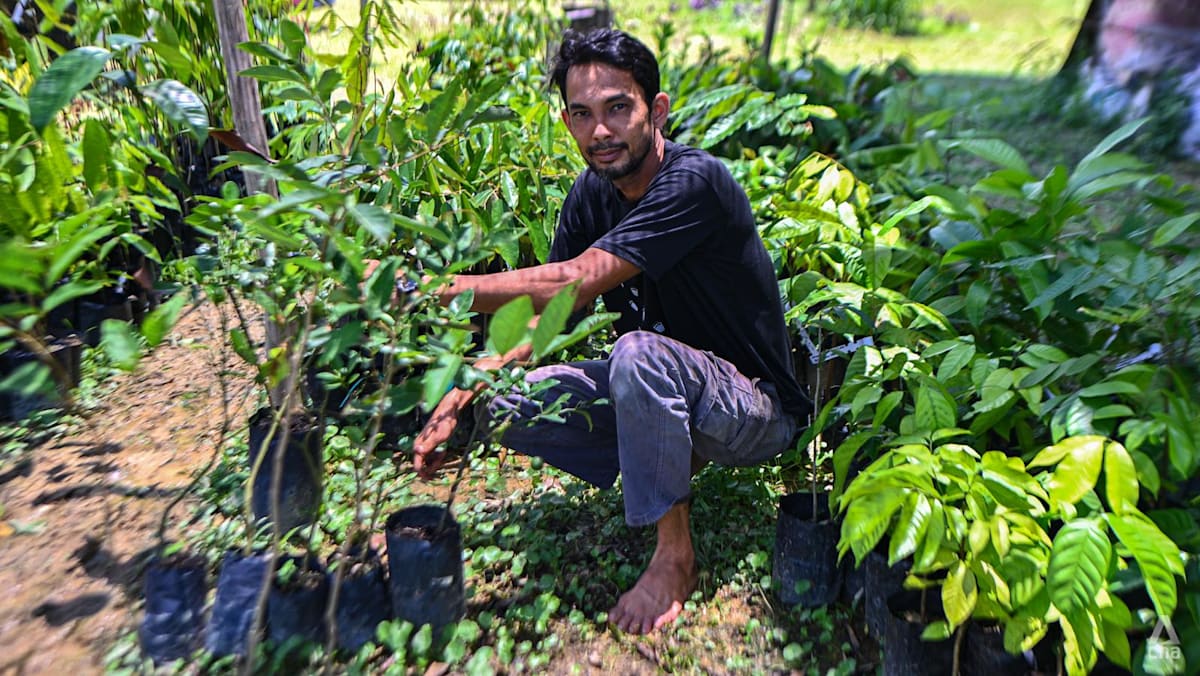
JOHOR BAHRU: Under the sweltering afternoon sun in Ulu Tiram, Johor, Imran Aljunied balanced on a ladder, reaching into a tangle of vines to pluck unripe pepper berries.
Sweat plastered his sunburnt face, but he was all smiles.
“We’re harvesting black pepper today,” the 40-year-old Singaporean said.
Imran helps manage A Little Wild, a 55-hectare farm he co-founded in 2020 with two other Singaporeans and a Malaysian. The farm, a former oil palm plantation, is about the size of 77 football fields and roughly 45 minutes’ drive from the Causeway.
His work days can stretch up to 12 hours but he said it beats his previous office job at a Singapore statutory board. The father of two has also traded life in a HDB flat in Singapore for a kampung house on the farm, where he lives with his wife and two children.
“I like the whole idea of community sufficiency. I’m not relying on any entity for my food and water … This gives me a sense of independence and freedom and I’m not beholden to (anyone),” Imran told CNA.
The farm draws freshwater from a small lake within its site, and the farmers eat the produce.
Once a week, his team harvests crops like pineapple, banana, cocoa, pepper and lemongrass. They pack the produce, which is delivered to roughly 20 customers, including restaurants, based in Singapore.
The rest of the week is spent tending to the land — pruning, fertilising and closely tracking the growth of each crop.
Imran had tried farming back home but quickly ran into a hard limit: Space.
“I just wanted to pursue my passion and Singapore doesn’t have the land for me to do this,” he said.
Venturing north, he and his co-founders collaborated with other investors to purchase land in Ulu Tiram and began growing crops soon after clearing it.
Like Imran, some Singaporeans have ventured across the Causeway to start farms in Malaysia, drawn by cheaper land that affords them bigger plots, and the chance to build something of their own.
While there are no official statistics on the number of farms owned by Singaporeans in the southern state, checks by CNA found there are at least half a dozen of them in the rural parts of Johor, including Gelang Patah, Kota Tinggi and Kluang.
For those whom CNA spoke to, the appeal of being a farmer is clear: autonomy, purpose, and a closer connection to the food they consume.
With fuel and food prices currently rising amid the Middle East conflict, these farmers stressed the increasing importance of food security and self-sufficiency.
Said Singaporean Nabilah Bagarib, who co-founded a sheep farm in Desaru with her husband: “Especially with the current geopolitical situation, countries are more aware that becoming self-sufficient in food is important.
“If you don’t prioritise food security and local produce, you might be at the losing end of the bargain.”
A DIFFERENT KIND OF PAYOFF
For some, the move across the Causeway is about reimagining what success looks like.
Nabilah and her husband Ashraf Bakar embarked on that quest in 2015 with a modest sheep farm in Mersing.
The business expanded and they moved operations to a larger site in Desaru in 2017.
Their farm, Aliyah Rizq – named after Nabilah’s mother, who was also their first investor – now occupies the equivalent of 150 football fields and has hundreds of sheep, a few horses, camels, ostriches as well as chickens.
They also have smaller farms elsewhere in the region, including in other parts of Malaysia, and in Indonesia and Cambodia.
The couple’s days revolve around breeding and raising sheep and goats, many of which are sold both in Singapore and Malaysia for religious practices such as qurban and aqiqah, where the meat is distributed to the needy.
They have also turned the farm in Desaru into a recreational destination that sees about 500 visitors a month. On weekends, families and other guests come to ride horses, all-terrain vehicles, and get up close with the animals.
For Ashraf, 38, who previously worked in construction and trade, making the leap has been rewarding. He now earns more than before, and describes the farm as an “evergreen” and “intergenerational” business.
He also found “the opportunity and stability here are much better”.
Nabilah, a former psychologist, sees the business venture as both a practical and personal decision.
Funds in the stronger Singapore dollar from their previous jobs gave them more purchasing power in Malaysia, allowing the couple to invest in their business and expand it.
“Our currency is stronger, so it allows for better growth and expansion,” she said.
For Imran of A Little Wild, success these days means stewardship and regeneration of the land.
His team of around a dozen farmers is working to transform the former oil palm plantation into an educational agroforest — moving away from conventional farming methods towards what the co-founders believe to be a more sustainable model.
Instead of relying on fertilisers or chemicals, they grow a mix of crops in the same plot. This allows the different crops to replenish nutrients in the soil and help one another in their growth.
“I believe in the concept of a farmer as a caretaker of the land,” Imran said. “To be able to live a good life, while being in service of nature.”
A Little Wild’s Malaysian co-founder Will Chua, a Singapore permanent resident, gave up a six-figure annual salary as a senior public servant in Singapore to start his own farm.
He was searching for something that gave him a greater sense of purpose. “I started to realise what I found meaningful in life,” he said. “And I realised I didn’t need a lot to be happy.”
The change has not only reshaped his outlook but also his health, he said.
“Within a year of working on the farm, my health indicators went b
Source: jawawa.id (https://jawawa.id/newsitem/live-a-good-life-why-these-singaporeans-left-the-corporate-world-to-be-farmers-in-johor-1776552640)
Originally published by CNA (https://www.channelnewsasia.com/asia/johor-malaysia-singaporean-farmers-crops-food-security-6063136)