
Listed Companies Must Stay Protected Despite Indonesia's Many Disasters — How?
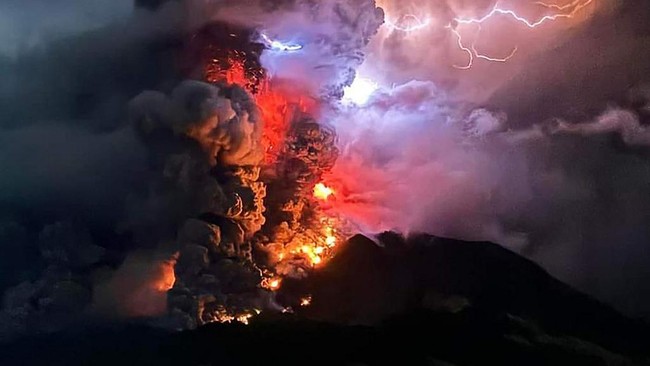
Jakarta, CNBC Indonesia — A series of natural disasters has once again tested the resilience of Indonesia’s economy and business world.
Within weeks, a major earthquake struck Flores in East Nusa Tenggara (NTT), forest and land fires spread across Sumatra and Kalimantan, followed by the eruption of Mount Anak Krakatau which disrupted flights across Java and Sumatra.
A magnitude 7.7 earthquake shook Flores on 15 August 2026. As of 21 August, 4,256 aftershocks had been recorded, the largest measuring M6.2. Beyond damaging buildings and infrastructure, the quake also forced businesses to face potential operational shutdowns and supply chain disruptions.
Another threat came from forest and land fires. The national area burnt between January and June 2026 reached 107,465 hectares, soaring 366% compared with the same period the previous year. West Kalimantan and Riau were the two regions with the largest burnt areas.
Meanwhile, the eruption of Anak Krakatau since early September spread volcanic ash as far as Banten, Jakarta, West Java, Lampung and Bengkulu. On 6 September, eight airports were temporarily closed. Around 150,000 passengers were stranded and 467 flights affected, comprising 409 domestic and 58 international flights.
These conditions show that the impact of disasters does not stop at physical damage. Facility closures, logistics disruptions, lost revenue, and impaired energy and telecommunications networks can deal a heavy blow to companies.
A wide protection gap
The Indonesian General Insurance Association (AAUI) estimates that only around 1%–5% of natural disaster risks in Indonesia carry insurance protection. This means there is a protection gap of 95%–99%.
By comparison, average economic losses from disasters in Indonesia over 15 years (2009–2024) are estimated at around Rp22.8 trillion per year.
The Financial Services Authority (OJK) stated that insurance claims related to floods and landslides in Sumatra at the end of 2025 approached Rp1 trillion, although this figure remains far smaller than the overall economic losses.
For listed companies, this protection gap matters because uninsured losses must be absorbed through cash, profits, or additional debt. The impact can ripple through capital expenditure, production, dividends and operational recovery.
Different disasters, different affected sectors
Each sector has different exposure. Therefore, policy purchases should be based on asset location mapping, maximum potential losses, and how long operations can be halted.
Business interruption policies also need scrutiny. In many contracts, claims only apply if the business interruption is preceded by physical damage covered by the policy. Airport closures due to volcanic ash, for instance, are not necessarily automatically covered.
Lessons from listed companies’ insurance burdens
In financial reports, the insurance burden is the expense a company recognises to obtain protection. This figure can represent premiums, but it is not always identical to cash payments in the same year due to differences in policy periods and accounting treatment.
Among companies disclosing this separately, TLKM, INDF and PTBA showed increased insurance expenses in 2025.
The rise in TLKM’s insurance burden was partly related to expanded protection for fixed assets, equipment, satellites and leased buildings. However, this table is a sample of relatively clear disclosures, not a ranking of all Indonesian listed companies. The recording of expenses can also differ between companies.
TPIA leads in sum insured values
Beyond insurance costs, company reports disclose the value of assets or interests insured. Based on a screening of 2025 reports, TPIA recorded the largest sum insured in the sample, followed by ASII and INCO.
Foreign currency conversions in the table use an assumed rate of Rp17,500/US$, while values denominated in Hong Kong dollars, Singapore dollars and Malaysian ringgit use consistent comparison rates.
INDF consolidates ICBP, so the two values must not be added together to calculate the group’s economic protection.
The sum insured is also not a premium and does not automatically represent the maximum claim value that will definitely be paid. Payouts still depend on the type of risk, per-event limits, deductibles, exclusions, asset condition, and loss assessment results.
For example, INCO’s assets carry a sum insured of around US$5.9 billion, or Rp103.25 trillion. However, the protection limit for a single event is recorded at US$750 million, or around Rp13.13 trillion. This difference highlights the importance of reading policy limits, not just the total insured assets.
Pertamina and PLN hold strategic assets
Beyond listed companies, the scale of protection at Pertamina and PLN deserves attention because disruption to these two companies’ assets can have a broad impact on the national energy supply.
In 2024, Pertamina Group insured inventories, investment properties, fixed assets, and oil, gas and geothermal assets worth around US61.36billion.AtRp17, 500/US, this is equivalent to Rp1,073.88 trillion.
Subsidiary figures must not be added to Pertamina Group as this risks double counting. The disclosure years and asset types also differ.
In 2025, PLN disclosed protection covering buildings, installations and power plants, transmission, telecommunications and data processing equipment, and vessels. After standardising with the same exchange rate assumption, the value is around Rp451.46 trillion.
This comparison merely illustrates the scale of insured strategic assets. These figures are not a direct ranking because the periods, asset coverage, policy structures and claim limits differ.
Lessons from Japan to America
Japan offers an important lesson through earthquake insurance for residential homes attached to fire policies and backed by government reinsurance. Premium discounts of 10%–50% are granted based on the earthquake resilience of buildings.
A similar principle can be applied to the business world through incentives for factories, warehouses, towers and facilities that meet mitigation standards.
France uses a government–insurance industry partnership scheme to cover natural disasters, supported by a public reinsurance company. The United States mandates flood protection for properties in high-risk zones when purchases are financed through federally backed housing credit.
Caribbean countries use pooled parametric insurance.
Payouts can be made when parameters such as earthquake strength, rainfall or wind speed exceed certain thresholds, without waiting for all physical damage to be calculated. Indonesia is also developing a parametric approach to accelerate disbursement of funds after disasters.
Protection does not stop at premiums
The large sums insured by TPIA, TLKM, Pertamina or PLN show that important assets are protected. However, large figures do not guarantee a company can recover quickly if policies do not cover business interruption, specific natural disasters, access closures, or supplier damage.
Companies need to test whether the sum insured still reflects asset replacement costs, construction inflation, exchange rates, location concentration, and maximum potential losses. Audits of deductibles, sublimits and exclusions should also be carried out regularly.
Amid successive eruptions, earthquakes and forest fires, insurance should no longer be seen as an administrative cost. Proper protection is part of business continuity — determining how quickly companies, communities and the economy can get back on their feet after a disaster.
Source: jawawa.id (https://jawawa.id/newsitem/listed-companies-must-stay-protected-despite-indonesias-many-disasters-how-1788853897)
Originally published by CNBC Indonesia (https://www.cnbcindonesia.com/research/20260907134553-128-765796/kantong-emiten-harus-aman-meski-ri-banyak-bencana-bagaimana-caranya), translated from Indonesian