
List of Critical Notes from YLBHI Regarding the Agrarian Reform Law
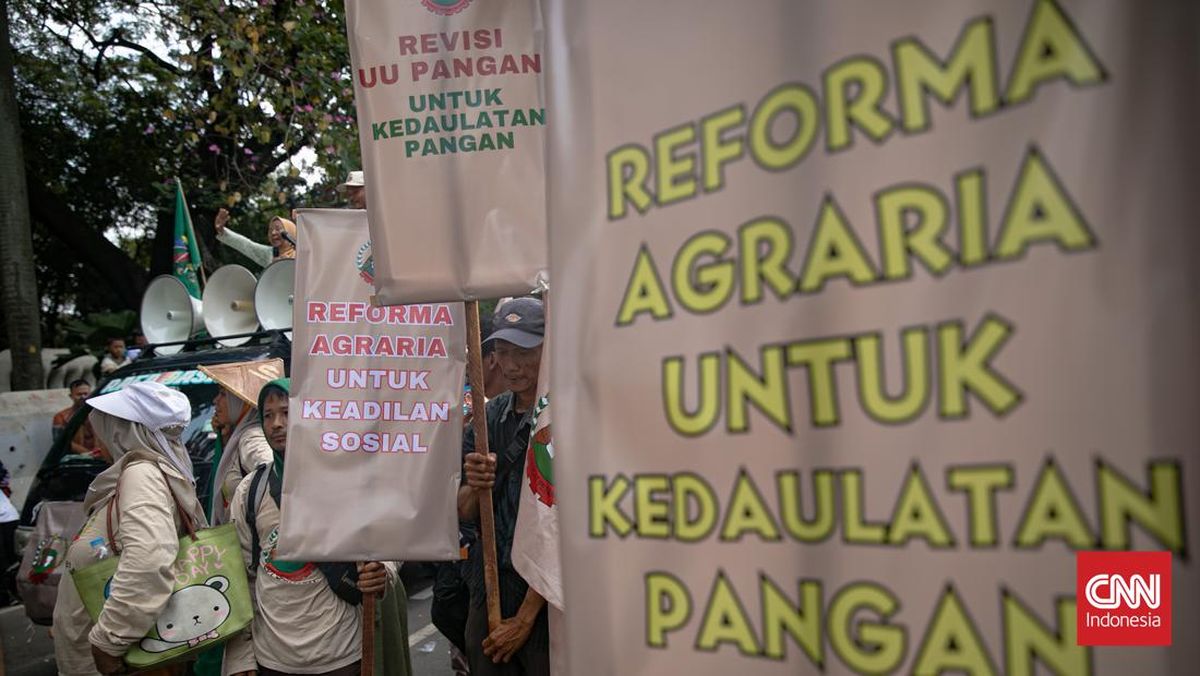
Jakarta, CNN Indonesia –
The Indonesian Legal Aid Foundation (YLPSHI) has provided several critical notes regarding the Agrarian Reform Bill, which was passed in a plenary session of the House of Representatives (DPR) on Tuesday (22/9).
YLBHI assesses that both the discussion and the ratification of the Agrarian Reform Law were conducted too hastily, with minimal opportunity for the public to examine the draft and its substance.
“Agrarian reform must not be born through a lightning process that closes the opportunity for the community to read the draft, voice objections, and obtain answers to their input,” YLBHI wrote in its official release on Monday (21/9).
YLBHI highlighted the timeline of the Bill’s preparation leading up to its ratification. The Bill was only recorded in the National Legislation Programme (Prolegnas) on 27 August 2026, drafted between 1–7 September, and submitted as a DPR proposal on 8 September 2027. Hearing sessions (RDP) were held from 9–16 September, followed by discussions on the List of Problem Inventories (DIM) from 17–19 September. Finally, the first-level deliberation took place on 21 September and was ratified in the Plenary Session on 22 September.
“The discussion with the DPR and the Government regarding these widely impactful norms lasted less than one week,” the foundation stated.
In short, the rapid processing of the Agrarian Reform Bill meant that the affected communities, in particular, did not have sufficient time to scrutinise the text, test the consequences of every change, or provide input on the formulated regulations. This contradicts the Constitutional Court Decision Number 91/PUud-XVIII/2020, which affirms the public’s right to be heard, considered, and provided with explanations regarding their input.
YLBHI also pointed to Article 96 of the Law on the Formation of Laws and Regulations, which guarantees participation at every stage and easy access to academic papers and draft regulations. Although the official DPR website displays meeting results, it does not clearly demonstrate how public input was accepted or rejected.
Furthermore, YLBHI noted the lack of comprehensive involvement from the Regional Representative Council (DPD), despite the Bill directly relating to land matters, central-regional relations, and natural resource management.
YLBHI recorded several substantive points in the Agrarian Reform Bill that have triggered controversy:
- Agrarian reform is reduced to an administrative matter
The final formulation defines Agrarian Reform as the restructuring of agrarian structures through asset and access arrangement, but removes mentions of farmers, labourers, fishermen, indigenous peoples, women, and the economically disadvantaged from its definition. The principle of siding with victims of agrarian conflicts has also been removed. In conflict resolution principles, siding with victims is replaced by siding with ‘Agrarian Reform Subjects’; a human rights-based approach is replaced by a justice-based approach; and the correction of state policies and actions that serve as sources of conflict has been eliminated.
The decision to retain the word ‘regulation’ in the title further reflects this direction: agrarian reform is treated as an administrative object rather than the fulfilment of a constitutional obligation to correct imbalances in the control, ownership, use, and exploitation of agrarian resources. This direction is inconsistent with Article 33 (3) of the 1945 Constitution, MPR Decree Number IX/MPR/2001, and Law Number 5 of 1960 regarding the Basic Agrarian Regulations.
- The tool for correcting land concentration is emptied
Limiting the maximum control of land should be the heart of land reform. However, the final draft excludes State-Owned Enterprises (BUMN), Regional-Owned Enterprises (BUMD), cooperatives, and public companies, while the specific maximum limits are entirely left to Government Regulations. The obligation for holders of land use rights (HGU) and plantation business permits to surrender at least 20 per cent of the land area may also be replaced by a 20 per cent profit-sharing scheme. This formulation changes the obligation of land redistribution into a profit-sharing scheme, maintaining an imbalanced structure of land ownership.
- State land is locked within the regime of assets and strategic interests
The norm that the ‘social function’ applies to land controlled by the state, ministries, BUMN, BUMD, TNI, and Polri—and cannot be set aside by the state finance regime—has been removed from the main body and moved to the explanatory notes. Simultaneously, the transfer of state-owned, regional-owned, and BUMN/BUMD assets is returned to sectoral asset management mechanisms. The determination of objects must also consider land that has a strategic function for national interests. Consequently, land most needed for the restoration of rights may become locked by asset bureaucracy, government projects, concessions, and the interests of state institutions.
The Bill also fails to provide a firm mechanism to subordinate the control and function of the Land Bank (Bank Tanah) to the mandate of agrarian reform. Land controlled by the TNI is no longer explicitly stated as an object of agrarian reform, even though conflicts such as Rancapinang, Bara-Baraya, Lekok and Nguling, Rumpin, and Pundenrejo demonstrate the importance of a correction mechanism for land controlled by state institutions.
- The rights of the people and indigenous communities are treated as a ‘grant’
State land and other areas of use can only be established as objects if controlled in good faith for 20 years. Redistribution may be granted as a time-limited right on land under management rights, meaning recipients obtain derivative rights that can expire. The category of people who lose land control and their livelihoods has also been removed from the list of subjects. The proposal that the law does not apply retroactively also risks closing the door on the restoration of land seizures from the past. Without regulations for recognition and…
Source: jawawa.id (https://jawawa.id/newsitem/list-of-critical-notes-from-ylbhi-regarding-the-agrarian-reform-law-1790160983)
Originally published by CNN Indonesia (https://www.cnnindonesia.com/nasional/20260923145338-20-1407301/daftar-catatan-kritis-ylbhi-soal-uu-reforma-agraria), translated from Indonesian