
Lippo and Pakuwon Mall Owners Agree to Dismantle High Fences
Jakarta - Two of Indonesia’s largest shopping centre network owners, Lippo Group and Pakuwon Group, have jointly asserted that the national security situation remains conducive, negating the need for high fences at shopping centres. They confirmed that the installation of fences at several malls was not a corporate policy but an initiative of local management.
Lippo Group Chairman James T. Riady stated that all Lippo malls had previously installed fences during past periods of civil unrest, but these were dismantled long ago once the situation stabilised. ‘All malls installed fences when there were riots in the past. Now they are no longer needed because the situation is calm,’ James said in a statement on Monday (3/8/2026).
James stressed that the public need not worry about the nation’s social or economic conditions. He noted that the government has successfully maintained public purchasing power through various policies, such as keeping subsidised fuel prices, household electricity tariffs, and the price of 3-kilogram LPG cylinders stable despite rising global energy prices due to geopolitical conflicts. ‘As long as subsidised fuel does not increase, 3-kg LPG does not increase, and subsidised household electricity tariffs remain, there is no reason for the public to be anxious,’ he said.
He assessed that this stability is reflected in the performance of the shopping centre industry, which is currently enjoying strong growth. James noted that demand for business space from tenants now exceeds the available supply in many malls. ‘We are actually short of space now. The demand to open shops is greater than the supply of space in modern shopping centres. This is a golden era for the mall business,’ James said.
Looking at these prospects, Lippo Group continues to expand. The company currently manages 71 malls and 35 shopping centres, totalling 106 centres spread across more than 29 cities in Indonesia. According to James, the network controls approximately 25% of the nation’s modern retail space. He believes the high demand for space is proof of strong business confidence in Indonesia’s economic prospects. ‘We continue to open new shopping centres because demand is very high. If the situation were unsafe, tenants would not be competing to open shops,’ he stated.
James reiterated that the fence installations were isolated cases and did not reflect the overall condition of the shopping centre industry. The decision was entirely an initiative of local management, not a directive from the owners or head office. ‘It was purely a local management initiative, not a policy from the owners or head office. After confirmation, it was clear that such fences are not necessary,’ James stressed.
Meanwhile, Pakuwon Group founder Alexander Tedja confirmed that the fence temporarily installed at Mal Kota Kasablanka (Kokas) in South Jakarta would be immediately dismantled. According to Alex, the installation was a decision made by local management without direction from shareholders or the head office. ‘It was a local management policy and it will be dismantled immediately,’ Alex said.
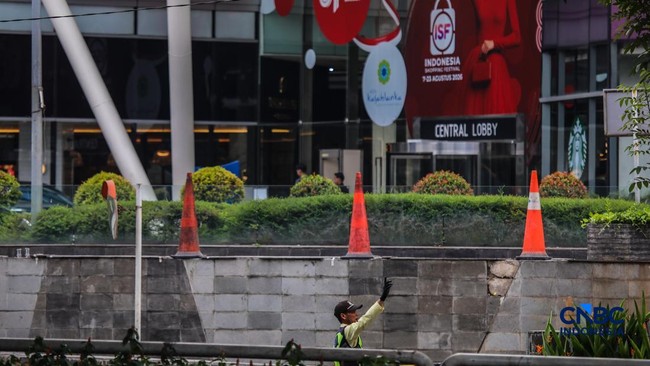
He also noted that the issue of mall fences had been widely discussed on social media. He asserted that the current security situation remains safe, so there is no reason to install barrier fences at shopping centres. The approximately 2.5-metre-high iron fence that had surrounded the exterior area of Mal Kota Kasablanka has already been removed. Monitoring at the location on Monday confirmed the fence, which had stood for nearly a week, was gone and replaced by a line of traffic cones along the mall’s perimeter. Information obtained indicated the dismantling process was carried out on Saturday night.
The existence of the high fence had previously drawn public attention after photos and videos circulated widely on social media. Jakarta Governor Pramono Anung subsequently requested the fence be taken down, deeming it unnecessary. He also confirmed that the Jakarta Provincial Government, together with the Indonesian National Armed Forces (TNI), the Indonesian National Police (Polri), and relevant authorities, had coordinated to ensure the capital city’s security situation remains conducive.
Previously, the Chairman of the Indonesian Shopping Centre Management Association (APPBI), Alphonzus Widjaja, explained that the fence installation was not intended as a precaution against riots. He stated that the fences were used to regulate visitor access and serve as a security barrier for shopping centres located near areas that frequently host demonstrations.