
Like 'Gaza' in Lenteng Agung
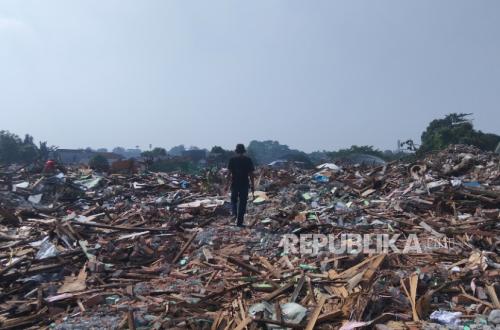
There was not a single cloud covering the Jakarta sky that Wednesday (17/6/2026). As morning approached noon, the blazing sun was already scorching. But for Kardi, work had to go on. What lay strewn across Lenteng Agung, South Jakarta, that day could help him scrape a living.
As far as the eye could see, right on the edge of the main road to Depok, were the ruins of houses. Not a single one remained standing out of more than a hundred previously built on the site. Wooden foundations were scattered on the ground, walls had collapsed and were destroyed, furnishings were broken. Posters that had once clung to bedroom walls, shoes and sandals, torn clothing.
“Yes, it looks like it was bombed, like in Gaza, Mas,” Kardi told Republika when met at the location that afternoon. About six of his fellow waste pickers were sorting through the debris for anything that could be resold. One by one, they put items into sacks, then placed them onto carts.
Not long after, a middle-aged man wearing green army camouflage trousers and a T-shirt arrived. “Oi!” he shouted, calling out to the group of waste pickers. “Later, gather the blocks that are still in good condition. Don’t take them away,” he yelled at the scavengers.
“You tell my friends yourself, sir. They won’t listen to me,” Kardi replied.
“Don’t you be cheeky! You go and tell your friends!”
The man refused to give his name to Republika. “I am still active in the unit,” he said. He claimed his house was one of those destroyed among the rubble. He now has to rent a place with his family. “Enough, no more questions. The point is, this land is for the state,” he said, ending the conversation.
A total of 152 houses in the Lenteng Agung area, Jagakarsa District, South Jakarta, had been targeted for eviction by the Indonesian Army since Tuesday (9/6/2026). The houses were deemed to be standing on state-owned land.
One of the residents affected by the eviction, Supri (60), claimed that the process had been underway since 2024 when residents received the first warning letter (SP1) to vacate their homes. The warning letters were issued up to three times. However, residents continued to occupy the homes they had lived in for decades because there was no compensation from the Army.
“Actually, the bottom line is, the community would actually be willing to move if there was some compassionate payment, because why? These buildings date back to the 1950s. Automatically, if the occupants don’t repair them, they would eventually collapse, right?” he told Republika on Thursday (11/6/2026).