
Lessons in Preparedness for Anak Krakatau Activity: Learning from the 1883 Eruption
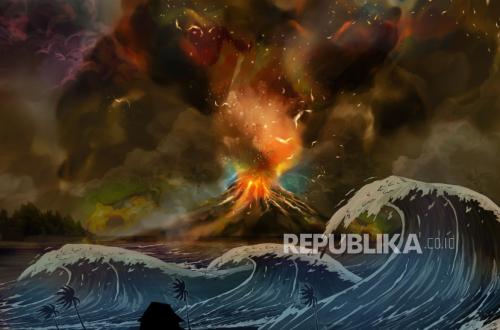
The eruption of Mount Krakatau in 1883 remains one of the largest and most deadly volcanic eruptions in modern history. Volcanic activity began increasing in May 1883 and reached its peak on 26–27 August 1883. The largest series of explosions on 27 August destroyed much of the mountain’s body and triggered a massive tsunami that struck coastal areas around the Sunda Strait.
This event caused 3_6,417 deaths, most due to the tsunami. The disaster primarily impacted the coastal regions of Banten in Java and Lampung in Sumatra. The scale of Krakatau’s impact demonstrates that volcanic hazards are not limited to lava, ash, or pyroclastic flows, but can also trigger secondary hazards such as tsunamis.
Krakatau 1883 also had impacts far beyond Indonesia. The large-scale eruption injected volcanic material and gases, including sulphur dioxide, into the atmosphere. This material subsequently affected sunlight distribution and atmospheric conditions on a global scale.
According to the Natural History Museum, the explosive force of the Krakatau eruption is estimated to be equivalent to approximately 200 megatons of TNT. The eruption also caused a drop in average global temperatures of about 0.6 degrees Celsius for several months following the event.
Compared to the 1815 eruption of Mount Tambora, which is generally viewed as a larger eruption with a broader climatic impact, Krakatau 1883 remains one of the most significant volcanic events in history due to the magnitude of its explosions, the resulting tsunami, the death toll, and its impact on the global atmosphere and society.
Global Impact
One characteristic of Krakatau 1883 was the vast extent of its atmospheric impact. Volcanic material ejected into the atmosphere spread following air circulation, affecting how sunlight interacted with the atmosphere.
Several months after the eruption, various regions worldwide reported unusual changes in sky colours and sunsets. Intense red hues and other unusual colours were among the many phenomena recorded following the eruption.
This phenomenon was linked to volcanic aerosols formed from the eruption’s materials and gases. These aerosols affected the light scattering process in the atmosphere, resulting in visual changes to the colour of the sky and sunsets.
Thus, Krakatau 1883 provides the lesson that a natural disaster occurring in one region can produce impacts felt on a much wider scale.
The 1883 Krakatau Tsunami
Another vital lesson concerns the tsunami accompanying the eruption. The 1883 Krakatau tsunami was not triggered by a standard tectonic earthquake. Eruptive activity, significant changes to the mountain’s structure, and material entering the sea played roles in forming the tsunami that struck the coastal areas of the Sunda Strait.
The tsunami waves hit various coastal areas of Banten and Lampung. Wave heights varied by location, meaning tsunami heights should not be generalised as a single figure for the entire region.
The event also serves as a reminder that tsunamis are not always preceded by earthquakes felt by the public. Tsunamis can be triggered by various natural processes, including volcanic activity and landslides occurring underwater or near the sea.
Therefore, coastal communities need to understand various warning signs and not solely associate tsunami threats with earthquakes.
Community Testimonies
Historical records of Krakatau 1883 also provide a glimpse into the experiences of people living around the Sunda Strait.
One well-known testimony comes from Johanna Beijerinck, who lived with her family in the Katimbang area, South Lampung. Her diary describes the sound of the eruption and pumice material hitting her residential area.
Another testimony comes from Ong Leng Yauw, a resident of Karangantu, Banten. In his account, he describes the changing sea conditions before the arrival of the massive waves. He survived after being caught in a tree, while his residential area was destroyed by the tsunami.
Such community testimonies are valuable not only as historical records but also as learning material regarding human behaviour when facing disasters.
Krakatau 1883 and Anak Krakatau
The Krakatau that erupted in 1883 is different from the Anak Krakatau we know today. Anak Krakatau grew from the caldera area formed after the destruction of Krakatau 1883. The formation of this new volcano became visible in 1927 and has continued to develop into an active volcano in the Sunda Strait.
The most significant modern experience for Anak Krakatau occurred on 22 December 2018, when a landslide of part of the mountain’s body into the sea triggered a tsunami that struck the coasts of Banten and Lampung.
The 2018 event reaffirmed that volcanic activity in marine environments can cause tsunami hazards without being preceded by a large tectonic earthquake.
Therefore, the experiences of 1883 and 2018 must be part of the disaster literacy for communities living in or operating within the Sunda Strait region.
Anak Krakatau Activity, September 2026
In early September 2026, Anak Krakatau once again showed eruptive activity affecting the surrounding area.
The Geological Agency recorded continuous eruptions on 5 September 2026 at 23:07 WIB, accompanied by rumbling sounds. The eruptive activity is being continuously monitored by the Centre for Volcanology and Geological Disaster Mitigation (PVMBG).
This activity produced volcanic ash that spread according to atmospheric conditions. The impact was felt not only around the volcano but also disrupted flight operations.
The Ministry of Transportation has implemented a temporary closure.
Source: jawawa.id (https://jawawa.id/newsitem/lessons-in-preparedness-for-anak-krakatau-activity-learning-from-the-1883-eruption-1789192480)
Originally published by Republika (https://analisis.republika.co.id/berita/tl8kiw370/pelajaran-kesiapsiagaan-hadapi-aktivitas-gunung-anak-krakatau-belajar-dari-erupsi-1883), translated from Indonesian