
Lessons in Food Sovereignty from the Baduy Community
Food debates in Indonesia almost always culminate in figures: how many millions of tons of rice are produced, the total harvest area, available stocks, or farmer productivity. We discuss superior seeds, fertilisers, mechanisation, irrigation, and even precision agriculture. All are important. However, there is one dimension that is sometimes overlooked: how to ensure the ability to produce food persists from one generation to the next.
To observe that dimension, we can learn from the Baduy community in the Kendeng Mountains, Banten. For the Baduy people, farming is not merely an economic activity. Food is integrated with the land, forests, water, custom, and community life. Rice is cultivated in ‘huma’ (dryland farming), alongside bananas, taro, maize, chillies, tubers, ginger, trees, and other plants.
Their agriculture relies on rainfall and the natural fertility of the soil with relatively low external inputs. This pattern differs from modern intensive agriculture that pursues high productivity. Yet, it is precisely from this difference that important lessons about sustainability emerge.
The harvested paddy is not treated entirely as a commodity for immediate sale. A portion is stored in ‘leuit’, traditional granaries that hold a vital position in Badut life. The grain becomes a family supply, a reserve for difficult times, and a source of seeds for the next planting season.
In today’s food terminology, the ‘leuit’ can be understood as both a household food reserve and a form of community seed bank. It protects today’s food while maintaining the ability to produce food for tomorrow.
Within this system lies a wealth of local rice varieties passed down through generations. Seed diversity is not just a cultural heritage, but an ecological asset. As seasons become increasingly unpredictable, the diversity of varieties can expand the community’s options in facing environmental changes.
There is also a social dimension that is often absent from food production calculations. When families face hardship, mechanisms of sharing and mutual cooperation (‘gotong royong’) serve as a layer of protection. This means that food security is determined not only by the contents of a warehouse, but also by the strength of social bonds within the community.
Preserving Living Space, Preserving Food
These lessons become increasingly relevant as climate change brings new uncertainties to agriculture. The Baduy people read natural changes through long-standing experience: the arrival of rain, wind patterns, temperature, animal behaviour, and various natural signs are part of the knowledge used to determine farming times.
Such traditional knowledge should not be pitted against modern science. Rather, our challenge is to bring the two together. Climate information, agricultural technology, and modern research can develop without having to erase the ecological knowledge that has been formed over generations.
Of course, Baduy agriculture does not need to be romanticised. Its productivity cannot simply be compared to intensive agriculture. Pressures on land, climate change, tourism, market economies, and the changing lifestyles of the younger generation also present challenges.
However, the Baduy community demonstrates something interesting: change does not always have to mean abandoning all old knowledge. The outside world can be accepted selectively, while still considering the boundaries set by custom and the sustainability of living space.
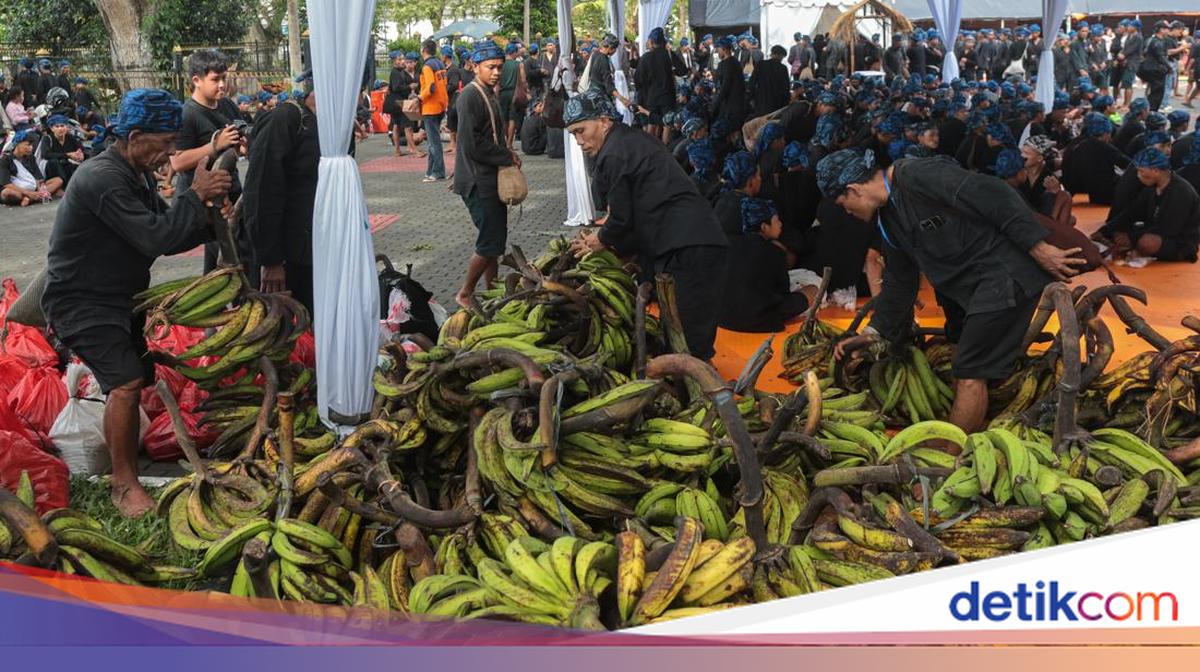
This message was evident in the ‘Seba Baduy 2026’. A total of 1,552 Baduy residents were received by the Banten Provincial Government in Serang City on 25 April 2026. The theme of Seba, “Ngajaga Amanat, Ngarumat Jagat”, emphasises the relationship between upholding ancestral mandates and caring for the earth. The message—that mountains must not be destroyed and valleys must not be ruined—was reiterated.
This message is not merely cultural romanticism. It relates directly to the sustainability of the food system. Forests protect water and soil. Water sustains the ‘huma’. Soil produces rice. Rice enters the ‘leuit’. Some grain becomes seed and is replanted in the ‘huma’. The cycle repeats and is inherited.
Therefore, the protection of indigenous communities must not stop at cultural festivals, traditional clothing, rituals, or tourism promotion. The living space that allows their culture and food systems to survive must also be protected.
This context is increasingly important as the issue of Baduy customary land (‘tanah ulayat’) remains a concern. In September 2026, the application process for Management Rights over approximately 5,161 hectares of Baduy customary land was discussed again, including issues regarding river flows passing through the customary territory. Beyond the administrative and legal aspects, the issue demonstrates how land, rivers, forests, and food for indigenous peoples constitute a single, unified living space.
Indonesia certainly cannot apply the Baduy agricultural system to meet the food needs of more than 280 million people. We still require technology, mechanisation, irrigation, seed research, increased productivity, and agricultural innovation.
But modernisation does not have to mean losing the wisdom that has been tested across generations.
From the Baduy, we are reminded that food sovereignty is not just the ability to produce millions of tons of food. It also concerns who controls the seeds, how land and water are protected, how strong household food reserves are, how farming knowledge is passed down, and the extent to which communities have the ability to determine their own food systems.
Perhaps we ask too often when indigenous communities will follow progress. Amidst climate change and the search for more sustainable food systems, that question is occasionally worth reversing: what, instead, does the modern world need to learn from them?
The answer may be simple: food does not begin when the harvest enters the warehouse. It begins when the soil remains fertile, the water continues to flow, the forests remain standing, seeds remain available, and humans understand that…
Source: jawawa.id (https://jawawa.id/newsitem/lessons-in-food-sovereignty-from-the-baduy-community-1791086069)
Originally published by detikcom (https://news.detik.com/kolom/d-8691468/pelajaran-kedaulatan-pangan-dari-masyarakat-baduy), translated from Indonesian