
Lessons from President Lula
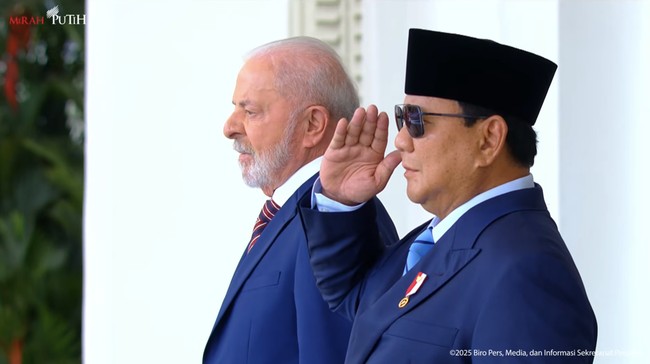
There are similarities between the political journeys of Brazilian President Luiz Inácio Lula da Silva and Indonesian President Prabowo Subianto. Both were elected after their fourth candidacy. Previously, President Lula lost in the 1989, 1994, and 1998 elections.
Similarly, Prabowo entered the national political stage as a vice-presidential candidate in 2009, before running for president in 2014 and 2019.
Lula was elected using anti-market rhetoric. This narrative caused concern among global investors, particularly regarding the potential renegotiation of Brazil’s US$90 billion government debt.
Lula’s Economic Policy
Lula’s economic development strategy, known as ‘Lulism’, utilised a ‘social liberal’ approach that combined capitalism with social welfare programmes for workers and the lower-middle class.
During the early years of Lula’s leadership in 2003, the Brazilian government funded massive social welfare programmes. Consequently, the ‘Samba Nation’ faced issues with weak fiscal discipline, characterised by a debt-to-GDP ratio exceeding 60% and a fiscal deficit-to-GDP ratio of more than 3%.
Furthermore, during the early Lula administration, the primary balance was negative (state revenue was lower than expenditure, excluding interest payments) and Credit Default Swaps (CDS) rose, reflecting increased default risk.
As a result, Brazil’s country risk premium increased significantly. This led to higher debt costs reflected in domestic and foreign interest rates, rising government bond yields, and falling bond prices.
These conditions were exacerbated by tax revenues failing to meet expectations. This forced the Brazilian central bank to cover the high fiscal deficit through money creation.
Global rating agencies such as Moody’s, Fitch Ratings, and Standard & Poor’s downgraded Brazil’s debt to ‘highly speculative’, with Brazil’s government CDS reaching an all-time high of 3.75.
This situation caused an extreme depreciation of the Brazilian real. Similarly, the Brazilian stock market, the Bovespa Index, experienced a drastic decline, eventually leading to the worst-case scenario: a Brazilian government default.
Prabowo’s Economic Policy
Prabowo’s narrative is somewhat similar to Lula’s, focusing on ‘state capitalism’—a hybrid of socialism and capitalism. ‘Prabowonomics’ attempts to take positive elements from both systems.
At the start of his administration, Prabowo allocated massive portions of the government budget to social programmes, such as the Free Nutritious Meal (MBG) programme, the Red and White Village/Sub-district Cooperative (KDKMP) programme, and People’s Schools.
As a result, the fiscal deficit as a ratio of GDP is projected to increase from 2.29% in 2024 to 2.92% in 2025. This narrows the government’s fiscal space amidst global economic uncertainty caused by conflicts in the Middle East.
Most concerning is that Indonesia’s debt service ratio (DSR) is rising towards 50%. This means nearly half of the state’s revenue is being used to service debt.
The ‘state capitalism’ narrative, which emphasises the role of the government, has triggered negative sentiment among global investors. This is reflected in the downgrade of Indonesia’s sovereign debt outlook from ‘stable’ to ‘negative’.
Consequently, Indonesia’s country risk premium has risen to 2.46, higher than Malaysia’s 1.55 and Thailand’s 2.07.
Similarly, the potential for an Indonesian government default has increased, with Indonesia’s CDS reaching 1.05, higher than Malaysia’s CDS of approximately 0.53.
A high country risk premium has caused net foreign outflows from Indonesia, putting pressure on the Rupiah against the US Dollar and the Jakarta Composite Index (IHSG). The Rupiah exchange rate reached its worst level since the 1998 Reformasi.
As reported by The Japan Times, three major global banks—Citigroup, Standard Chartered, and HSBC—have withdrawn approximately 11.5 trillion rupiah in funds over the last two years.
Furthermore, foreign ownership of Indonesian Government Securities (SBN) has declined from 41% in 2018 to only about 13% by 2025. This represents a 28% decrease over seven years, or an average decline of 4.0% per year since 2018.
What, then, can Prabowo do? First, maintain fiscal discipline by ensuring the fiscal deficit-to-GDP ratio does not exceed 2.5% by relaxing some populist programmes.
Second, gradually reduce the government’s DSR from the current level of nearly 50% down to 30%. Additionally, improve tax revenue realisation to bring the tax-to-GDP ratio to approximately 13%.
Third, reduce the perception of risk to the national economy by adopting a pro-market ‘state capitalism’ narrative, reducing the ‘anti-market’ rhetoric within ‘Prabowonomics’ that overemphasises the state’s role.