
Lessons from Daluang, the Nusantara Heritage Paper Used for Qur’anic Manuscripts
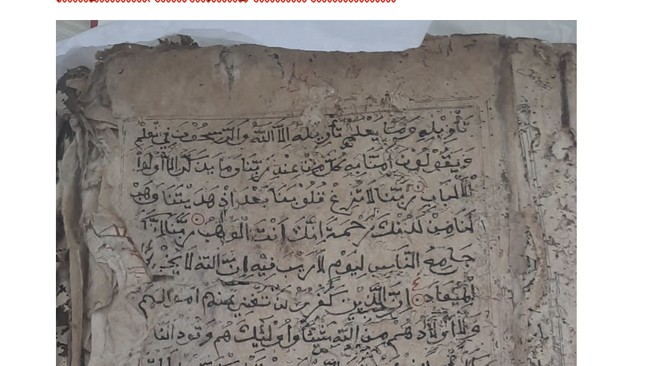
In a collection room at the Directorate for the Management of Scientific Collections (DPKI) of the National Research and Innovation Agency (BRIN), a Qur’anic manuscript more than three centuries old is kept. Its pages are not made of European paper, but of daluang, traditional Indonesian paper produced from tree-bark fibres.
For readers today, the manuscript is more than an antique. It is living evidence that Islamic civilisation in the Nusantara grew from local wisdom, and that preserving this heritage requires knowledge rooted in local conditions as well.
Daluang’s history in the Nusantara
Daluang has long been part of the history of writing in the Nusantara. The word “daluang” appears in the Kakawin Ramayana, dating from the ninth century. The paper is made from the bark fibres of the saeh tree, or paper mulberry (Broussonetia papyrifera).
Initially, daluang was used to make garments for religious figures. In 2014, it was registered by the Ministry of Education and Culture as an Indonesian Intangible Cultural Heritage, under registration number 2010000609.
Unmatched strength?
Daluang is known for its strength. Its fibres are long and interwoven, and its pH tends to be more neutral than that of European paper. European paper made from rags of cotton, linen and hemp tends to be acidic and therefore more vulnerable to deterioration. These differences in chemical properties mean that conservation methods for the two materials cannot be treated as interchangeable.
Daluang’s durability led Nusantara scholars to choose it for copying Islamic manuscripts. In addition to an early eighteenth-century Qur’anic manuscript, the DPKI at BRIN holds books on fiqh, tawhid and aqidah made from daluang. The Qur’anic manuscript was donated by the Semarang Centre for Religious Research and Development.
The scholars’ choice of daluang was not without reason. European paper was scarce and expensive at the time, while the raw material for daluang was abundant in the natural environment of the Nusantara and easy to process. Daluang was also much cheaper. This blending of local technology with the needs of Islamic dissemination made daluang important to the intellectual tradition of Islamic boarding schools, or pesantren.
A medium for scholars and a marker of pesantren tradition
Daluang was commonly used as a writing material in the Nusantara before Islam arrived. As Islam began to spread, scholars adopted and adapted this local technology to copy Islamic texts, including the Qur’an, books on fiqh and prayers. The tradition continued in pesantren and became an integral part of the spread of Islam across the Nusantara.
Daluang—traditional sheets made from saeh tree bark by beating, fermenting, drying and smoothing the fibres—played an important role in the spread of Islam in the Nusantara as a medium for writing the Qur’an and Islamic scholarly works. It also replaced lontar palm leaves centuries ago.
In pesantren tradition, daluang served as a social marker because it was commonly distributed in pesantren circles rather than royal courts. Examples include Qur’anic manuscripts with interlinear, or gandul, meanings; an eighteenth- to nineteenth-century copy of Tafsir al-Jalalayn in Tegalsari, Ponorogo; and Qur’anic manuscripts with simple decoration in Subang, Garut, Cangkuang and Mandailing Natal.
Daluang manuscripts have distinctive physical or codicological features: their fibres are coarse and thick, their natural colour is light brown, and they lack watermarks. As a result, they are difficult to date without radiocarbon testing. Unfortunately, the craft of making daluang nearly died out around 1960.
Today, efforts to preserve the craft are under way in Tegalsari (Ponorogo), Bandung and Sukoharjo. Preserving the knowledge of how to make daluang is just as important as preserving the Qur’anic manuscripts themselves (Iswanto, n.d.).
Conservation methods cannot be the same
The daluang manuscripts in the DPKI collection are currently in good condition and remain legible. Their care is still largely passive preservation: dust and dirt are cleaned off regularly. Manuscripts with holes or damaged edges are repaired using Japanese tissue. However, a shortage of conservation materials is a constraint, as the procurement of Japanese tissue has not yet been realised.
The DPKI is open to researchers wishing to conduct on-site research. They need only submit an application through the DPKI’s official website. So far, however, no dedicated service is available beyond this standard procedure.
The greatest challenge in caring for daluang manuscripts is Indonesia’s tropical climate. Daluang is highly susceptible to mould growth and moisture-related degradation. Manuscripts kept in enclosed spaces with poor ventilation are usually affected by mould around folds and page edges. Stable, dry storage conditions are therefore a key concern.
The right conservation approach for daluang cannot be the same as that used for European paper. The materials are made differently and have different pH levels. Applying European methods to daluang could cause damage. More specific approaches grounded in local knowledge are needed.
Rescuing daluang manuscripts through digitisation also requires suitable equipment. Many manuscripts are scattered in a severely damaged condition and need serious attention from multiple parties.
Valuable information waiting to be revealed
Texts written on daluang contain valuable information for reconstructing the circumstances and conditions of society in the Nusantara in the past. The DPKI’s daluang collection contains information about religious teachings and practices. Research into these manuscripts could reveal how Islam was disseminated and interpreted, and how it was blended with local traditions.
Daluang is more than paper. It bears witness to the intellectual journey of the Nusantara, bridging local wisdom and Islamic values. To care for it is to care for the nation’s identity and history.
But preserving daluang requires more than admiration. It calls for concrete action: research into the manuscripts and the history of paper, safe digitisation, the provision of conservation materials, and the preservation of the skills involved in making daluang. Amid the rapid advance of digitisation, daluang manuscripts await reading, study and transmission to future generations—not as frozen relics, but as knowledge that continues to live.
Source: jawawa.id (https://jawawa.id/newsitem/lessons-from-daluang-the-nusantara-heritage-paper-used-for-quranic-manuscripts-1793170254)
Originally published by CNBC Indonesia (https://www.cnbcindonesia.com/opini/20261028123935-14-780153/pelajaran-dari-daluang-kertas-warisan-nusantara-untuk-mushaf-alquran), translated from Indonesian