
Lenteng Agung Road Reopened; Rano Karno Calls for Roadside Verge Repairs
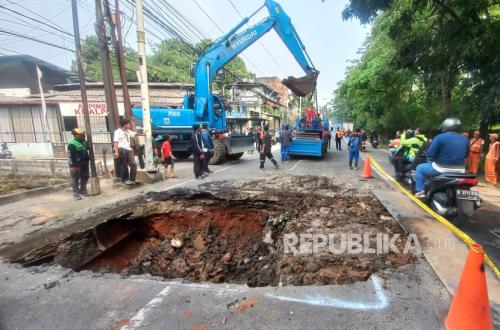
Lenteng Agung Road, which had been closed since Monday afternoon (1/6/2026), was fully reopened on Tuesday (2/6/2026). The road surface, which was reported to have subsided on Thursday (28/5/2026), has been fully repaired and is once again accessible to vehicles under normal conditions.
Jakarta Deputy Governor Rano Karno stated that it took five days to repair the subsidence on the connecting road between Jakarta and Depok in the Srengseng Sawah area, Jagakarsa, South Jakarta. During the final day, the road section was completely closed to facilitate the repairs.
“Alhamdulillah, as this is a main route towards Jakarta and Depok, it is finished today,” he said while inspecting the site on Monday afternoon.
He explained that managing the drainage in the area presented technical challenges, as the water flow beneath the road originates from the University of Indonesia Reservoir and passes under railway tracks. Consequently, repairs could not be carried as standard excavation.
“Because the channel is located beneath a railway crossing, handling it cannot be done through conventional excavation. We had to use drilling or pipe-pressing methods directly towards the reservoir,” he explained.
Currently, the new retaining channel structure has been reinforced using high-quality K-400 concrete. This reinforcement is expected to increase the durability of the channel and the road surface, ensuring greater safety for road users.
Nevertheless, Rano assessed that the repair process is not entirely complete, as the road shoulders on both the left and right sides remain in disarray. Therefore, Rano has instructed his subordinates to carry out repairs on the roadside verges in the area, noting that damaged shoulders could potentially cause new problems in the future.
“I have requested the relevant agencies to also repair the road shoulders so that traffic flow is not disrupted. Above all, since the beginning of this incident, the priority has been the safety of the public using this route,” he said.
He noted that this road section is vital for public traffic, serving as one of the primary access points from Jakarta to Depok.
Based on technical investigations, the primary cause of the subsidence was the corrosion of the corrugated steel pipe structure, known as armco. It is estimated that the armco structure is over 30 years old.
“This type of steel is quite old, likely more than 30 years. Aging structures inevitably experience corrosion,” Rano said.
He assessed that this phenomenon could potentially occur in other areas, as similar armco structures still exist. As a preventative measure, he has requested the Water Resources Agency (Dinas SDA) to conduct an inventory and mapping of the drainage network that still utilises aged armco structures. This mapping aims to identify vulnerable points and accelerate mitigation if similar potential damage is found elsewhere.
“We do not want to hide the existing risks, but rather focus on anticipatory measures. All scenarios must be prepared. We must be ready for the worst-case scenarios so that mitigation and handling can be carried out swiftly,” he concluded.