
Lemhannas Calls for Stronger National Resilience Amid Global Turmoil
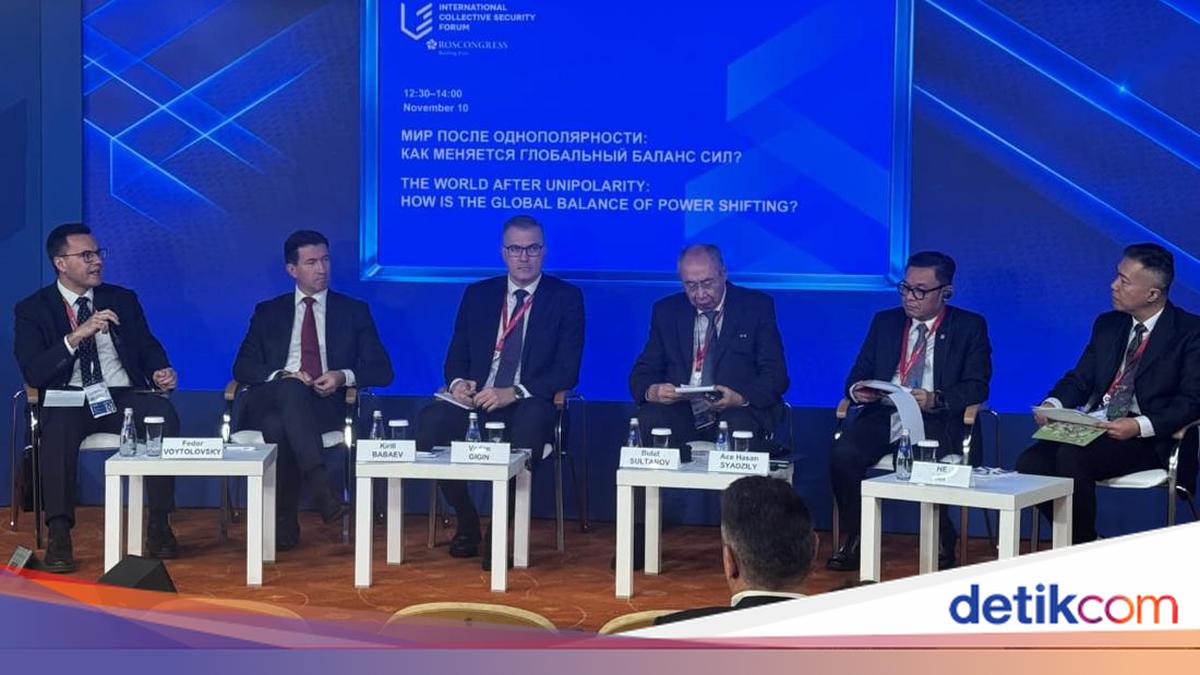
Lemhannas RI Governor Ace Hasan Syadzily has urged that national resilience be made a strategic priority as the world moves towards a future no longer dominated by a single global power. He made the remarks in a speech to delegates from member states of the Collective Security Treaty Organisation (CSTO) at the International Collective Security Forum in Moscow, Russia.
“We must place national resilience at the centre of strategic planning,” Ace said in a written statement on Wednesday (11 November 2026).
In his speech, titled ‘Beyond Unipolarity: Shaping a New Global Order through Strategic Balance and Collective Security’, Ace explained that national resilience involves combining defence, diplomacy, economic and technological capabilities, social cohesion and strategic leadership. The aim is to anticipate risks, safeguard national interests and contribute to world peace.
Alongside national resilience, Ace proposed two other strategic priorities: shifting competition for dominance towards a balance of responsibility, and strengthening multilateral institutions so they are more representative and effective.
Ace stressed that a nation’s resilience is closely linked to the resilience of its region and the world.
“For Indonesia, resilience cannot be separated. A strong nation builds a strong region, which in turn contributes to global stability,” he said.
He therefore emphasised that food must not be used as a weapon. Conflicts should be resolved through dialogue, de-escalation and respect for international law, including the 1982 United Nations Convention on the Law of the Sea (UNCLOS) and the principle of freedom of navigation.
Ace also said strategic autonomy must go hand in hand with global cooperation. Indonesia, he added, is strengthening its energy resilience through the B50 programme and a 100 GW solar power initiative, while promoting a just energy transition and building resilient supply chains.
He argued that developing countries must move beyond being mere consumers to become producers, innovators and creators of technology. His remarks stemmed from a fundamental question posed at the start of his speech.
“As the world moves beyond unipolarity — a period when one global power dominated — is it heading towards a more balanced international order, or entering an era of more intense competition between global powers?” he said.
According to Ace, this is not simply a question of which countries will rise, but of what kind of international order will be built and passed on to future generations. The main challenge is to ensure that geopolitical competition, technological disruption and economic fragmentation do not undermine peace, development and human security.
Ace then described three major shifts in the global balance of power. First, power is becoming more dispersed, enabling middle powers to help shape global policy through strategic partnerships and practical cooperation.
Second, interdependence is both a source of opportunity and a source of vulnerability. Disruptions in energy, food, technology and supply chains can quickly develop into security threats.
“Third, the scope of security is expanding. Cyber threats, artificial intelligence, information manipulation, climate disasters, pandemics and disruptions to critical infrastructure are reshaping security beyond traditional military responses,” Ace said.
These shifts pose a fundamental challenge for collective security: how countries can protect their sovereignty and security without harming others, and how deterrence can prevent aggression without triggering an arms race.
To address these challenges, Ace proposed three principles: security grounded in respect for sovereignty and international law; deterrence accompanied by diplomacy; and collective security that continues to evolve to meet non-traditional threats.
He added that, through stronger international cooperation, the true strength of collective security should be measured not only by its ability to respond to threats, but also by its capacity to prevent conflict and uphold human dignity and shared prosperity.
Ace also said Indonesia adheres to its free and active foreign policy, meaning it does not side with any power bloc and maintains constructive relations with all nations. Through ASEAN centrality and broader international partnerships, Indonesia is working to build an inclusive security architecture.
“We believe a multipolar world should create greater opportunities for cooperation, not deepen divisions,” Ace said.
Concluding his speech, Ace said global power should be measured not by dominance, but by its contribution to a safe, peaceful and prosperous world.
“Let us work together to shape a more balanced, inclusive and resilient international order,” he said.
At the forum, the Lemhannas RI Governor was accompanied by Lemhannas RI Chief Secretary Commissioner General of Police Gatot Tri Suryanta; Lemhannas RI Professional Expert for Natural Resources Prof. Dadan Umar Daihani; and Head of the Bureau of Cooperation and Law at the Lemhannas RI Secretariat, Brigadier General of the Indonesian Navy Suliono.
The forum was also attended by senior government officials from CSTO member states and other friendly countries, representatives of international organisations, diplomats, academics and leading experts.
Source: jawawa.id (https://jawawa.id/newsitem/lemhannas-calls-for-stronger-national-resilience-amid-global-turmoil-1794394428)
Originally published by detikcom (https://news.detik.com/berita/d-8748589/lemhannas-dorong-penguatan-ketahanan-nasional-di-tengah-gejolak-global), translated from Indonesian