
Legok Nangka Waste-to-Energy Plant to Have 40.79 MW Capacity
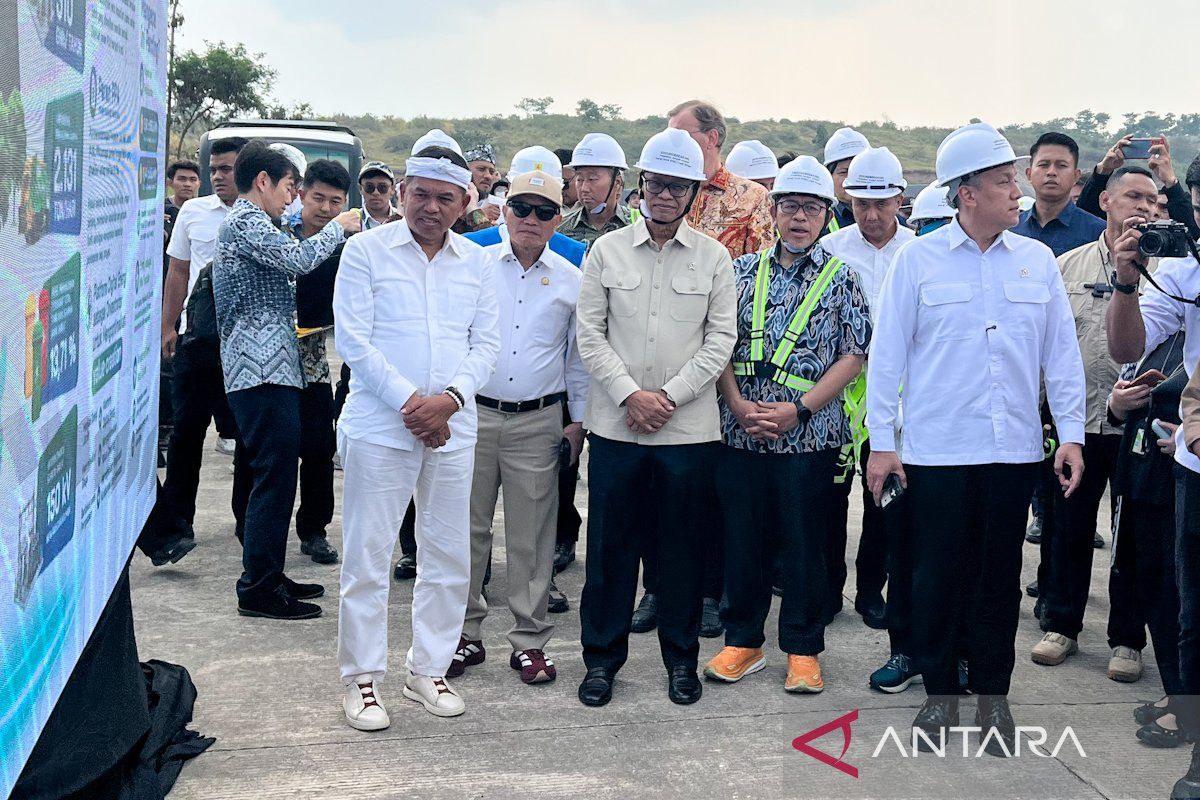
Bandung Regency, West Java (ANTARA) — Deputy Minister of Energy and Mineral Resources (Wamen ESDM) Yuliot Tanjung said the Legok Nangka Waste-to-Energy Plant (PSEL) in Bandung Regency will have a capacity of 40.79 megawatts, with an investment of around Rp7.2 trillion.
“The Legok Nangka PSEL is designed with a generating capacity of 40.79 megawatts and an investment value of 400 million US dollars, or around Rp7.2 trillion,” the Deputy Minister said at the groundbreaking of the Legok Nangka PSEL and the signing of a West Java waste-to-energy development cooperation agreement in Bandung Regency on Wednesday.
Beyond serving as a solution to urban waste problems and producing clean energy, the Deputy Minister said the project is also projected to reduce greenhouse gas emissions by 311,874 tonnes of CO2 equivalent.
“The construction period will last approximately 41 months, with the commercial operation date in 2029. During construction, the project is expected to absorb around 1,565 workers,” he said.
He expressed hope that construction could be accelerated so that the Legok Nangka PSEL can begin operating earlier.
To that end, support and commitment from all stakeholders are needed — the central government, regional governments, PT PLN (Persero), developers, financing institutions, and the community.
He said the Legok Nangka PSEL is expected to become a model for waste-to-energy project development that can be replicated across various regions.
Yuliot said President Prabowo Subianto has instructed that urban waste problems be resolved comprehensively before 2029 through an upstream-to-downstream approach that converts waste into a source of sustainable energy.
According to Yuliot, waste-to-energy development is also a national target under the 2025–2029 National Medium-Term Development Plan (RPJMN), as part of accelerating the national energy transition and waste management.
He noted that nationally, Indonesia still faces major challenges in waste management; in 2025, waste generation reached 56.63 million tonnes.
The biggest problem arises when daily waste generation turns into unmanaged stockpiles downstream. Around 63.3 per cent of waste is managed through transport to final processing sites (TPA), waste banks, or integrated waste processing facilities (TPST).
Unmanaged waste stands at around 35.67 per cent, equivalent to 20.2 million tonnes. That waste ends up being burned in the open, dumped into rivers, or piled up into illegal dumps that pollute the environment.
Meanwhile, there is overcapacity at final processing sites, as most TPA in Indonesia’s large cities use an open dumping system.
The government has strengthened regulations to accelerate waste-to-energy development through Presidential Regulation Number 109 of 2025 on Urban Waste Management through Environmentally Friendly Technology-Based Waste-to-Renewable-Energy Processing.
In follow-up to that regulation, the Ministry of Energy and Mineral Resources has introduced simplified business licensing for PSEL, waste-to-bioenergy processing, and renewable fuel within a single business field classification.
In addition, the Electricity Supply Business Plan (RUPTL) has been set to include plans for PSEL development with a total capacity of 452.7 MW, along with flexibility to develop PSEL capacity beyond the RUPTL quota.
He also expressed appreciation to the West Java Government for its support and commitment in accelerating the construction of the Legok Nangka PSEL project.
The Deputy Minister also gave recognition to PT Jabar Environmental Solution (JES) for initiating and contributing to the development of waste-to-electricity processing using environmentally friendly technology.
“Also to the Government of Japan, which has encouraged Japanese companies to invest in waste to energy — namely Sumitomo Corporation and Hitachi Zosen Corporation, in a joint venture with the national company PT Energia Prima Nusantara,” the Deputy Minister said.