
Legislator pushes for rice price stabilisation to protect farmers and consumers
Jakarta (ANTARA) - Daniel Johan, a member of Commission IV of the Indonesian House of Representatives (DPR RI), is urging the government to maintain a balance in rice prices so that farmers obtain a decent profit and the public can continue to purchase rice at affordable prices.
“We request that food stabilisation be built sustainably by maintaining price equilibrium at both the producer and consumer levels,” Daniel confirmed in Jakarta on Sunday.
Nevertheless, he appreciated the stabilisation and food intervention measures undertaken by the National Food Agency (Bapanas), including the policy to add an additional allocation of 1 million tonnes of rice under the Food Supply and Price Stabilisation (SPHP) programme to strengthen availability and maintain food affordability for the public.
According to him, these various stabilisation instruments have had a positive impact on maintaining supply while helping to reduce pressure on public expenditure.
However, he reminded that food stabilisation must also be built sustainably by maintaining the balance of prices at the producer and consumer levels.
“The stabilisation and intervention programmes carried out by Bapaney, including the additional 1 million tonnes, are very good. The programme helps ease the burden on the community,” said Daniel.
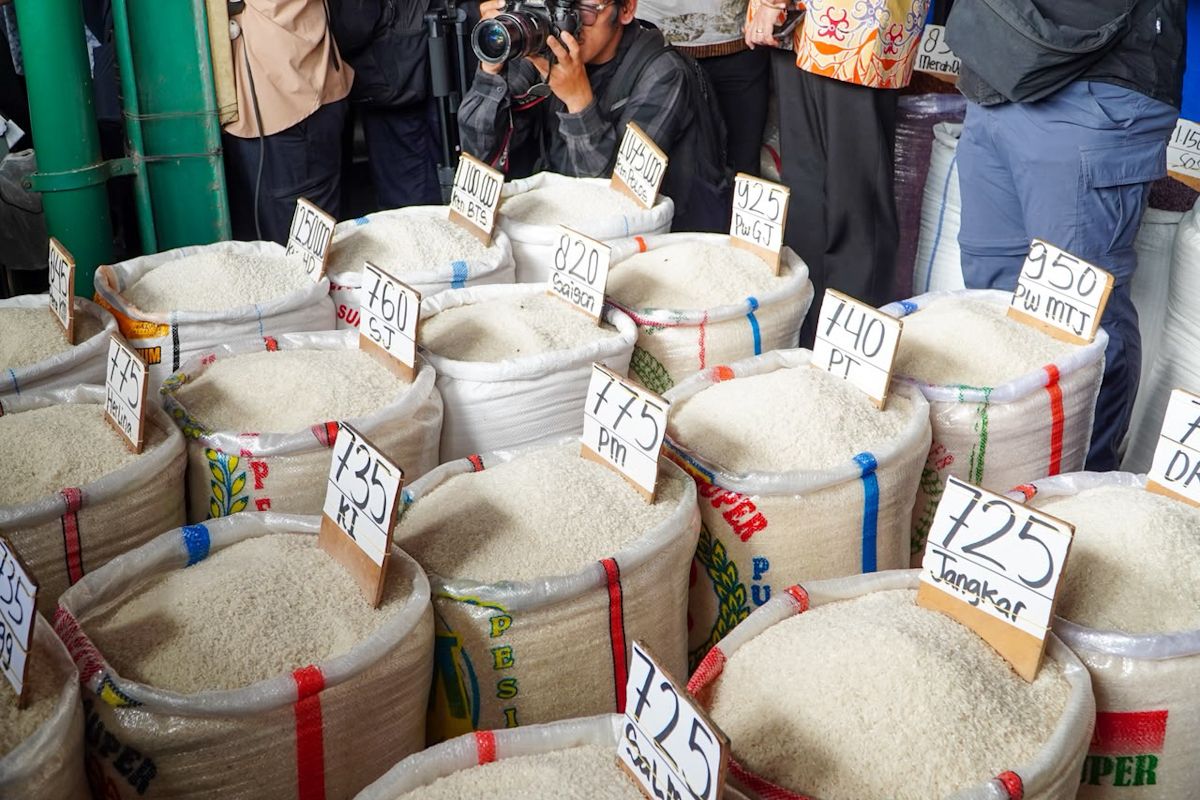
Previously, he conducted a working visit alongside Commission IV of the DPR RI and officials from Bapanas to the Cipinang Rice Wholesale Market (PIBC) in Jakarta on Friday (2/10).
He stated that the government needs to continue strengthening medium- and long-term stabilisation policies so that the resulting prices continue to provide adequate incentives for farmers, while remaining affordable for the public.
“But beyond that 1 million tonnes, we must also consider further measures. What we must consider is how to stabilise prices at the farmer level, as well as at the consumer level,” he said.
It is noted that the SPHP rice assignment, which previously totalled 828,000 tonnes, was 100 per cent distributed by 23 September 2026.
Consequently, the government decided to increase the SPHP rice allocation to 1 million tonnes based on a directive from President Prabowo Subianto via a letter from the Minister of State Secretary dated 28 September 2026.
At the beginning of October, Bapanas issued an additional assignment for the SPHP rice programme to Perum Bulog for 74.18 thousand tonnes, equivalent to 14.83 million 5kg SPHP rice packages.
Meanwhile, the Deputy for Food Availability and Stabilisation at Bapanas, Hermawan, emphasised that the current national rice condition is secure and the government continues to ensure adequate supply moving forward.
This is evident from direct monitoring of rice supply and trade conditions at the Cipinatively Rice Wholesale Market, which serves as an important barometer for rice, particularly for the Jakarta area and its surroundings.
“The government continues to monitor supply, stocks, and prices to ensure the needs of the community are met,” said Hermawan.
He stated that the government is not only focused on national stock adequacy but also ensuring that distribution runs smoothly and supply is available evenly down to the consumer level.
“What we are guarding is not just how large the available stock is, but how that stock can move and reach the community at the right time, location, quantity, quality, and price,” he explained.
According to Hermawan, Bapanas, along with relevant ministries, agencies, Perum Bulog, local governments, business actors, and the Food Task Force, continues to strengthen coordination in maintaining rice stability from upstream to downstream.
Various government instruments, including Food Supply and Price Stabilisation, food assistance, management of Government Rice Reserves, Cheap Food Movements, and periodic monitoring of prices and supply, continue to be optimised according to needs and field developments.
“In principle, the government is guarding two interests in balance. Farmers must obtain a fair price to provide incentives to continue producing, while the public must also obtain rice at an affordable price. This is the balance we continue to maintain,” said Hermawan.
He emphasised that the government will continue to ensure rice availability and strengthen various stabilisation instruments so that the public does not need to worry about meeting food needs.
“We are guarding our rice availability, strengthening our distribution, and continuously monitoring prices. The government will continue to be present to protect the interests of farmers while also protecting the purchasing power of the community, so that national food stability can be maintained,” he said.