
Legendary Japanese Cake Shop Chateraise Adds Rp 1.4 Trillion Investment to Bekasi
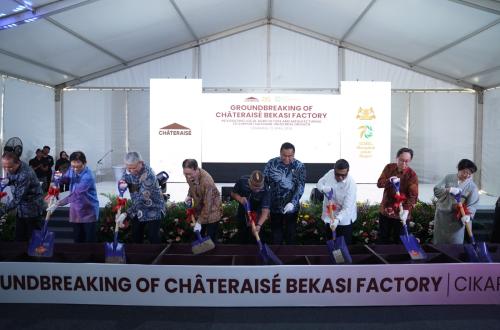
Chateraise Gobel Indonesia is building its second factory in Indonesia with a total investment of Rp 1.4 trillion. “Chateraise has a ‘farm to factory’ concept. So it’s not just about making cakes, but an integrated ecosystem between farmers, industry, and consumers. This is a new approach to strategic partnerships that uplifts farmers while serving consumers,” said Rachmat Gobel, chairman of Gobel Group, on Monday (13/4/2026).
He made the statement during the groundbreaking ceremony for the Chateraise factory in Bekasi, West Java. This is the second Chateraise factory in Indonesia. The first factory is in Bogor, established in 2017. Chateraise Gobel Indonesia is a joint venture between Japan’s Chateraise and Indonesia’s Gobel Group.
The event was attended by Haikal Hasan, head of the Halal Product Assurance Agency (BPJPH). Also present were Takako Saito, CEO of Chateraise Japan, and Yuji Kuruya, Acting Business Officer of the Japanese Embassy in Jakarta.
Additionally, farmers from Gorontalo attended, along with several village heads and sub-district heads from Limboto and Taluditi in Gorontalo. Also present were Ridwan Monoarfa, Deputy Chairman of the Gorontalo Provincial DPRD; Sofyan Puhi, Regent of Gorontalo Regency; Iwan S Adam, Deputy Regent of Pohuwato; Roman Nasaru, Chairman of the Gorontalo Regency DPRD; Faisal Yunus, Chairman of the Bone Bolango Regency DPRD; and officials from Boalemo Regency.
“The presence of farmers at this event is to show that the role of farmers is very important as part of the ecosystem,” said Gobel. According to him, Chateraise is not just seeking profit but making farmers part of the food industry.
Gobel explained that the food industry in Japan has very high standards. Because farmers are integrated into the Chateraise ecosystem, he said, there will be guidance and mentoring from Chateraise for farmers in cultivation that meets Japanese food standards. “For example, the nutrition must be good, the ingredients must be high quality, it contributes to reducing global warming, and helps reduce CO2 emissions,” he said.
Gobel also explained that by integrating Gorontalo farmers into the food industry ecosystem, Chateraise is contributing to efforts to alleviate poverty in Gorontalo. “This province is one of the poorest in Indonesia,” he said.
Furthermore, he said, Chateraise in Indonesia will serve as a base for exports to Middle Eastern and Southeast Asian countries. The Indonesian agricultural products to be absorbed include cocoa, coffee, palm sugar, cassava, peanuts, and others.
Takako Saito, CEO of Chateraise Japan, said that Chateraise products are always high quality with affordable prices. Currently, there are 14 factories in Japan and 4 factories outside Japan, namely in the Netherlands, Vietnam, and Indonesia.
Chateraise produces 400 types of cakes. The number of outlets outside Japan is 185. According to her, cocoa from Kolaka and Gorontalo has already become part of Chateraise. “With the ‘farm to factory’ concept, it goes directly from farmers to the factory. So the origin of the raw materials is clear,” she said.
Furthermore, Saito said that through the Chateraise and Gobel partnership, there will also be technology transfer and absorption of labour. “But there’s more than that; this partnership is built on mutual respect and mutual benefit for both parties,” she said.
Meanwhile, Yuji Furuya said that Chateraise has a philosophy that prioritises health and the use of natural ingredients. “Since it opened in 2017, Chateraise has been liked by Indonesian society,” he said.
Haikal Hasan said that initially he did not know there was a Chateraise in Indonesia. “It turns out my children love it. That’s how I found out about Chateraise,” he said.
On that occasion, he explained the meaning of halal for the global community. “Halal is not just a religious function, but also an economic one. In the UK, halal is green life and saving the world. In the US, halal is a symbol of health. In Korea, halal is double clean. In China, halal is an engine of economic growth because of its Rp 21 quadrillion potential. In Japan, halal is kaizen, with the 5S: Seiri (simplify), Seiton (organise), Seiso (clean), Seiketsu (standardise), and Shitsuke (discipline),” he said.
Source: jawawa.id (https://jawawa.id/newsitem/legendary-japanese-cake-shop-chateraise-adds-rp-1-4-trillion-investment-to-bekasi-1776077535)
Originally published by Republika (https://ekonomi.republika.co.id/berita/tdfgwu475/toko-kue-legendaris-jepang-chateraise-tambah-investasi-rp-14-t-ke-bekasi), translated from Indonesian