
Legal Expert: Non-Performing Loans at LPEI Do Not Automatically Constitute State Losses
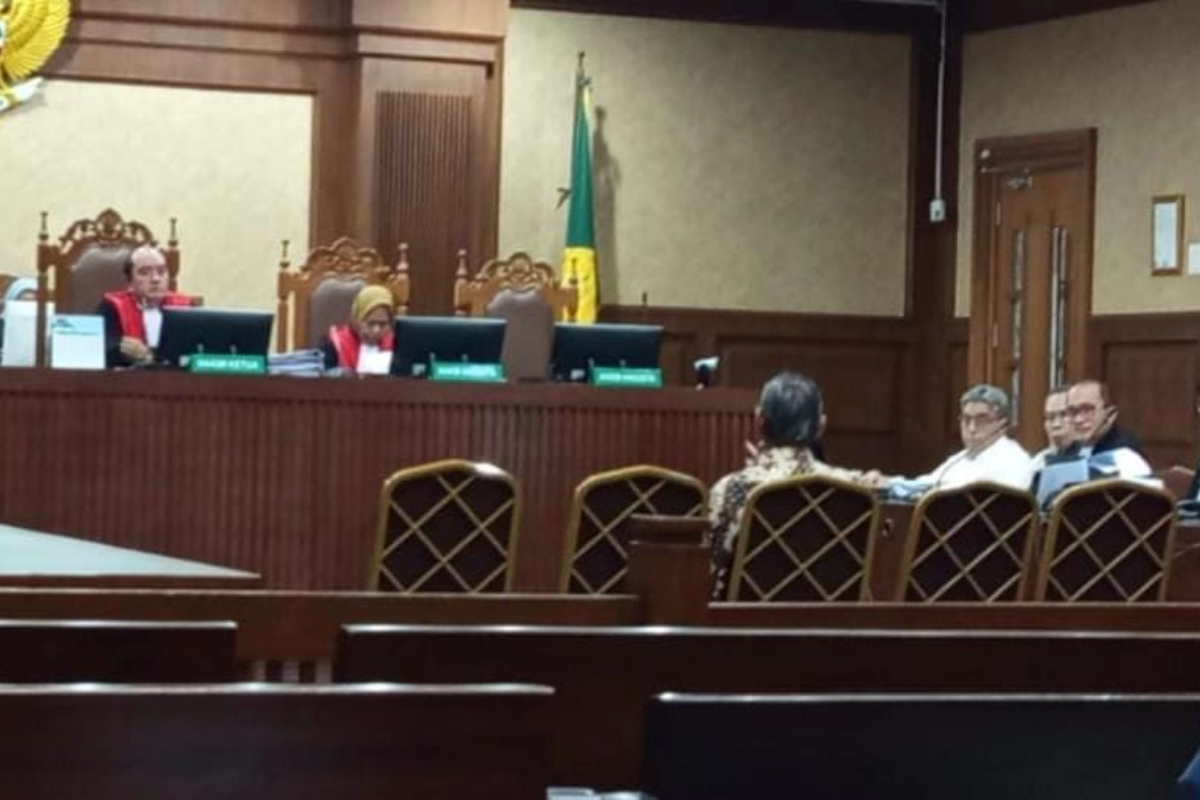
State finance legal expert Siswo Suyanto has asserted that a state loss in the Indonesian Export Financing Institution (LPEI) financing case does not automatically arise simply because a credit facility has defaulted or become problematic. According to him, a state loss must be linked to an unlawful act and calculated only on the portion that genuinely caused the loss. This was conveyed by Siswo while testifying as an expert in the trial of alleged corruption in the provision of LPEI financing facilities, involving defendants Handoko Limaho, Liu Raymond, Dwi Wahyudi, and Rian Wahyudi at the Central Jakarta Corruption Court.
During the trial, the legal advisory team for the defendants explored the expert’s views on the concept of state losses, the characteristics of LPEI as an institution managing separated state assets, and the difference between business risk and unlawful acts. Responding to a question from legal counsel Rasamala Aritonang regarding LPEI’s status, Siswo explained that the institution has a special character (sui generis). He noted that while LPEI manages state finances, its operational mechanisms are governed by a separate law, meaning it is not fully subject to banking mechanisms or government bureaucratic governance.
He explained a fundamental difference between government and corporate governance. Bureaucracy is process-based, oriented towards compliance with procedures, whereas corporations place greater emphasis on achieving results. “In a corporation, the approach is results-based. The process can be more flexible, but the final outcome must be correct,” Siswo told the panel of judges.
Regarding the calculation of state losses, Siswo stressed that auditors must identify the point at which the unlawful act occurred, rather than immediately considering the entire financing value as a state loss. He stated that the terms total loss and actual loss are not methods of calculating loss but merely describe the condition of the loss that occurred. “What is calculated is the portion that caused the loss. Not automatically the entire financing value,” he said. Siswo illustrated that if all funds were lost without producing any benefit, the loss is comprehensive. However, if part of the work was completed and only a portion of the funds was misused, the state loss is calculated only on the misappropriated value.
He also distinguished between errors in decision-making and irregularities occurring during the implementation phase. According to him, if the credit approval decision was made according to procedure, but the funds were subsequently used for other purposes by the debtor, the state loss arises at the moment the irregularity occurs, not from the time the credit was approved. For example, Siswo explained that if a Rp1 billion credit was used for its intended purpose, but Rp300 million was later used for gambling, the state loss is only Rp300 million. “If the decision-making was correct, and then a deviation occurs midway, what is calculated is the misused portion,” he said.
Siswo also clarified the position of collateral or guarantees in the calculation of state losses. He stated that an auditor still calculates the full loss value if an unlawful act has been found, while the existence of collateral serves as an instrument to recover state losses after a legally binding court decision. Meanwhile, defendant Handoko Limaho questioned whether a credit initially granted correctly, but which later defaulted due to the debtor’s actions, could be directly charged to the party who made the credit approval decision. In response, Siswo said no. He stated that if the irregularity occurred during the implementation stage, the responsible party is the perpetrator of that irregularity, not automatically the initial decision-maker.
A similar point was made when answering a question from defendant Liu Raymond regarding the concept of scarcity in state finance. Siswo assessed that this concept is used to explain the limitations of state resources in providing public services and is therefore not appropriate to apply to an institution like LPEI, which manages separated state assets. He reiterated the need to differentiate between business risk and unlawful acts. According to him, losses arising solely from business risks cannot automatically be categorised as state losses in a corruption case. In this case, the DKI Jakarta High Prosecutor’s Office has charged eight individuals in connection with alleged corruption in the provision of LPEI financing facilities, which is said to have caused state losses of nearly Rp1 trillion.