
Leaving a Trail of Service: USU Medical Faculty in Tano Niha, Cutting Through Old Perceptions
The Faculty of Medicine at Universitas Sumatera Utara (USU) has recorded a journey of community service in the medical field in Tano Niha — Nias Island — particularly in North Nias Regency, a region created through the splitting of Nias Regency in 2008. Centred on the town of Lotu at the northernmost tip of Nias Island, the area borders the Indian Ocean to the north and west, blessed with beautiful white-sand beaches lined with coconut palms along the roadsides.
Reaching Lotu begins with a small aircraft from Medan and ends with a slightly nerve-racking yet memorable landing at Binaka Airport in the Gido area, about thirty minutes from Gunungsitoli. The island air greets visitors with a faint, warm scent of the sea mingled with the fragrance of tropical soil.
The onward journey to Lotu passes through Gunungsitoli by car, tracing asphalt roads that cut through small villages fenced with coconut trees, modest houses, semi-permanent shopfronts, old buildings and stilt houses evoking the architecture of the past.
The further one travels from Gunungsitoli, the quieter it becomes. The road is not entirely straight, rising and falling and occasionally taking sharp bends as it follows Nias’s hilly contours, with coastal panoramas on either side, the crash of waves, gentle sea breezes and the shimmering expanse of the Indian Ocean beneath the sunlight.
For the people of North Nias, health and infrastructure are two closely intertwined matters. Before various developments carried out in recent years, the poor condition of inter-regional roads meant some residents had to travel long distances to reach referral health facilities. During the rainy season, the challenge grows heavier as several road sections suffer damage or become difficult to pass.
The scattered geography also affects access to specialist medical personnel. Many patients previously had to be referred to Gunungsitoli or even Medan for advanced care. The consequences involve not only long travel times but also substantial transport and living costs for patients’ companions — a heavy burden for families of limited economic means.
Complex challenges for PPDS
For dr. Trinidia Lubis, M.Ked(OG), a specialist registrar (PPDS) from USU’s Faculty of Medicine who has just completed her residency posting on Nias Island, the atmosphere in the archipelago was deeply impressive. Trinidia, together with several fellow PPDS from the faculty, was placed in different areas. She served at dr M Thomsen Hospital in Gunungsitoli, the main referral hospital in the Nias Islands.
Meanwhile, her colleagues — dr. Ricky Bonatio Hutagalung, dr. Devinda Villarsi, dr. Edgar Anthony Petra Sihite and dr. Margareth Duma Sari Sirait — served at Tafaeri Hospital in Lotu, North Nias Regency. For three months, counted from early March 2026, they served as specialist doctors bearing the name of the Universitas Sumatera Utara Faculty of Medicine in providing healthcare to the community. Accompanied by study programme and faculty teams, the PPDS from the fields of Internal Medicine, Obstetrics and Gynaecology, Anaesthesiology and Intensive Care, and Clinical Pathology were formally handed over to their respective placement hospitals.
For these young doctors, serving in an island region initially conjured somewhat anxious expectations. Limited facilities, communication difficulties with patients and low public understanding of modern healthcare all weighed on their minds. Yet the reality on the ground proved far less daunting.
“The challenges we initially thought would be very difficult turned out not to be so. There were some obstacles in communicating with patients who generally use the local language, but these could be overcome with the help of nurses who translated, and the patients’ families were quite cooperative,” said dr Trinidia.
Elderly patients generally speak only Nias and do not understand Indonesian. However, this barrier was overcome thanks to local health workers who acted as a communication bridge between doctor and patient.
During their residency, the PPDS doctors served across various units, from outpatient clinics and the emergency department to operating theatres. Every medical procedure they performed was documented as part of the specialist education process, which demands clinical experience across a wide variety of cases.
At dr. M. Thomsen Hospital in Gunungsitoli, the caseload in obstetrics and gynaecology is notably high. According to dr Trinidia, the hospital handles around 35 caesarean sections and seven to eight hysterectomies per month. Yet only two obstetricians and gynaecologists serve there, one of whom is approaching retirement. This makes the need for specialist doctors increasingly urgent.
Even so, the greatest challenge lies not in the number of patients but in the limitations of the healthcare support system, with one of the most crucial problems being blood availability.
“Obstetric surgery depends heavily on blood. The problem is that the blood bank is not available 24 hours. After 10pm it closes, even though emergency cases can arrive at any time. Meanwhile at Tafaeri Hospital in North Nias, my colleague faced an even greater challenge because there is no blood bank there at all. So medical procedures must be carefully considered. Patients from North Nias often have to be sent to Gunungsitoli due to the lack of blood,” added dr Trinidia.
Under normal circumstances, this limitation might barely be felt. But for patients suffering massive haemorrhage during childbirth, every minute determines whether they live or die.
Limitations are also felt in diagnostic support services. For anatomical pathology examinations, for instance, the hospital has no specialist, so every biopsy sample must be sent to Medan. As a result, establishing diagnoses, including suspected cancer, takes considerably longer. A further problem arises when patients require sub-specialist care not yet available on Nias Island.
As the archipelago’s main referral hospital, dr. M. Thomsen Hospital frequently faces a dilemma. On one hand, patients need advanced medical treatment; on the other, sub-specialist facilities and personnel are unavailable. The final option is referral to Medan.
For island communities, however, the referral process is far from simple. Besides high transport costs, patients must undertake sea or air journeys with various administrative requirements. Even to board a ship or aircraft, patients’ families must obtain a letter stating that the transport provider bears no responsibility should an emergency occur during the journey. This administrative process can take two to three days.
“Sometimes we know a patient needs a sub-specialist. But we also look at the family’s economic condition. Just reaching Medan is already a huge burden, let alone continuing the onward overland journey which takes no small amount of time,” explained Trinidia.
No small number of patients also come from North Nias Regency. Interestingly, this is not because the area lacks doctors — PPDS doctors in obstetrics and anaesthesiology from USU’s Faculty of Medicine have in fact been placed at Tafaeri Hospital in North Nias. But limited facilities, particularly the absence of a blood bank and constrained ICU capacity, mean some cases must be referred to Gunungsitoli.
Beyond this, there is the factor of public trust. Some patients choose to go directly to dr. M. Thomsen Hospital because they believe the newly posted doctors at Tafaeri Hospital lack sufficient experience. In one month, around six to seven patients were referred from North Nias to dr. M. Thomsen Hospital. Some patients even arrived directly without going through the proper referral procedure.
“The PPDS doctors placed there are competent too. But public perception remains a challenge,” Trinidia recounted, recalling the obstacles faced by her colleague serving in North Nias.
Of all her experiences serving in Nias, one story remains most vivid in Trinidia’s memory. A mother arrived at the hospital in the early hours of the morning in a state of shock from postpartum haemorrhage. Her baby had been born at 7pm, but the mother had remained at home, attended by a traditional birth attendant long trusted by the family. She was only brought to hospital at 1am, by then in a rapidly deteriorating condition.
On arrival at the emergency department, her body was pale, her blood pressure could no longer be measured, and she was in severe shock. Trinidia and the medical team immediately performed life-saving treatment. The wound was managed. Sadly, the single most vital requirement was unavailable: blood.
The blood service had been closed since 10pm. Intravenous fluids could maintain circulation temporarily, but in cases of massive haemorrhage, blood remains the only primary therapy capable of saving a life. Despite every effort, the patient ultimately could not be saved.
“It was not because we failed to act. But in such a condition the patient needed a blood transfusion as quickly as possible. Blood must be replaced with blood,” stated Trinidia.
That story is a stark illustration that the challenges of healthcare in island regions concern not only medical facilities but also social and cultural factors. Community trust in traditional birth attendants remains very strong. Some families only bring patients to hospital once every traditional effort is deemed exhausted. Yet in obstetric emergencies, a delay of just a few hours can determine a mother’s life or death.
For the PPDS doctors, the three months serving on Nias Island was far more than a specialist education requirement. They learnt that being a doctor means understanding the realities of communities in their entirety — from limited health infrastructure and the geographic challenges of island regions to the cultural values still alive within society.
The experience also affirms that improving healthcare quality in the regions requires more than simply deploying medical personnel. It demands stronger hospital facilities, 24-hour support services, faster referral systems and sustained public education on the importance of safe childbirth in health facilities.
Because ultimately, saving lives depends not only on a doctor’s ability, but on the presence of a healthcare system capable of reaching every member of society whenever they need it.
The Universitas Sumatera Utara Faculty of Medicine (FK USU) and the North Nias Regency Government formally signed a Cooperation Agreement (PKS) in early March 2026, following up on a memorandum of understanding signed previously.
The agreement affirms USU’s commitment to supporting government programmes, particularly those of the Ministry of Health of the Republic of Indonesia and the North Sumatra Provincial Government, in developing healthcare in underdeveloped and island regions, including Nias Island.
One form of this commitment is giving priority to doctors who are natives of the region and committed to returning to serve in Nias to undertake the Specialist Medical Education Programme (PPDS) at FK USU, funded by the North Sumatra Provincial Government.
The programme has been running for one year, and to date FK USU has received seven native Nias doctors, four of whom come from North Nias, undertaking specialisation in Internal Medicine, Surgery, Anaesthesiology and Intensive Care, and Radiology. This step is expected to accelerate improvements in access to specialist healthcare in North Nias Regency.
North Nias currently has 11 inpatient community health centres (puskesmas) spread across all its districts and one regional hospital, RSUD Tafaeri, which serves as the regency’s healthcare referral hub. However, the availability of health personnel remains homework that has not yet fully met the needs of the entire area.
For this reason, the presence of specialist services at RSUD Tafaeri carries far greater meaning than a mere addition to the range of services. The presence of specialist doctors means shorter distances, lower treatment costs, faster patient care and better chances of recovery for the community.
In North Nias, distance is measured not only in kilometres. It is counted in how long a pregnant mother must travel to reach hospital, how much a family must spend to accompany a relative seeking treatment, and how quickly an ambulance can reach villages scattered among hills and coastlines. Thus, when specialist services begin to arrive closer to home through RSUD Tafaeri, what arrives is not merely healthcare but new hope for thousands of residents at the northern tip of Nias Island.
It is within this context that the cooperation between USU’s Faculty of Medicine and the North Nias Regency Government becomes highly strategic. The presence of resident doctors, capacity building for local health workers and specialist education programmes for local sons and daughters represent a long-term investment in building self-sufficient healthcare in the archipelago.
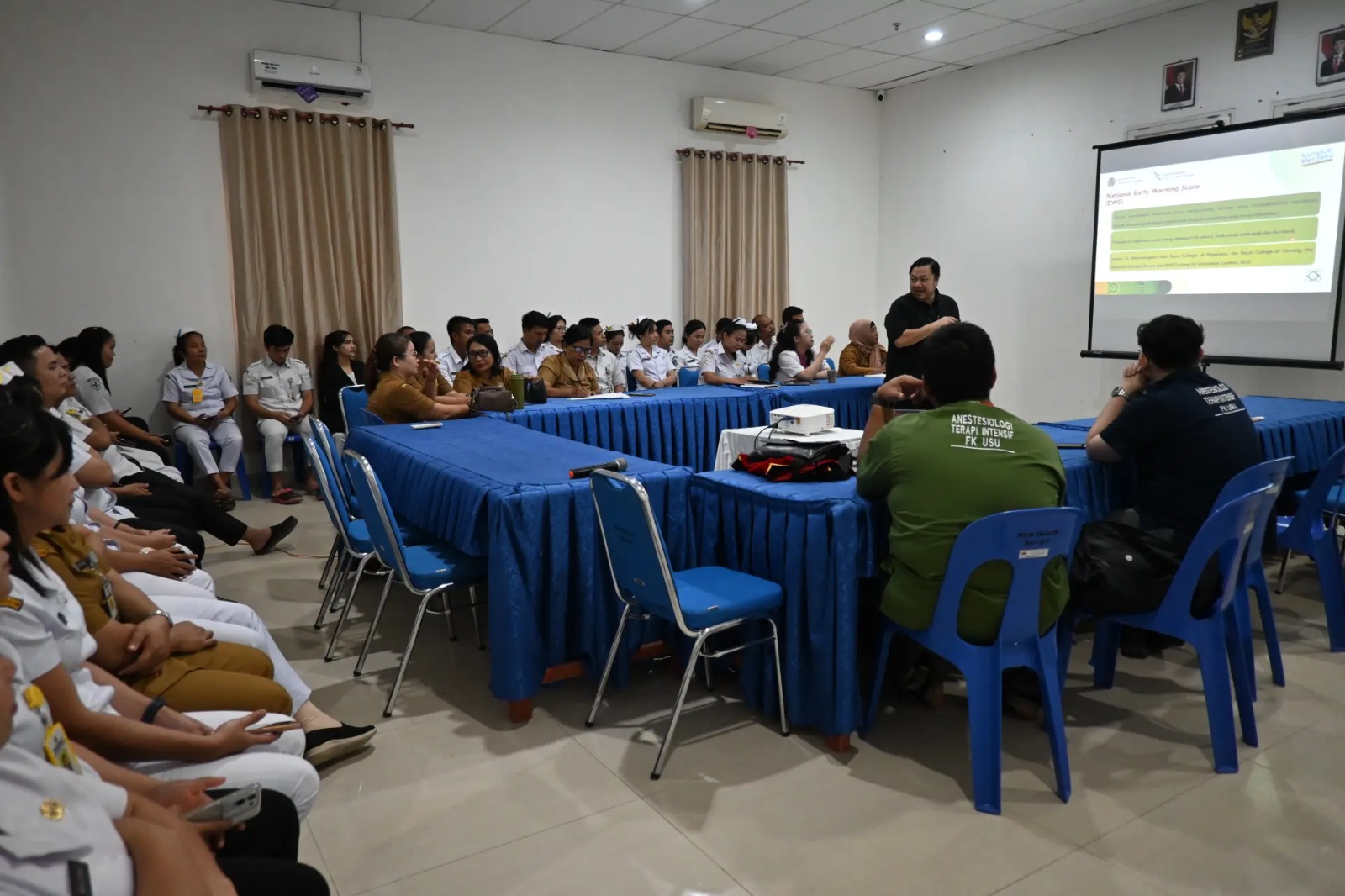
FK USU, together with RSUD Tafaeri and the North Nias Regency Health Office, had previously carried out a community service programme at RSUD Tafaeri in Lolofaoso Village, Lotu District, North Nias Regency, in March 2026.
The outreach by FK USU lecturers included antenatal examinations and ultrasound for pregnant women, gallstone screening, haemoglobin and blood glucose checks for the public, and emergency care training for RSUD Tafaeri health workers. The activities were warmly received by residents who filled every available service room, even spilling out along the hospital corridors. It is a service they very rarely receive, and one they would not dream of passing up.