
Learning Rural Revitalisation from Villages in Yunnan
Kunming (ANTARA) - A visit to villages in Yunnan, China, has allowed Indonesian village officials to observe closely how local communities transform natural and cultural potential into economic resources without abandoning their traditional character.
In Sanman Village, for example, they witnessed how three neighbouring villages transitioned from separate development patterns to a collaborative model. For Titin Bainah, a village head from North Sumatra, her first visit to Sanman Village in Xishulaobanna, Yunnan Province, provided an opportunity to see firsthand how a rural community can convert local resources into new opportunities.
“This village is very clean, and I am impressed by the blend of tourism and culture, as well as the collective economy,” said Titin, adding that she hopes to bring some of this experience back to Indonesia.
From 12 to 13 September, a group of Indonesian village officials visited rural communities in the Yunnan border region. They did not merely admire the scenery but also inquired about how villagers are involved, how local industries develop, how traditional culture is transformed into economic resources, and how villagers share in the benefits.
Sanman is part of the Mangajian Village Committee. Previously, the three villages operated separate industries, relying primarily on rubber tapping and migrant labour, while traditional crafts struggled to find successors. Since 2023, a team led by Professor Li Xiaoyun from China Agricultural University has assisted in planning and management. While maintaining the characteristics of the Dai ethnic village, the local community has developed cafes, rainforest tourism experiences, and shops for cultural and creative products, thereby unifying previously scattered resources.
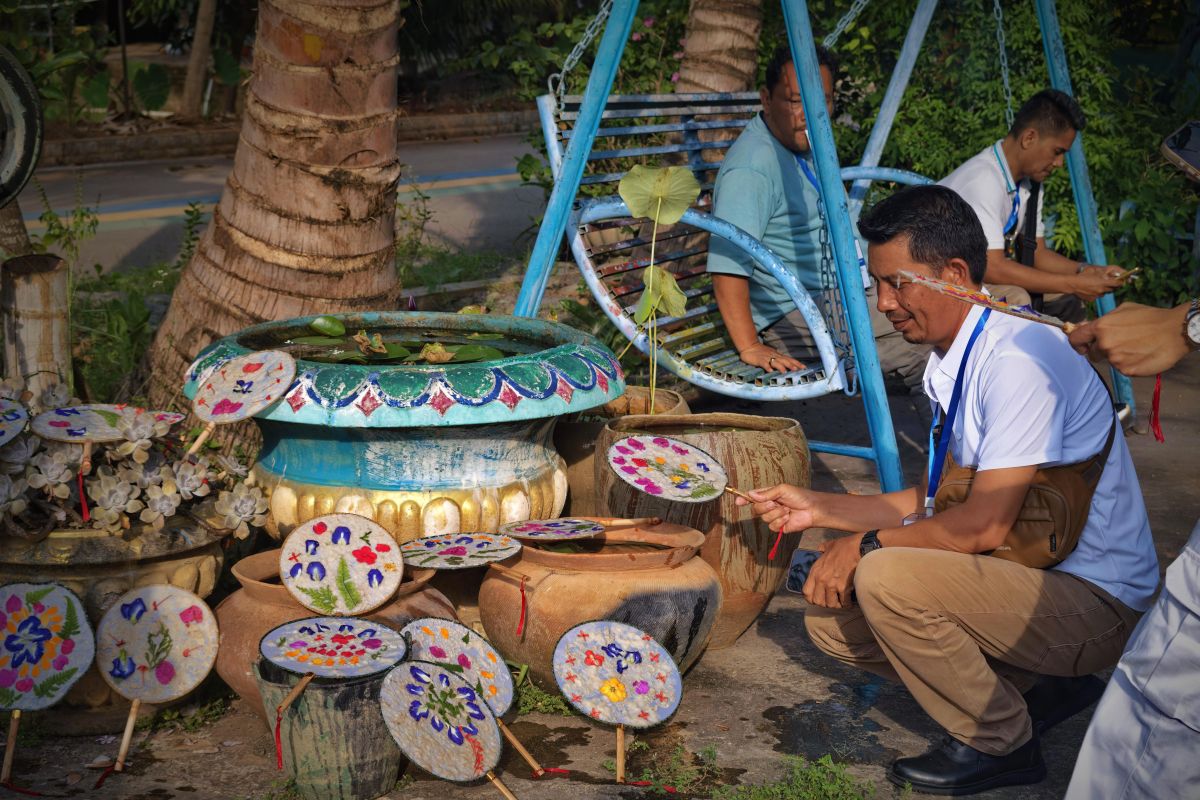
What particularly caught the attention of the Indonesian officials was how villagers benefit from these changes. On the afternoon of 13 September local time, the Indonesian officials visited Manzhao Village in the Menghai region of Yunnan Province. This village is currently the only village in Xishuangbanna that produces traditional Dai ethnic paper.
Revenue from visitor spending is distributed through cooperatives, management companies, village collective business entities, and village groups, allowing households to share in the benefits. In 2025, Sanman recorded a business turnover of 2.58 million yuan (1 yuan = Rp2,629). The village collective enterprise earned a revenue of 570,000 yuan, including 70,000 yuan distributed as dividends to all 140 households.
“Regarding rural development, ultimately the most important thing is that the villagers benefit,” said Titin.
She stated that rural development requires more than just a beautiful environment; it also requires industries that encourage villagers to remain actively involved. She was particularly interested in how Yunnan villages have transformed cafes, sunset viewing spots, and various everyday attractions into new sources of income. This has inspired her to consider how Indonesian villages can better utilise their own resources.
From the transformation of Sanman to the revitalisation of traditional crafts in Manzhao, they observed a vital lesson: rural revitalisation is not merely an effort to beautify the appearance of a village. Rural revitalisation is about integrating ecological, cultural, and industrial resources, while ensuring that villagers act as both participants and beneficiaries of such development.
In a cultural and creative products shop, Dai ethnic paper has been processed into various items such as packaging, handbags, gift boxes, fans, lamps, and decorative paintings. A villager named Yu Kangkang has helped develop more than 60 products, bringing this craft, which has a history of over 800 years, into the modern market.
The visiting officials expressed their hope to bring these experiences back to Indonesia.