
Learning from Churchill and Gandhi: When Trust Becomes Strength
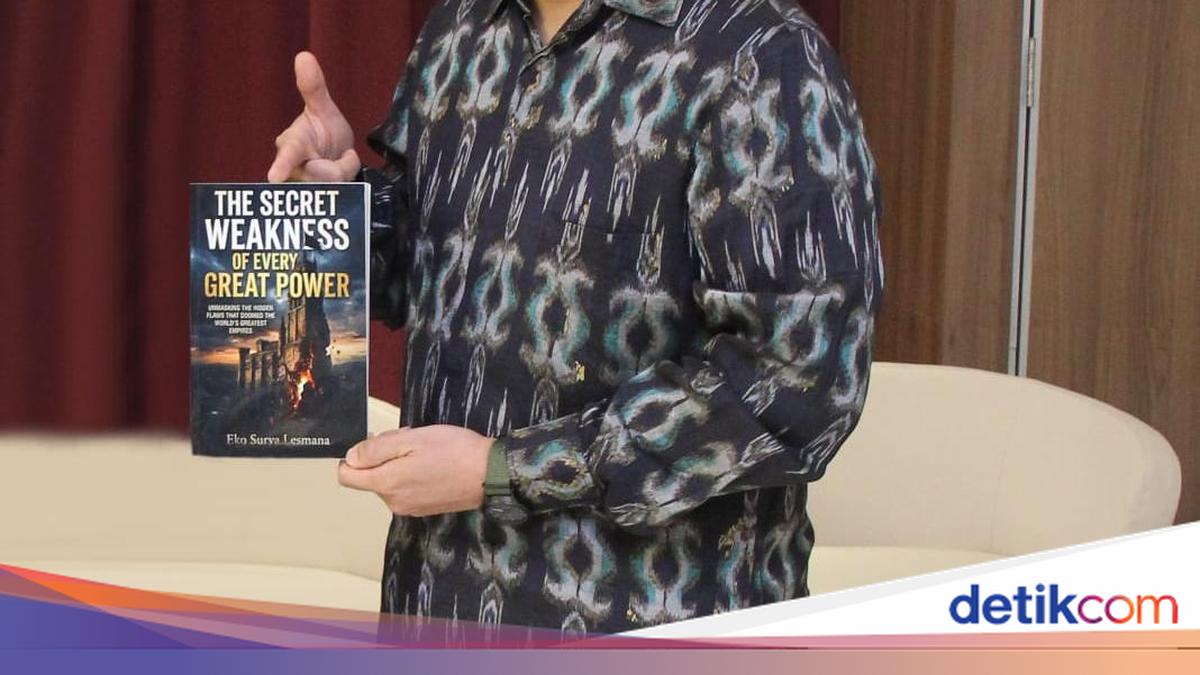
Dr Eko Surya Lesmana stated that a good leader is not necessarily the most loved, but one who remains trusted even when the people disagree with him. He made the remarks during a discussion of his book, The Secret Weakness of Every Great Power, at the Nyi Ageng Serang Jakarta Library on Saturday (29/8/2026). The event, organised by Rumah Perubahan, was moderated by Dr Boy Bayu Idisondjaya.
According to Eko, a leader’s strength does not lie solely in the amount of power they hold. Equally important is the ability to turn trust into support, and then mobilise that support into action. British Prime Minister Winston Churchill and Mahatma Gandhi of India were the two examples Eko used to explain this idea.
Churchill faced Britain in a wartime situation when the country’s future was under threat. Rather than concealing the difficulties, he spoke frankly to the people and invited them to face reality together. That trust then became one of Britain’s sources of strength to endure. Gandhi demonstrated a different approach. He transformed the support of the Indian people into a movement that was simple, concrete, and easy to follow. One example was the salt-making action as a form of resistance against British colonial policy.
From these two figures, Eko showed that strength does not always originate from weapons, troop numbers, or vast resources. Strength can grow when society trusts its leadership and is willing to turn that trust into action. This idea is one of the main topics in The Secret Weakness of Every Great Power.
The book invites readers to see another side of great powers: how seemingly solid power can weaken when trust and support from within begin to slip away. Eko formulated this concept through the term SPLIT, a condition in which external strength still appears intact while internal support and trust slowly drift away.
The collapse of the Soviet Union in 1991 serves as one illustration. The superpower still possessed nuclear weapons and the apparatus of power when it finally dissolved and split into 15 countries. From this, the question of strength is no longer merely about how much a country owns, but how effectively that strength can be maintained and used.
This perspective was reinforced by Rear Admiral (Ret.) I Nengah Putra A., a permanent lecturer in the Defence Industry Study Programme at the Indonesian Defence University. He cited the Vietnam War (1955–1975) as an example. The United States held major advantages in military, technology, industry, and logistics. However, that material superiority did not automatically produce political victory.
According to Nengah, the Vietnam experience shows that great power requires the right strategy to convert resources into results. The size of the means does not guarantee the achievement of the ends if the ways used do not match the strategic environment.
Besides Nengah, the book was also discussed by Dr Ian Montratama, a geopolitics expert at the National Defence Council of Indonesia, and Darwin Silalahi, former CEO and President Director of PT Shell Indonesia as well as Country Chairman of Shell Companies in Indonesia.
Eko, who earned a doctorate in Strategic Management from the Faculty of Economics and Business at the University of Indonesia in July 2025, currently serves as Deputy for Risk Management at the Hajj Financial Management Agency (BPKH). Through the book, he aims to show that great power is not built solely through material capability. Power also requires legitimacy, support, resilience, and above all trust. For even the greatest power can lose its force when the people who sustain it no longer believe in defending it.