
Learning from BAIC: Iftitah Says Industrial Progress Is Built on Investment in People and Technology
Beijing – China’s industrial progress did not happen overnight. Behind automotive products that can now compete in international markets lies a long process of developing human resources, mastering technology, investing, conducting research and building industrial partnerships.
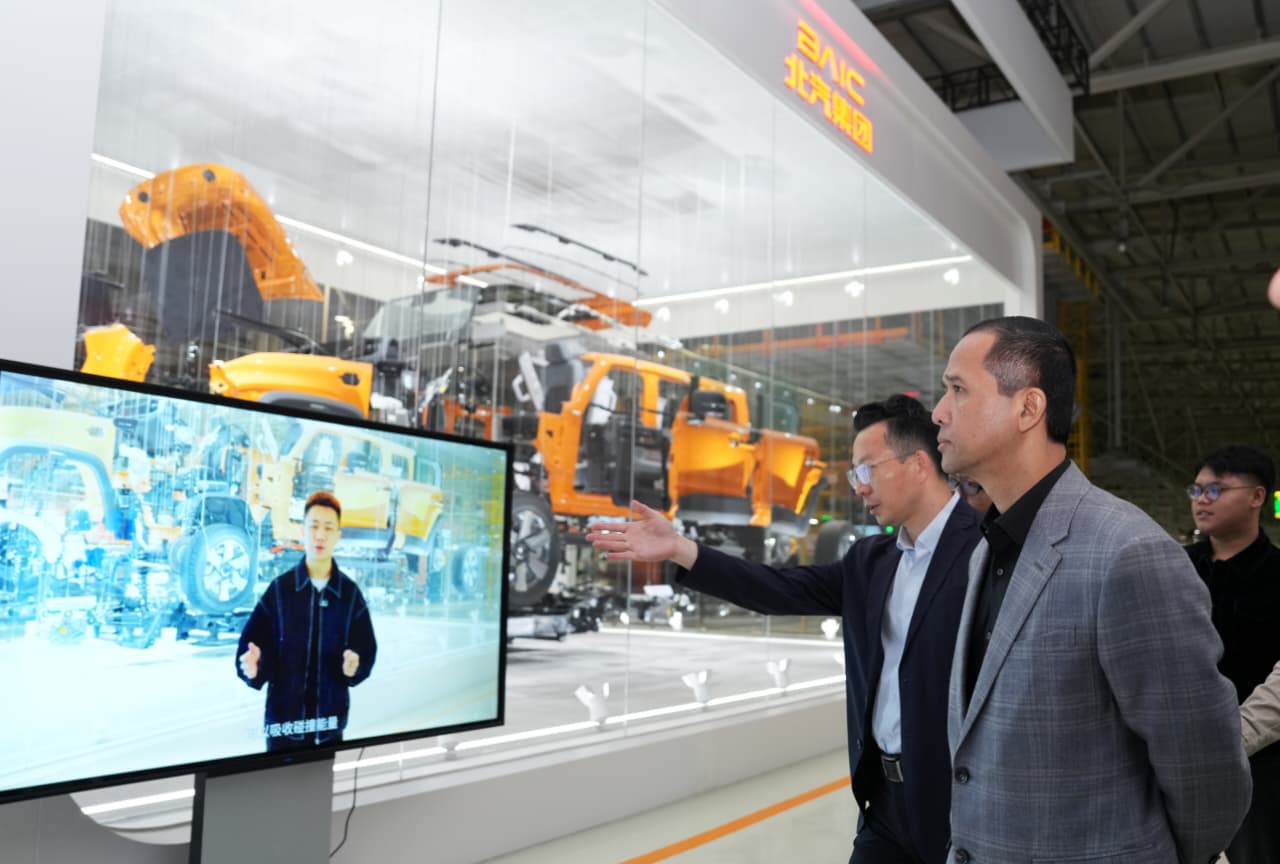
That process drew the attention of Transmigration Minister M. Iftitah Sulaiman Suryanagara during a visit to Beijing Automotive Group (BAIC Group), one of China’s major automotive companies, in Beijing on Tuesday (13 October).
“I am interested not in the products, but in the process,” Iftitah said.
He said the most important lesson for Indonesia was not simply how a company produces high-quality vehicles, but how industrial capabilities are built, developed and strengthened until they can compete.
Iftitah sees BAIC’s experience as relevant to Indonesia’s efforts to develop industry and new economic growth centres, including through the transformation of transmigration areas.
“First, they are people-oriented. That is why they invest heavily in human resources. That is the first lesson I have taken away,” he said.
Iftitah said industrial development must begin with developing people. Machinery, factories and capital are important, but the capabilities of workers, engineers, researchers and industrial managers are the foundations that determine sustainability and competitiveness.
For this reason, the development of industrial areas in Indonesia needs to go hand in hand with education, training, research and preparing workers to meet businesses’ needs.
Learning from global collaboration
Another aspect of BAIC’s experience that attracted Iftitah’s attention was its openness to international collaboration. During its development, BAIC formed partnerships with several global automotive companies, including South Korea’s Hyundai and Germany’s Mercedes-Benz.
These partnerships have contributed to the company’s development of production capabilities, technology, management and industrial networks.
Iftitah said this experience showed that national industry did not have to develop every capability independently from the outset. Working with partners that already have technology and experience can accelerate learning, improve workers’ skills and strengthen domestic industry.
“Nothing can be built overnight. It took them decades, but at a certain point there will be an acceleration,” he said.
Iftitah said the process offered important lessons for Indonesia. Successful industrialisation requires consistent policies, long-term investment, a willingness to build partnerships, and a firm commitment to developing science and technology. The progress visible today is the result of capabilities built gradually over many years.
Industry requires more than factories
Iftitah also focused on the industrial ecosystem that has grown around automotive companies such as BAIC. A large industrial company does not operate alone. Its production depends on networks of component suppliers, supporting businesses, research institutions, specialists, logistics systems and expanding markets.
When such an ecosystem takes shape, the economic opportunities can benefit not only the lead company but also a range of supporting businesses.
“If we invest in research and the ecosystem is established, others will not have to start from zero,” Iftitah said.
He said this lesson was highly relevant to the transformation of transmigration, which is now aimed at creating new economic growth centres outside Java.
Transmigration areas need more than land and natural resources. They also require industry, technology, infrastructure, skilled workers and business networks capable of turning local potential into higher-value products.
Industrial development is expected to create formal jobs, strengthen local businesses and raise household incomes. In this way, investment can do more than generate production: it can also build regional economic capacity sustainably.
Indonesia has a large market and industrial potential
During the visit, Iftitah also highlighted Indonesia’s large domestic market as an important asset for developing national industry. He said opportunities for industrialisation come not only from commodities and natural resources, but also from growing domestic demand.
The automotive sector, including electric vehicles, is one example of an industry that could be developed through technological expertise, international collaboration and the creation of supply chains.
“Demand for vehicles is also high, and perhaps electric vehicles will become dominant in the future. Why shouldn’t Indonesia build a similar industry, starting by learning about the process in China?” he said.
Iftitah said Indonesia should learn from countries that have successfully built industrial capabilities without necessarily copying their entire development models.
Every region in Indonesia has different potential and characteristics. Industrial development should therefore reflect local resources, market needs, infrastructure readiness and communities’ capabilities.
In the context of transmigration, lessons from BAIC could be applied to developing industrial ecosystems based on local strengths, from processing agricultural and plantation products to manufacturing and supporting businesses.
For Iftitah, establishing an economic growth centre cannot be measured simply by the arrival of investment or the construction of a factory. Success should be reflected in the growth of regional industrial capabilities, improved community skills, the development of local businesses, and the creation of more jobs and sources of income.
The BAIC visit was part of a series of working visits by the Ministry of Transmigration to China from 12 to 18 October 2026 to study the country’s experience in industrial development, technology and regional economic development.
The delegation was received by several BAIC Group officials, including Peng Jin, Director of the Strategic Customer Division; Jiang Dong, Deputy Director of the International Business Office; Sun Zhiyong, Vice President of BAIC International; and Li Jiayi, Country Manager for Indonesia.
Source: jawawa.id (https://jawawa.id/newsitem/learning-from-baic-iftitah-says-industrial-progress-is-built-on-investment-in-people-and-technology-1791996622)
Originally published by transmigrasi.go.id (https://www.transmigrasi.go.id/belajar-dari-baic-iftitah-kemajuan-industri-dibangun-dari-investasi-pada-manusia-dan-teknologi/), translated from Indonesian