
Leaking Pipes and Idle Water Systems Fuel Clean Water Crisis: AHY’s Plan
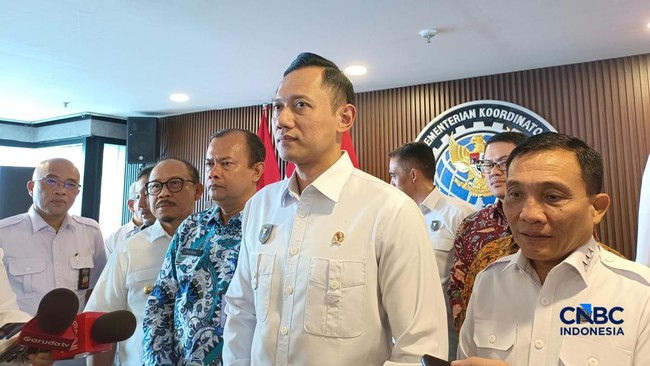
Jakarta, CNBC Indonesia — The government aims to reduce Indonesia’s non-revenue water (NRW) rate from 33% to 25% by 2029. One measure is to repair the networks of regional drinking water companies (PDAMs), which have been affected by leaks.
Earlier, Coordinating Minister for Infrastructure and Regional Development Agus Harimurti Yudhoyono (AHY) said that around a third of the water managed by PDAMs in Indonesia is lost before generating revenue.
“One-third of PDAM water is lost. This is what is often called non-revenue water. It reaches 33%,” AHY said at the National Water Self-Sufficiency Coordination Meeting at his office in Jakarta on Thursday (15 October 2026).
NRW refers to water that has been produced and distributed but does not generate revenue for the service provider. This is one of the challenges facing the government in ensuring access to clean water for the public.
In response, Nazib Faizal, Deputy for Basic Infrastructure Coordination at the Coordinating Ministry for Infrastructure and Regional Development, said the government had formed a task force to help reduce water losses.
“Many cases of NRW occur because a lot of pipes are leaking. The Coordinating Ministry for Infrastructure and Regional Development has formed a task force, which we lead,” Nazib said after the coordination meeting.
He said leaks were caused in part by ageing networks and physical damage to pipes.
“The pipes leak because they are old. And sometimes, because of the conditions, they can get buried or the pipes can break. That is the issue,” he said.
He explained that PDAMs are responsible for the pipe networks. The Coordinating Ministry for Infrastructure is encouraging local governments and PDAMs to speed up repairs through coordination and the task force.
Funding could come from PDAMs or investors, Nazib said. One possible arrangement is a performance-based contract, under which investors are paid according to results.
“In Bandung, for example, there is already an investor. It uses a performance-based contract. They are paid once the network no longer leaks. More or less, that is how it works,” he said.
Nazib acknowledged that water losses would need to be reduced gradually, as the government also had to consider other development priorities.
“There are other priorities, so it has to be done in stages,” he said.
The government has set a target of reducing water losses from the current 33% to 25% by 2029.
Many drinking water systems lie idle
As well as water losses during distribution, the government is focusing on drinking water supply systems (SPAM) that have been built but are not being used optimally.
AHY previously said that completed but non-operational SPAM facilities had a combined capacity of about 28,000 litres per second.
“SPAM systems have been built but are not operating. Their capacity is around 28,000 litres per second. They are built, but not operating,” AHY said.
Nazib said the situation is known as idle capacity: available capacity that is not being used to its full potential. One reason is that pipes connecting the system to residents’ homes have not been built or completed.
“It is called idle capacity. Sometimes, for example, the capacity is 10,000 litres. But because of a conflict with residents, the pipes to their homes cannot yet be built,” Nazib said.
He said water delivery problems are not always related to production capacity. Downstream obstacles, including permits for network installation and distribution constraints, can also prevent existing facilities from operating effectively.
The Coordinating Ministry for Infrastructure is currently compiling data on SPAM facilities with significant idle capacity to identify what action is needed, including possible network expansion and the search for investors.
“We are working on it. I am collecting data on which SPAM systems have substantial idle capacity. We are assessing what is needed. If a PDAM needs an expansion, we will find an investor,” he said.
He said the government was working with the Ministry of Public Works to speed up the response so that drinking water services could reach more households.
“The Coordinating Ministry is working to accelerate the response to idle capacity together with the Ministry of Public Works,” Nazib said.
Source: jawawa.id (https://jawawa.id/newsitem/leaking-pipes-and-idle-water-systems-fuel-clean-water-crisis-ahys-plan-1792068668)
Originally published by CNBC Indonesia (https://www.cnbcindonesia.com/news/20261015171647-4-776584/pipa-bocor-spam-nganggur-bikin-krisis-air-bersih-begini-rencana-ahy), translated from Indonesian