
LDII Yogyakarta's 8th Regional Conference Formulates Five-Year Agenda, Eight Service Programmes as Foundation
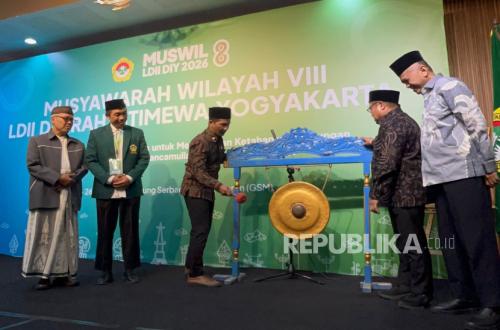
YOGYAKARTA – The eighth regional congress (Musyawarah Wilayah VIII) of the Indonesian Islamic Da’wah Institute (LDII) for the Special Region of Yogyakarta (DIY), held on Sunday (26/7/2026), was not merely a forum for electing new leadership, but also a moment to evaluate existing programmes and formulate LDII DIY’s strategic agenda for the next five years.
Atus Syahbudin, chair of LDII DIY’s regional board for 2021-2026, said the congress carried the theme “Strengthening Professional, Religious Human Resources to Realise Environmental and Cultural Resilience in Support of Pancamulia for the Special Region of Yogyakarta”. Discussions were directed at strengthening LDII’s contribution to regional development, DIY’s Pancamulia vision, and the realisation of a sustainable Golden Indonesia 2045.
“Through this congress, we hope to face the challenges of Golden Indonesia 2045, in connection with the DIY regional government’s Pancamulia programme. We will look at what we have already done, and then combine the SDGs, self-empowerment and global challenges with LDII’s eight fields of service to the nation,” Atus said in his address on Sunday (26/7/2026).
According to him, the challenges on the road to Golden Indonesia 2045 cannot be met with academic intelligence and technological capability alone. He said Indonesians need human resources with character, integrity, care for the environment, and the ability to preserve cultural values.
The various programmes implemented during his term of leadership will serve as a foundation for sharpening LDII DIY’s contribution over the next five years. The eight fields of service are: nationhood; religion and da’wah; education; the economy; herbal health; food security and the environment; digital technology; and new renewable energy.
In the field of nationhood, LDII DIY promotes strengthening national awareness through flag ceremonies, commemorations of Independence Day and Santri Day, the Prosecutor Enters the Pesantren programme, and communal work under the theme Working Together, Devotion to the Nation.
In religion and da’wah, the development of the next generation is carried out in stages, from kindergarten and primary school ages through Learning and Recitation Groups (KBM), Supplementary Religious Schools (MDT) and Qur’an Education Centres (TPA), up to pre-teens, teenagers, marriageable age and the elderly in nearly 500 taklim assemblies across DIY. Other programmes include Quranic study for the deaf community, end-of-year religious gatherings, crescent moon sighting training, da’wah training, and the development of Islamic boarding schools.
Education focuses on strengthening the quality of the younger generation through formal schooling and boarding-school-based character building. In the economy, LDII DIY promotes the strengthening of Sharia Savings and Financing Cooperatives (KSPPS), Baitul Maal wat Tamwil (BMT), and pesantren cooperatives as vehicles for entrepreneurial learning. Synergy with Bank Syariah Indonesia is also pursued to broaden sharia economic literacy and access.
Meanwhile, in herbal health, LDII DIY encourages public awareness of healthy living through health education, the use of herbal plants, and Free Health Check activities targeting various age groups, including the elderly.
A particularly strong contribution is made through food security and the environment. LDII DIY has developed the Kyai Care About Waste movement, the Grand Waste Alms event, and Waste Becomes Charity. Since 2023, 313 Mosque-Based Waste Alms Groups have been initiated.
Environmental programmes also include the construction of biopore infiltration holes, Jugangan Ing Omah (Jugangin Om) and Jugangan Ing Masjid (Jugangin Mas), which process organic waste into compost while improving groundwater absorption.
“Our environmental commitment is also realised through the development and intensive assistance of two Climate Village Programme (ProKlim) sites,” Atus said.
“We must bequeath this earth to our children and grandchildren in a better, greener, healthier state. Because there is only one earth. For that reason, mosques must be the base for carrying sustainability forward. The base is the mosque,” he said.
Meanwhile, in digital technology, LDII DIY has developed online Quranic study, training on the use of artificial intelligence for lecturers, and journalism training. These programmes aim to build people’s capacity to use technology productively and responsibly. In new renewable energy, LDII DIY promotes clean energy through the installation of solar-powered lamps at the Sangurejo Climate Village. In water conservation, LDII initiated the installation of collection tanks to harvest rainwater from the roof of the Mantrijeron multipurpose building.
Atus said these programmes will be sharpened in the five-year agenda ahead so that they connect ever more closely with government programmes and sustainable development goals.
“We will sharpen these over the next five years, so that the ideals we hold at the Indonesian Islamic Da’wah Institute connect with government programmes and also with the SDGs at the international level,” he said.
On the succession of leadership, he called for regeneration. “Every leader always has innovations. So give the younger ones a chance to step forward; let them create, let us appreciate them, and where things fall short we offer input, so they can run faster than those before them,” he said.
Meanwhile, the general chair of LDII’s central board, Dody Taufiq Wijaya, said strengthening the organisation at the grassroots level would be one of the challenges requiring attention over the next five years. He said the mentoring capacity of sub-branches at the kelurahan and village level, as well as branch development, needs continuous improvement so that organisational programmes can be implemented effectively.
“What matters most is that the outcomes of these programmes genuinely bring broad benefits to the surrounding community,” Dody said.
He also highlighted the challenge of information technology development for the younger generation. He said LDII will continue to strengthen the development of the next generation so they can resist negative influences in the digital space, including pornography and online gambling.
Dody said LDII, together with the Ministry of Communication and Digital Affairs, has conducted various healthy internet training sessions. The organisation also has norms and a code of conduct for social media use.
“The government is making efforts, and we as a religious mass organisation are also trying to protect our young generation from the negative influences brought about by information technology,” he said.
He said the regeneration agenda is also an important part of the organisation’s journey, stressing that leadership must not only create followers but must produce new leaders.
“Great leaders don’t create more followers. We create more leaders, not followers,” he said.
Singgih Januratmiko, deputy chair of the House of Representatives’ Commission VIII, who also attended the event, expressed hope that LDII DIY can broaden its contribution to society. He said religious organisations play an important role in nurturing the younger generation amid rapid technological development.
“We hope that going forward LDII DIY can contribute even more to the people of DIY, especially in Islamic matters, for the progress and welfare of the people of DIY in general,” he said.
Meanwhile, the head of the People’s Welfare Bureau at the DIY Regional Secretariat, H. Faishol Muslim, said the regional government cannot work alone in delivering services and development to the public. Collaboration with community organisations is therefore considered important.
He said LDII DIY’s various programmes align with DIY’s Pancamulia development vision, from Mulia Budaya (Noble Culture), Mulia Manusia (Noble People), Mulia Ekonomi (Noble Economy) and Mulia Lingkungan (Noble Environment) to Mulia Tata Kelola (Noble Governance). Going forward, the DIY regional government will continue to support LDII as a strategic partner of the government.
“We know LDII is very focused on environmental issues and on nurturing the young generation. So if we connect it with Pancamulia as DIY’s development vision—there is Noble Culture, Noble People, Noble Economy, Noble Environment, Noble Governance—it seems these are being and continue to be carried out by our friends at LDII,” he said.