
Layoffs Increase but Poverty Rate Declines: What's Going On?
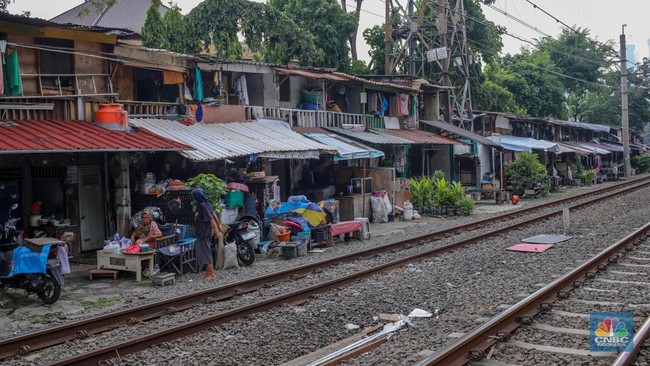
Jakarta, CNBC Indonesia - Indonesia’s poverty rate has continued to decline in recent years. Even as the number of layoffs (PHK) has surged.
According to data from the Ministry of Manpower (Menaker), the layoff rate in Indonesia reached 88,519 people in 2025. This figure is an increase of 10,554 people compared to the number of layoffs in 2024, which was 77,965 people.
Even compared to four years ago, the number of employees laid off reached 63,405 people, compared to the number of layoffs in 2022 at 25,114 employees.
On the other hand, Indonesia’s poverty rate has shown a downward trend over the past five years. According to the Central Statistics Agency (BPS), the number of poor people in Indonesia in September 2025 reached 23.36 million people, or a poor population percentage of 8.25%.
This number is a significant decrease compared to 2021, with the number of poor people at 26.50 million souls and a poor population percentage of 9.71%.
Director of Social Resilience Statistics Nurma Midayanti said that there is actually a contribution from layoffs to the poverty rate.
However, it also needs to be seen whether there are other sources of income for laid-off employees to survive temporarily, such as savings, severance pay, or other sources.
“So layoffs do actually pose a risk related to poverty, but we also need to see that when someone is laid off, do they have other sources, for example, if they still have savings or receive severance pay, so for a while they might still be able to hold on. Because what we emphasise in calculating poverty is more about consumption,” she said during a workshop titled Utilisation of Strategic BPS Data, at the BPS Central Office, Jakarta on Tuesday (21/4/2026).
Nurma reiterated that there is an influence from the layoffs that occur, but the effect is small on the poverty rate.
“So when they are laid off, the direct impact on poverty is not too strong,” she said.
Nurma added that if the laid-off employees can no longer earn income, thus affecting consumption over the long term, this will increase the potential to fall into poverty.
“But when they have no other sources and can’t eat much, so it decreases, purchases for non-food items decrease, because they’ve been laid off for a year or so, that’s the potential to fall into poverty,” she added.