
Lawyer: Asset Forfeiture Bill Aims to Make Corruptors Poor
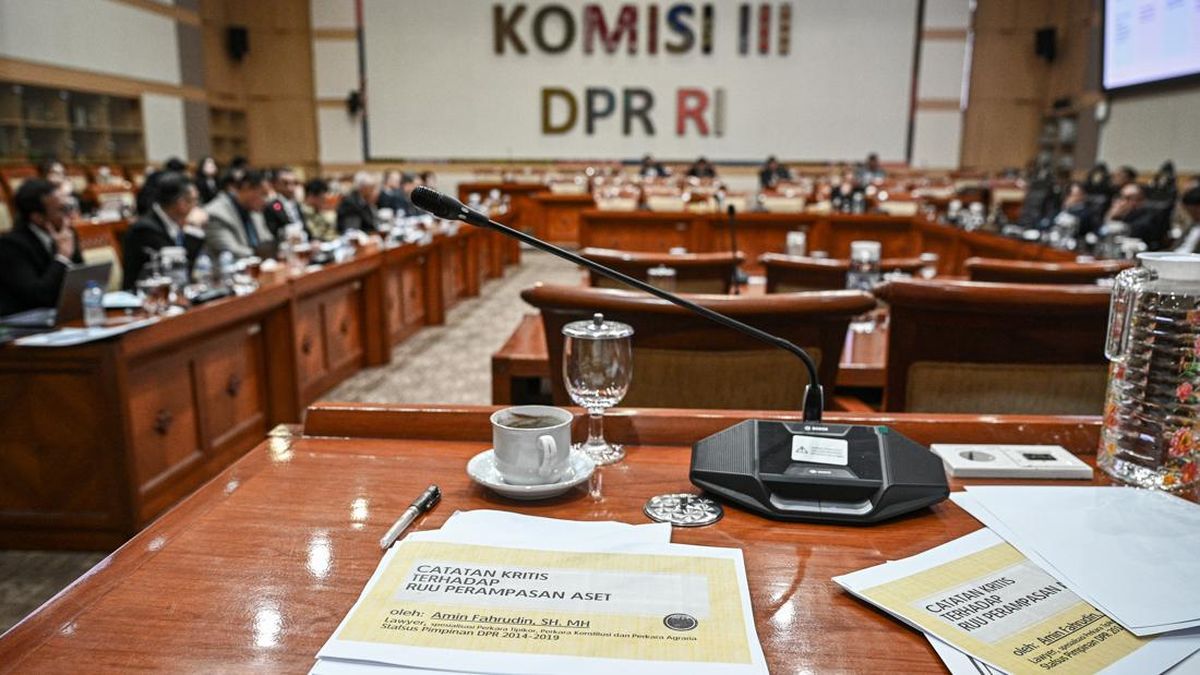
Lawyer Amin Fahrudin said the Asset Forfeiture Bill sends the public a message that corruptors should indeed be made poor.
He made the remarks at a public hearing with House of Representatives Commission III on Wednesday (28 October).
“Whose fault is it that you committed corruption? You deserve to be made poor. This must be the message to the public: the Asset Forfeiture Bill aims to impoverish corruptors,” Amin told Commission III’s leaders at the parliamentary complex in Senayan, Jakarta.
Corruption is one of 13 offences covered by the bill. Amin said that if the legislation were implemented seriously, professionally and consistently, it could deter corruptors.
“After all that effort to commit corruption, it turns out that the amount you have to return to the state is just as much,” he said.
Amin added that proper implementation of the bill would also deter people from engaging in corruption.
“They will think a thousand times, sir, because if they do it, not only assets directly connected to the crime will be seized and transferred to the state, but also tainted assets,” he said.
Under the Non-Conviction Based (NCB) concept discussed in the bill, assets tainted by a corruptor’s actions could also be seized, Amin said.
“Under the NCB concept, it is not only the proceeds or instrumentalities of the crime, but also tainted assets. And the question of what is tainted is subjective,” he said.
Amin said he had proposed that NCB asset forfeiture under the bill should be based on criminal proceedings.
According to the Finance Ministry’s website, Non-Conviction Based (NCB) refers to in rem asset forfeiture, or the forfeiture of assets without a criminal conviction. The term was formally introduced by the United Nations Convention against Corruption (UNCAC).
Amin argued, however, that the NCB concept should be accompanied by criminal proceedings. This would help prevent politicisation by ensuring that the person whose assets are seized has actually committed a criminal offence.
“That is why I believe that, even if NCB is applied under this bill, it should be based on criminal proceedings. As I said earlier, the formal elements of the offences should be set out in a restrictive manner. I agree with that; it is very appropriate, so the system does not become arbitrary. The targets cannot be politicised because the basis is culpability and the commission of a criminal offence,” Amin said.
He said the NCB concept could also address inconsistencies in asset seizures. As an example, he cited corruption at state insurer PT Asuransi Jiwasraya, where a Supreme Audit Agency (BPK) audit report put state losses at Rp22.7 trillion. After the criminal verdicts, however, only Rp18 trillion was ordered to be repaid.
“That means a difference of around Rp4.7 trillion,” Amin said.
He also cited corruption cases involving the electronic identity card (e-KTP) project and Garuda Indonesia, saying they showed a disparity between the amounts embezzled and the amounts recovered.
“Taken together, these three cases alone involve nearly Rp15 trillion. That could be pursued through the NCB instrument,” he said.
Amin added that if the value of seized assets came close to the actual losses, punishment would be more effective.
“If the state seizes assets worth the same as, or close to, the losses, then the purpose of punishment becomes effective. But if Rp10 trillion is embezzled and only Rp1 trillion is seized, that is ineffective. The state is still losing Rp9 trillion,” he said.
Amin also questioned how offences other than corruption would be measured under the bill.
He said the State Officials’ Wealth Report (LHKPN) could be used as a benchmark in corruption cases, but that there was no definitive measure for other offences.
“In corruption cases, the LHKPN might serve as a basis for applying limited illicit-enrichment provisions and a balanced burden of proof. But for the other 12 offences covered by the bill, how would they be measured?” Amin asked at the public hearing with Commission III at the parliamentary complex on Wednesday.
He explained that the LHKPN could help law-enforcement authorities assess the wealth of state officials and calculate state losses.
For example, an official might currently have assets worth Rp10 billion. Five years later, after taking a new position, the official’s LHKPN might show assets of Rp100 billion. If legitimate income, inheritance, gifts and other sources were taken into account, the official should have only Rp20 billion.
“How should the remaining Rp70 billion be accounted for? In corruption cases, that calculation can be made using the LHKPN,” Amin said.
For other offences, however, he said it would be extremely difficult to establish a clear benchmark for asset forfeiture.
Amin cited illegal logging and illegal fishing as offences covered by the bill, noting that they were often based around business operators rather than state officials.
“Take illegal fishing and illegal logging, which are based around business operators and have nothing to do with officials,” he said.
He also questioned how assets connected to narcotics offences could be assessed.
“How can the legality of narcotics trading be requested when the goods themselves are illicit? How can that be measured?” he said.
The House of Representatives has said the Asset Forfeiture Bill covers 13 offences: corruption; narcotics and psychotropic substances; terrorism; human smuggling; arms, ammunition and hazardous-material smuggling; forestry offences; environmental offences; tax offences; banking offences; insurance offences; mining offences; maritime and fisheries offences; and human trafficking.
Source: jawawa.id (https://jawawa.id/newsitem/lawyer-asset-forfeiture-bill-aims-to-make-corruptors-poor-1793226055)
Originally published by CNN Indonesia (https://www.cnnindonesia.com/nasional/20261028223530-12-1420780/advokat-ruu-perampasan-aset-untuk-miskinkan-koruptor), translated from Indonesian