
Law Minister: As Technology Advances, Journalistic Work Must Be Protected
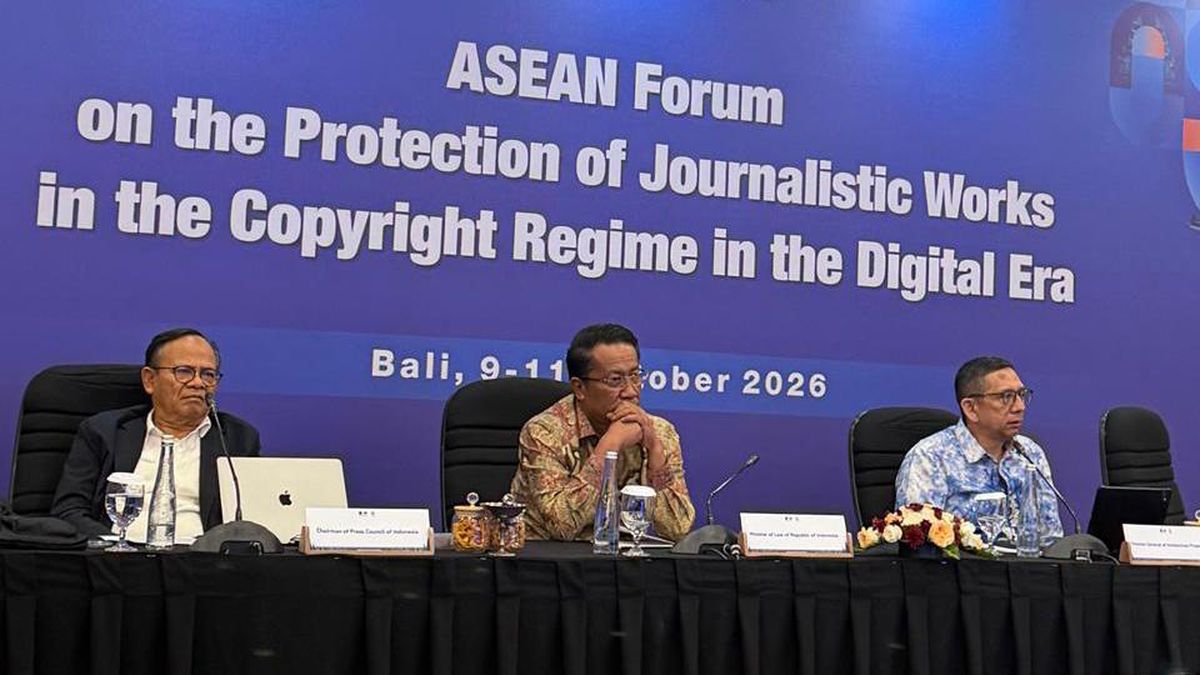
Law Minister Supratman Andi Agtas said the development of digital technology must go hand in hand with copyright protection and fair recognition of journalistic work.
He made the remarks at the ASEAN Forum on the Protection of Journalistic Works in the Copyright Regime in the Digital Era, held at The Patra Hotel in Bali on Saturday (10 October).
Supratman said journalists and media organisations needed legal certainty and a fair economic return from the work they produce.
“Technology must advance, but technological development must not make the value of human work increasingly invisible,” Supratman said in his address.
He explained that journalistic work can now be produced and disseminated instantly, reaching audiences across national borders. This creates challenges in ensuring that the use, distribution and commercial exploitation of such work continue to respect the rights of those who created it.
The minister stressed that protecting journalistic work is not only a matter of economic rights, but also of sustaining the information ecosystem, the quality of democracy, and public access to accurate and reliable information.
“In the ASEAN context, the challenge is more complex. Journalistic work is no longer confined by national borders,” he said.
To address these challenges, Indonesia is pushing for stronger regional cooperation in three key areas: transparency in the use of works, fair and proportionate remuneration, and interoperability of data and cross-border rights-management systems.
These efforts are needed to ensure that the use of journalistic work across different jurisdictions is managed more transparently and provides certainty for rights holders.
Meanwhile, Press Council Chairman Komaruddin Hidayat highlighted the unequal distribution of economic value in the digital ecosystem.
He said digital platforms derive substantial benefits from public attention, data and advertising revenue generated through content distribution, while the journalists and media organisations producing that content do not necessarily receive a commensurate share.
“It is deeply troubling when people who investigate reality receive no fair compensation for the reality they produce, while those who distribute, collect and monetise that work receive a disproportionate share of its economic value,” Komaruddin said.
He said the issue was not purely economic, but also concerned the ethics and sustainability of journalism. If journalistic work lacks a sound economic foundation, the media’s ability to serve the public and support democracy could also be affected.
Komaruddin also raised concerns about the use of journalistic work to develop artificial intelligence (AI).
AI can summarise, translate and recommend material, as well as generate content, by drawing on human intellectual work accumulated over many years.
Fifi Aleyda Yahya, Director General of Public Communication and Media at the Ministry of Communication and Digital Affairs, said it was important to ensure that digital platforms and AI systems respect rights in journalistic work and provide clarity about information sources.
Fifi said the rise of generative AI presented new challenges, as journalistic work could be used through crawling, scraping and data processing to develop AI systems.
“Technological developments, including artificial intelligence, create new opportunities, but also raise questions about recognition, protection and fair reward for journalists and media organisations,” Fifi said.
She added that policies to protect journalistic work needed to balance the rights of creators and rights holders with freedom of expression and the public interest.
In Indonesia, copyright protection operates alongside Presidential Regulation No. 32 of 2024 on the Responsibility of Digital Platform Companies to Support Quality Journalism.
Hermansyah Siregar, Director General of Intellectual Property, said the Bali forum provided a space to discuss policy options for protecting journalistic work under copyright law, including related rights for press publishers and the challenges of its use by digital platforms and AI.
The forum, held from 9 to 11 October 2026, was attended by 45 participants, including representatives of press councils and media editors from Indonesia and several ASEAN countries, academics and intellectual property law experts.
“We hope discussions with stakeholders across ASEAN will broaden perspectives on the legal status and practical protection of journalistic work, and help inform stronger policies in the future,” Hermansyah said.