
Laut Bercerita: Keeping Alive the Memory of a Dark Chapter under the New Order
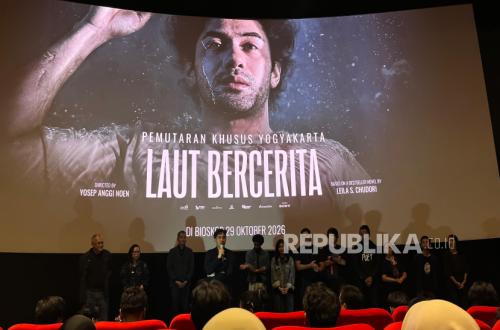
YOGYAKARTA — The film Laut Bercerita is one effort to preserve collective memory of Indonesia’s dark political climate under the New Order, particularly the enforced disappearances of activists in the period leading up to the 1998 Reformasi. Adapted from Leila S. Chudori’s novel and directed by Yosep Anggi Noen, the film depicts young people’s struggle to speak out against injustice, as well as the experience of families who lost loved ones through state repression.
The story begins with the concerns of young people in the 1980s and 1990s about injustice, corruption and government secrecy. Their efforts to organise, voice criticism and campaign for change came with the risk of arrest and enforced disappearance.
The film, however, is not only about activism and political repression. It also unfolds from the perspective of families who continue searching for missing relatives.
“So this is really a family story. A family that lost its child during the New Order,” said the film’s director, Yosep Anggi Noen, on Friday (23 October 2026).
Anggi said adapting the novel for film required a different approach because the two media have distinct characteristics. He opted for a linear narrative to make the story easier for audiences to follow, although the original novel moves back and forth in time.
“For the adaptation, we wanted to make it a little more accessible to audiences,” he said.
He explained that several scenes were also developed to clarify the historical context behind the story. One is a scene depicting young people demonstrating in the 1990s to protest a court ruling that sentenced someone to eight years in prison for reading a book by Pramoedya Ananta Toer.
“We added and emphasised certain things to show the context,” he said.
“This film is a collective effort to preserve historical memory,” Anggi said.
Producer Budi Setyarso said using film as a storytelling medium was part of an effort to voice values that could help make Indonesia better. Film, he said, has the power of visual language and the shared viewing experience, which can make a story feel more real to audiences.
“What does a better Indonesia mean? An Indonesia that never violates the human rights of its citizens, does not tolerate corruption and respects one another,” Budi said.
Laut Bercerita is intended not only to invite audiences to look back at past events, but also to offer lessons so that the fate of the activists who disappeared is not repeated.
“What matters more is how we respond, so that what happened to the friends depicted in Laut Bercerita does not happen again in the future,” he said.
Reza Rahadian, who plays Biru Laut, said the film carries the spirit of young people striving to express their concerns and fight for justice. The characters’ struggle, he said, can remind today’s generation that the freedom to express opinions must continue to be protected.
“I hope it continues to inspire people to think, ‘Yes, today we actually have many more platforms on which to speak out,’” Reza said.
He also emphasised the importance of keeping alive the memory of the enforced disappearance of activists. The events depicted in the film, he said, did not happen so long ago. Although pressure on freedom of expression may have changed in form, vigilance against repression remains necessary.
“It is a history that we hope will not be repeated, even if the forms of repression or pressure today may have changed,” he said.
Dian Sastrowardoyo, who plays Kasih Kinan, highlighted the role of women in activism in the period leading up to the 1998 Reformasi. Through research and meetings with women activists, she learned that Kinan’s character was inspired by several real people involved in the student movement at the time.
Dian said the women activists played an important role in planning the movement and maintaining solidarity among those fighting for justice. Through Kinan, she sought to portray a woman who puts the collective struggle before personal interests and considers the safety of her fellow activists.
“They didn’t have time to think about love or who they fancied. They seemed to devote their lives entirely to fighting for justice,” Dian said.
Ben Nugroho, who plays Alex, said taking part in the film deepened his understanding of the events of 1998 and the experiences of their victims. Before joining the production, he knew about the events but had not understood them in detail.
“Being involved in this film was eye-opening. I learned more about the details, especially when I met the activists,” Ben said.
He also developed his understanding of Alex through the novel and discussions with several former activists. His background in photography helped him understand the perspective of documentation and the experience of photographing demonstrations.
Kevin Julio, who plays Daniel, similarly highlighted the values of solidarity and friendship at the heart of the story. The characters’ struggle, he said, shows the importance of standing together in the effort to bring about change.
“I don’t think there’s anything wrong with that. It’s the most important lesson in this film,” Kevin said.
Ultimately, preserving memory is vital to understanding history and preventing human rights violations from happening again. Nearly three decades after the 1998 Reformasi, Laut Bercerita reminds audiences that the struggle for justice and freedom of expression remains relevant to today’s generation.
Source: jawawa.id (https://jawawa.id/newsitem/laut-bercerita-keeping-alive-the-memory-of-a-dark-chapter-under-the-new-order-1792849861)
Originally published by Republika (https://rejogja.republika.co.id/berita/tnewk0291/laut-bercerita-upaya-merawat-ingatan-sejarah-kelam-pada-masa-orde-baru), translated from Indonesian