
Launching Katalis 2.0, Indonesia-Australia Expand Multisector Cooperation
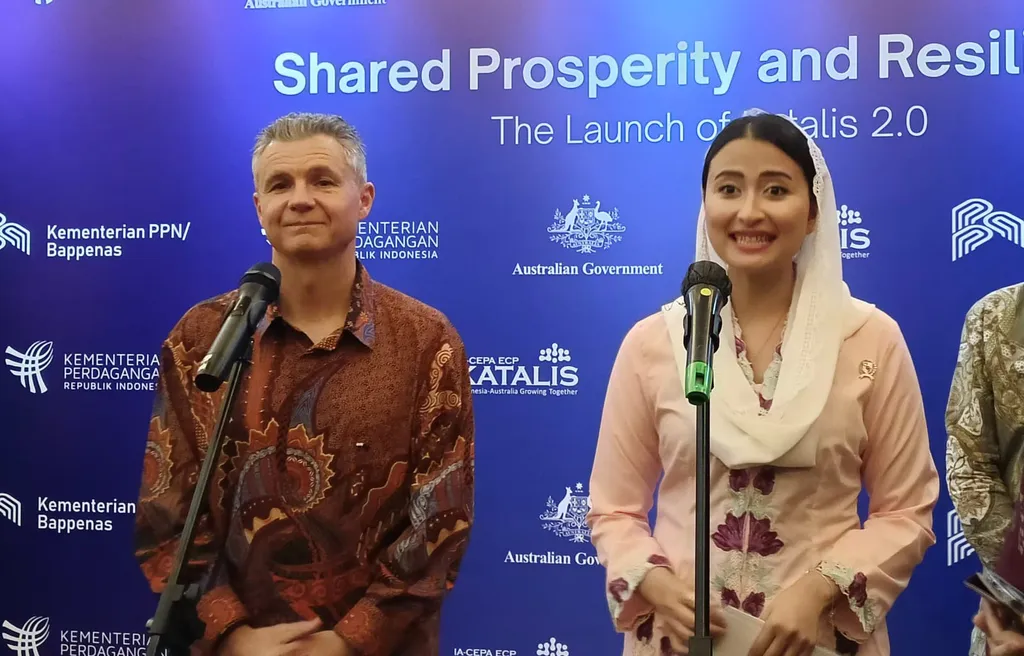
Building on the success of the first phase, the Katalis 2.0 programme will expand trade and investment opportunities and promote inclusive economic growth. Indonesia and Australia have launched the Katalis 2.0 programme to implement the two countries’ comprehensive cooperation agreement, or IA-CEPA. The second phase of the programme has the potential to broaden multisector cooperation between the two countries, such as trade in goods and services, investment, health, education, and strengthening SMEs to penetrate export markets. The launch of the Katalis 2.0 programme is a continuation of the Katalis 1.0 programme, which ran for five years from 2021 to the end of 2025. The programme is designed to strengthen the implementation of the IA-CEPA (Indonesia-Australia Comprehensive Economic Partnership Agreement). The scope of cooperation includes improving market access, developing workforce skills, and strengthening cooperation in strategic sectors such as agri-food, health services, digital services, tourism, advanced manufacturing, and economic development. Australia’s Assistant Minister for Foreign Affairs and Trade, Tim Watts, stated on Monday that under the Katalis 2.0 programme, the Australian Government is allocating more than US$33 million in new funding to strengthen inter-institutional relations. Part of the funds will be used to enhance Indonesian language skills and understanding of Indonesia in Australia. Watts said the Australian Government will fund US$40 million in the new Katalis 2.0 phase to build new business opportunities that previously developed under Katalis 1.0. An independent Australian Government evaluation of Katalis 1.0 showed the programme successfully strengthened bilateral trade and investment relations between the two countries. ‘We want to expand the range of industries and businesses that can benefit from this programme,’ Watts said at the launch of the Katalis 2.0 programme in Jakarta. Building on the success of the first phase, the Katalis 2.0 programme will expand trade and investment opportunities, strengthen institutional presence and governance, and encourage broader and more inclusive participation in economic growth, including for women and underrepresented groups. Deputy Minister of Trade Dyah Roro Esti Widya Putri, who attended the same event, said that since coming into force on 5 July 2020, the implementation of IA-CEPA has boosted trade relations between the two countries. The value of Indonesia-Australia trade rose from around US$7.2 billion in 2020 to approximately US$13 billion in 2025. ‘We are currently reviewing the IA-CEPA to identify other sectors where collaboration needs to be enhanced in the future so that the utilisation of this agreement becomes more optimal,’ Roro said. According to Roro, one sector of focus is education. The presence of Australian universities opening campuses in Indonesia is seen as expanding public access to international standard education without having to study abroad. In addition to education, the two countries are also discussing strengthening cooperation in the services sector, especially health services. The government hopes this collaboration will not only open job opportunities for Indonesian health workers but also encourage knowledge transfer and competency improvement through various training programmes. The government is also placing SMEs as a main focus of cooperation. Roro said the SME sector contributes more than 60 per cent to Indonesia’s gross domestic product (GDP), so increasing the capacity of business actors is important to enable them to utilise the export opportunities opened through IA-CEPA. Furthermore, strengthening cooperation is also directed at developing Indonesian human resources to meet the needs of the Australian labour market, particularly in the services sector. One example deemed successful is the export of premium Indonesian chocolate products to Australia. According to Roro, the success of cocoa downstream processing can serve as a model for developing other SME products. ‘Indonesia is no longer just exporting raw materials, but also value-added products. The success of this premium chocolate product needs to be expanded to other commodities,’ she said. Through Katalis 2.0, Indonesia and Australia will leverage the experience of the first phase to broaden the scope of collaboration amidst changes in global supply chains, digital transformation, and increasing global economic uncertainty. Based on data from the Ministry of Trade, in the 2021-2025 period, the non-oil and gas trade trend between Indonesia and Australia grew by 2.88 per cent. Total trade between the two countries in 2021 and 2025, for example, was valued at US$11.46 billion and US$12.25 billion, respectively. During the same period, Indonesia experienced a trade deficit with Australia. Indonesia’s trade deficit with Australia in 2021, 2022, 2023, 2024, and 2025 was US$5.47 billion, US$6.00 billion, US$5.75 billion, US$4.76 billion, and US$4.87 billion, respectively. Meanwhile, Deputy for Macro Development at the Ministry of National Development Planning/Bappenas Eka Chandra Buana said economic transformation is a main agenda in the 2025-2029 National Medium-Term Development Plan (RPJMN) as part of the long-term vision of Golden Indonesia 2045. ‘Economic transformation must be carried out through higher productivity, strengthening industrial capacity, downstream processing that generates added value, innovation through research and development, and investment.’