
Latest Updates on the Mekarsari-Cileungsi Skytrain Project
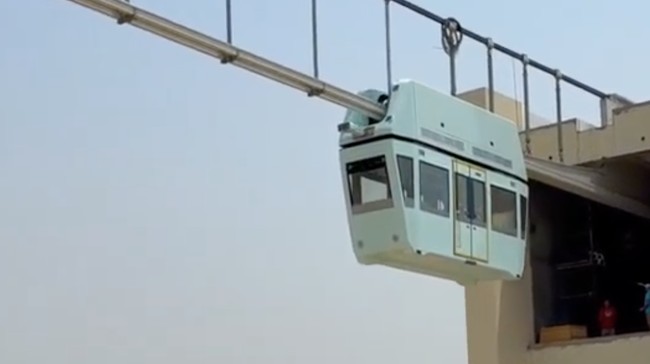
The Ministry of Transport (Kemenhub) is currently assessing the use of motorised cable cars, known as Skytrain, as an alternative mode of urban transport. This mode is being considered to support connectivity as a feeder for mass transit systems such as the LRT and MRT.
Risal Wasal, Director General of Transport Integration and Multimoda (Intram) at the Ministry of Transport, explained that the Skytrain under study differs from cable cars typically used for tourism. This mode utilises engines similar to trains, allowing it to operate as public transport.
“There is something being further researched called the Skytrain Suspended Train. This is a cable car, but with a train engine. It is not like those in Ancol or Taman Mini that are pulled; this one operates via an engine,” he stated during the Transport Journalists Forum Workshop on Friday (2/10/2026).
One of the considerations in studying this mode is the need for urban transport with more affordable construction and operational costs. The Ministry of Transport is also considering concession periods and the operational costs that must be borne after the construction phase.
“The construction cost is only Rp320 billion per kilometre, which includes the rolling stock, infrastructure, and systems,” he said.
As an example, the Ministry is studying the use of this mode as an LRT or MRT feeder to serve urban areas. One specific example mentioned is the connectivity from the Mekarsari area to Cileungsi. In the scheme being studied, the Skytrain could operate with a headway of approximately five to seven minutes, with an estimated capacity of around 200 passengers per train set.
“For example, for a train like this that we are preparing as an LRT or MRT feeder from Mekarsari to Cileungsi, with a headway of 5 to 7 minutes, the capacity is 200 per train,” he said.
From an operational perspective, the results of the study presented by the Ministry of Transport also estimate an annual operational cost of approximately Rp32 billion for a service with a seven-minute headway.
“For a 7-minute headway, the annual operational cost is only Rp32 billion, according to the study results,” he added.
Regarding construction, the Ministry of Transport noted that, based on initial calculations, the mode could be built in approximately one year. However, all figures are still part of the study and have not yet reached a final decision regarding the implementation of the mode.
In addition to costs, safety aspects and technical standards are also being considered. The Ministry of Transport stated that the mode under study must adhere to the standards set by the Directorate General of Railways (DJKA).
“We have chosen to follow the standards prepared by the DJKA,” he said.
He noted that the Skytrain technology being studied is not entirely new. Similar modes are reported to be operational in several countries, which serves as a key consideration in the Ministry’s study.
“It is proven; it has been tested and is operating in five countries. Simply put, it is already operational in five countries,” he concluded.