
Latest News: The Fate of Honorary and PPPK Teachers to Be Regulated in the National Education System Bill
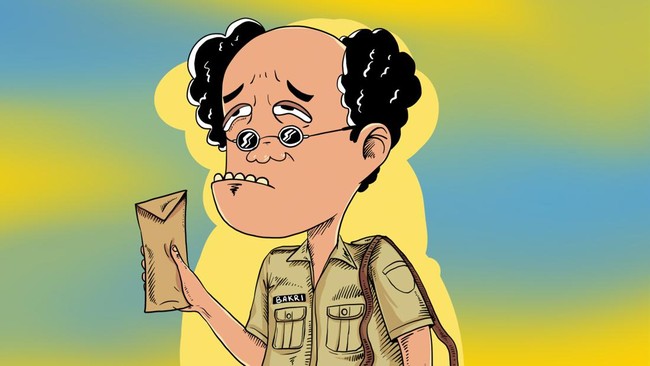
Latest news: the fate of non-civil servant teachers will be regulated in the National Education System Bill (RUU Sisdiknas).
Jakarta, CNBC Indonesia – The welfare of non-civil servant teachers, including honorary, private and madrasah teachers, is set to receive attention in the revision of the Law on the National Education System (RUU Sisdiknas).
Commission X of the House of Representatives (DPR RI) and the Working Committee (Panja) for the RUU Sisdiknas have agreed on the need to include provisions on a minimum wage standard for non-civil servant teachers in the main body of the bill.
The provisions are intended to ensure teachers earn a decent income and to reduce income inequality, particularly for non-civil servant teachers who have long received low pay.
Deputy Chair of Commission X, Lalu Hadrian Irfani, said the public aspirations on teacher welfare raised by civil society in a public hearing (RDPU) would be considered in deliberations on the bill.
He said the lower limit of teacher income needed to be stated explicitly in the articles of the bill.
“Today’s input is truly excellent. This is an additional consideration for us in deciding policy in the revision of the law. Teacher welfare is included, and it is high time we considered it. The input from our colleagues must be written into the articles,” Lalu said after chairing the RDPU of Commission X with civil society organisations at Gedung Nusantara I, Parliamentary Complex, Senayan, Jakarta, as cited from the DPR website, on Thursday (8 October 2026).
He stressed that Commission X, through the Panja for the RUU Sisdiknas, had agreed on the principle of setting a minimum wage standard. However, the nominal amount is still under discussion and technical calculation.
“We in principle also agree that Commission X, through this Panja, will write this into the main body. How much it should be is still being calculated,” he said.
Lalu added that the provision was expected to prevent teachers from earning very low incomes.
“And since we have all agreed, it will likely be locked in there so that no teacher of ours earns Rp100,000, Rp250,000, Rp500,000, and so on,” he stressed.
Private Schools in the Spotlight
Teacher welfare was one of the main aspirations raised at the Commission X public hearing.
Satriwan Salim, national coordinator of the Association for Education and Teachers (P2G), said there remained serious problems with the income of private school teachers. Based on data presented at the hearing, around 83.5% of private school teachers still earn less than Rp2 million a month.
In light of this, P2G, together with the Indonesian Education Monitoring Network (JPPI) and the Indonesian Private School Staff Association (PERISAI), has urged the RUU Sisdiknas to set a minimum salary standard for non-civil servant teachers referenced to the Provincial Minimum Wage (UMP) or the District/City Minimum Wage (UMK).
Beyond salaries, the position of madrasahs has also drawn attention. JPPI noted that around 95.4% of madrasah institutions are run by communities or private entities, meaning that financing and governance aspects need attention in the revision of the law.
Teacher Governance to Be Unified
Commission X also supports the proposal to establish a National Teacher Management Agency (BPGN).
Lalu said the body was expected to unify teacher governance and reduce overlapping authority among the central government, regional governments, and the ministries responsible for general education and madrasahs.
“The idea actually originated with Commission X. I myself voiced that there should be no overlap in authority, no differences in treatment, and no differences in rights and obligations, so that there is no inequality, whether under the Basic and Secondary Education Directorate or the Ministry of Religious Affairs,” he explained.
Commission X has also highlighted the impact of recruitment policies for Government Employees with Work Agreements (PPPK) on private schools.
Concern has arisen that efforts to meet teacher needs through PPPK recruitment could prompt teachers to move from private schools to state schools.
Lalu affirmed that private schools must remain an important part of the national education ecosystem.
“I and my colleagues in Commission X guarantee that this will not happen. We know that education is provided not only by the government but also by the community. These must go hand in hand, and there should be no inequality,” he said.
He added that arrangements for teacher welfare and the governance of educators in the RUU Sisdiknas must continue to take into account the sustainability of community-run schools.
Source: jawawa.id (https://jawawa.id/newsitem/latest-news-the-fate-of-honorary-and-pppk-teachers-to-be-regulated-in-the-national-education-system-bill-1791431569)
Originally published by CNBC Indonesia (https://www.cnbcindonesia.com/news/20261008082725-4-774275/kabar-terbaru-nasib-guru-honorer-pppk-bakal-diatur-di-ruu-sisdiknas), translated from Indonesian