
Latest Data on Civil Servant Teachers: 2.33 Million People, Majority Are Permanent Civil Servants
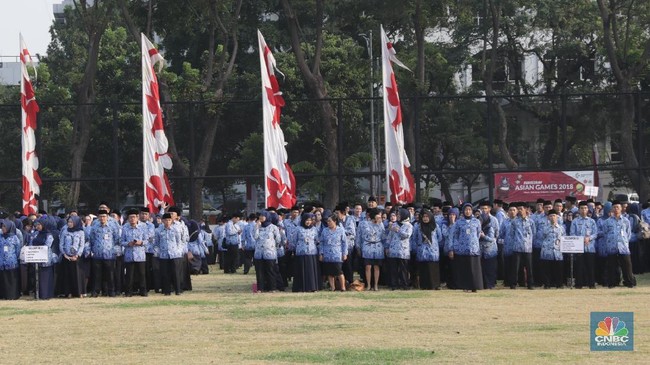
The number of civil servants (ASN) working as teachers stood at 2.33 million as of 30 June 2026, according to the latest data from the National Civil Service Agency (BKN).
The majority of civil servant teachers come from the permanent civil servant (PNS) formation, totalling 1.10 million people, or 47% of the total 2.33 million.
The remainder come from the government employee with work agreement (PPPK) formation, comprising 988,000 people or 42%, and part-time PPPK at 241,600, equivalent to 11%.
“Within the PPPK category, teachers dominate the position composition in line with the policy priority of PPPK teacher recruitment to meet the needs of the education sector,” as quoted from the BKN’s 2026 Semester I ASN Statistics Book, published on Friday (21/8/2026).
By gender, 68% of civil servant teachers are women, totalling 1.58 million people. The remainder are men, accounting for 32% or 744,700 people.
In terms of age, 55% are millennials or Generation Y, numbering 1.288 million people. Generation X follows at 39% or 905,400 people, Generation Z at 5.9% or 135,100, and Baby Boomers at 0.1%, equivalent to 1,958 people.
Some 92% of these teachers are under regional government administration, totalling 2.15 million people. Only 8% are under central government administration, or 177,200 people.
Some 99% of civil servant teachers hold functional positions, consisting of 1.10 million PNS, 959,600 PPPK, and 241,600 part-time PPPK. The remaining 1% are teacher implementers, dominated by PPPK at 28,432 people.
The highest educational attainment of these civil servant teachers is a bachelor’s degree (DIV/S1), held by 2.18 million people. Master’s degree (S2) holders account for 5%, or 108,000 people.
Diploma (DI-DIII) graduates number 20,700 people, or 1%, while primary to senior secondary school (SD-SMA) graduates total 17,400 people. Some 0.1%, or 1,100 people, hold doctoral degrees (S3).