
LaNyalla Earns Doctorate in Law and Proposes Independent Candidates for the House of Representatives
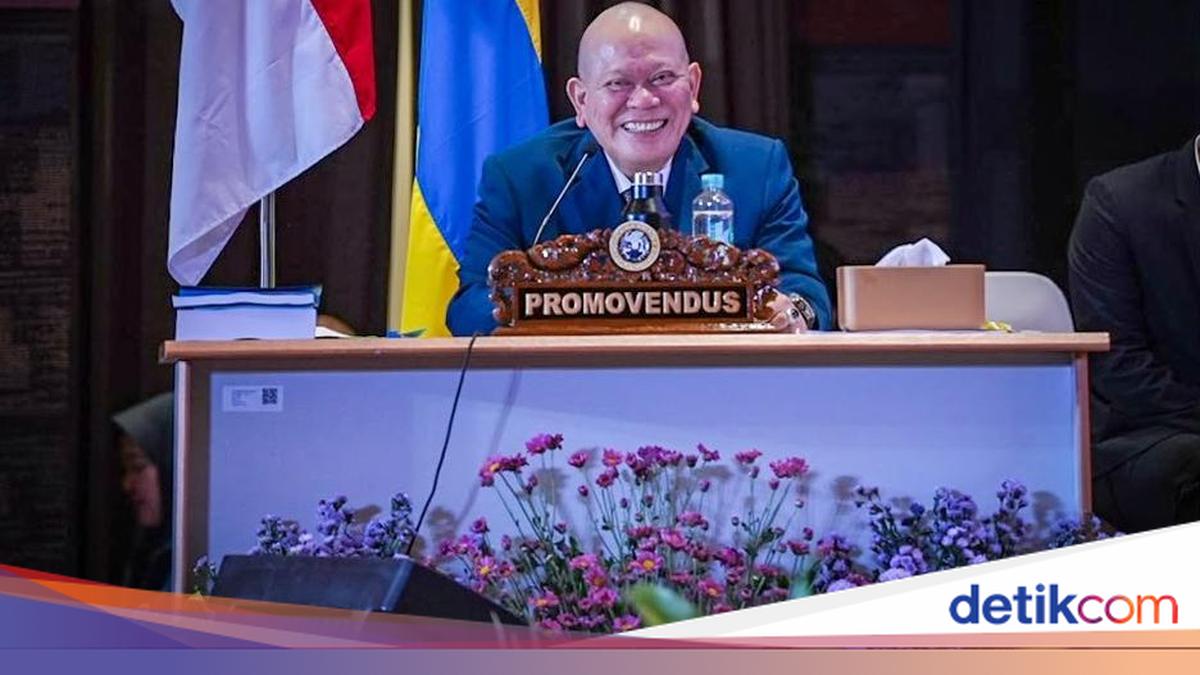
AA LaNyalla Mahmud Mattalitti, a member of Indonesia’s Regional Representative Council (DPD), has earned a doctorate in Law and Development from Airlangga University’s postgraduate school in Surabaya. He received a distinction of Summa Cum Laude in his dissertation examination.
His dissertation, titled “Reconstructing Membership of the Republic of Indonesia’s Representative Bodies from Non-Political Party Elements”, was examined today at Airlangga University’s ASSEC Tower.
In his academic work, LaNyalla highlights an imbalance of power in the legislature and what he sees as the absolute dominance of political parties, which he argues has distorted popular sovereignty.
He also draws attention to Article 22E(3) of the 1945 Constitution, which restricts participation in elections for the House of Representatives to political parties. In his view, this creates a “recall bottleneck”, in which representatives in Senayan are more beholden to faction discipline and the threat of inter-period replacement (PAW) by party elites than to the genuine aspirations of their constituents.
As a solution, LaNyalla proposes a constitutional reform (ius constituendum) to open a route for independent, non-party candidates to become members of the House of Representatives.
“An independent route is a democratic safety valve. It would break the political parties’ monopoly, restore direct accountability to the people, and open up broad opportunities for non-partisan groups such as technocrats, academics and professionals to serve in the main legislative chamber without having to submit to a particular party ideology,” LaNyalla said in a written statement on Wednesday (11 November 2026).
LaNyalla outlined several potential benefits of accommodating individual candidates in the House of Representatives. First, it would strengthen checks and balances within the legislature. Second, it could prevent the formation of oversized coalitions between political parties and the government, which he says often produce elite-friendly policies at the public’s expense.
Third, it could minimise conflicts of interest arising from the influence of political party sponsors, helping ensure greater fairness in strategic regulations covering the environment, health, spatial planning and employment.
He said the proposal was feasible, citing South Africa as a comparative example. In 2020, the country’s Constitutional Court ruled that its Electoral Act was unconstitutional because it prevented citizens from standing independently for the National Assembly. In 2023, South Africa enacted an amendment to its electoral law allowing independent candidates to take seats in the legislature without party backing, he said.
LaNyalla added that independent representation in national parliaments had long been practised in other established democracies. He cited the United Kingdom, the United States and Australia, as well as European Union members Germany and France, as countries that have opened their national parliaments to independent candidates.
Calls for a stronger DPD
LaNyalla’s dissertation also addresses what it describes as the extreme imbalance between the House of Representatives and the DPD, or “soft bicameralism”.
“The House of Representatives has absolute authority throughout the law-making process, from beginning to end. By contrast, the DPD can only submit proposals and offer considerations, without decision-making power,” he said.
Drawing on his experience as DPD chairman for five years, LaNyalla said he had seen regional aspirations and interests sidelined by centralised policies controlled by national political forces in the House of Representatives.
The second pillar of his proposed reconstruction is therefore to equalise the powers of the DPD. He wants it to have full authority as a co-legislator on an equal footing with the House of Representatives in legislation, budgeting and oversight.
To implement the two proposals, LaNyalla recommends comprehensive amendments to Articles 22E(3) and 22D of the 1945 Constitution.
His Summa Cum Laude achievement, the article says, marks not only his academic commitment but also provides a blueprint for the future of Indonesian constitutional law. The work is expected to prompt wider national debate on equitable development and returning sovereignty to the people rather than leaving it in the hands of party elites.
“True sovereignty cannot be delegated to an oligarchy; it must be returned to its rightful owners, the Indonesian people,” he said.
Those serving as examiners included Romdhoni, Suparto Wijoyo, Muhamad Nafik Hadi, Dossy Iskandar Prasetyo, Muhammad Hatta Ali, Radian Salman, Mas Rahmah, Wahyu Aditama and Prawitra Thalib.
Academic guests who posed questions included Mulyadi of the University of Indonesia’s Faculty of Social and Political Sciences, Dailami Firdaus and Badikenita Br Sitepu, both DPD members, and Deputy Minister of Manpower Afriansyah Noor.
Source: jawawa.id (https://jawawa.id/newsitem/lanyalla-earns-doctorate-in-law-and-proposes-independent-candidates-for-the-house-of-representatives-1794419587)
Originally published by detikcom (https://news.detik.com/adv-nhl-detikcom/d-8749067/lanyalla-raih-gelar-doktor-ilmu-hukum-usulkan-jalur-independen-di-dpr-ri), translated from Indonesian