
Landfill Fires in Indonesia: A Record of Crisis Over the Past Five Years
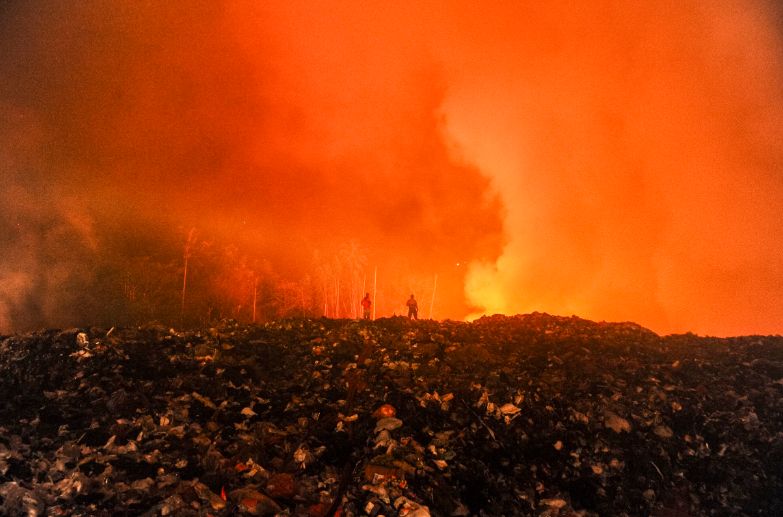
Fires at Final Processing Sites (TPA) for waste have become a serious threat to the environment and public health in Indonesia, particularly over the past five years. This phenomenon is not merely an ordinary accident, but rather an accumulation of suboptimal waste management, the influence of climate change, and the characteristics of flammable methane gas within waste piles. Between 2019 and 2024, the frequency of landfill fires tended to increase, especially during prolonged dry seasons triggered by the El Niño phenomenon. Several regions in Indonesia have experienced a waste crisis due to the disruption of operations at burnt landfills. Unlike building or forest fires, landfill fires involve internal chemical factors that make them extremely difficult to extinguish. These fires are not just an operational issue for sanitation departments, but also a humanitarian and environmental disaster. To prevent future tragedies, a transformation of waste management is needed, shifting from open dumping systems to more sustainable methods. The difficulty in extinguishing these fires arises because the flames are often located deep beneath waste piles, at depths of 10 to 20 metres, where water cannot easily reach and methane gas continuously fuels the combustion. Residents living near a burning landfill are advised to wear medical or N95 masks, keep house ventilation closed, and evacuate immediately if they experience shortness of breath. If managed properly, methane gas from landfills can be captured through pipes and utilised as cooking fuel or for simple power generation. The year 2023 recorded the highest number of landfill fires in the past five years, driven by an extreme El Niño phenomenon. A TPS is a temporary waste collection site before transport, whereas a TPA is the final waste processing site. Data on these landfill fires was compiled from various regional and national disaster reports from the 2019-2024 period. Mitigation efforts continue to be carried out by the government to minimise similar risks in the future. The Police Medical and Health Unit provided health services and distributed masks to residents of Rajeg, Tangerang, affected by smoke from the Jatiwaringin landfill fire. The Ministry of Environment used thermal drones to detect hotspots beneath the waste piles at the Jatiwaringin landfill, with handling involving injection methods and water bombing. The Ministry of Environment and the Environmental Management Agency conducted weather modification operations at the Jatiwaringin landfill in Tangerang, using injection methods and water bombing to tackle subsurface fires. Deputy Minister of Environment Diaz Hendropriyono urged the acceleration of extinguishing efforts at the Jatiwaringin landfill using water injection and weather modification. The Ministry of Forestry deployed 30 Manggala Agni personnel to assist in extinguishing the fire at the Jatiwaringin landfill in Tangerang Regency.