
Lampung Provincial Government Urges CSR to Become Social Investment in Development
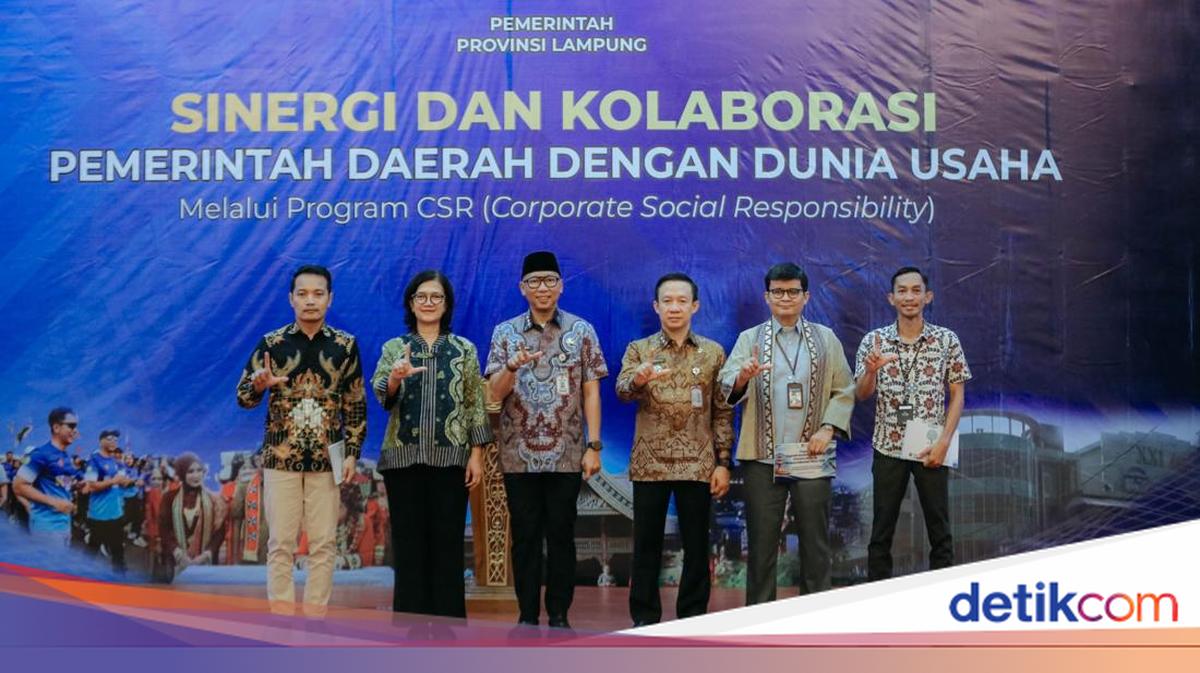
Lampung Governor Rahmat Mirzani Djausal has called for stronger collaboration between the provincial government and businesses through corporate social responsibility (CSR) programmes. CSR, he said, should not be treated simply as aid, but as part of the ecosystem and coordination of regional development.
He made the remarks at an event on local government and business collaboration through CSR, held at the Bank Indonesia Representative Office in Lampung Province on Thursday, 8 October.
Djausal said regional development must have a clear direction and remain aligned with the country’s goals: protecting the Indonesian people, advancing public welfare, educating the nation and contributing to world order.
He said this principle was consistent with Article 33(1) of the 1945 Constitution, which states that the economy is organised as a collective endeavour. Businesses, he stressed, have an important role in development, as much of economic growth comes from private-sector activity.
Lampung’s economy grew by 5.28% in 2025, Djausal said, supported by sectors including agriculture, manufacturing, trade, transport, and information and communications.
The growth showed that economic activity was driven not only by government spending, but also by businesses and the public, he said. The government and businesses therefore needed to work together and align their programmes to deliver greater benefits to communities.
“Government programmes must be aligned with the country’s direction. CSR programmes and the CSR Forum must also follow that direction, so that everything has an impact,” Djausal said in a written statement on Sunday, 11 October 2026.
The Lampung provincial government’s vision is ‘Together, Advancing Lampung towards a Golden Indonesia’, which emphasises the importance of collaboration among all parties, he said.
Djausal said budget constraints meant the government could not deliver development alone. Priorities at central, provincial and regency or municipal levels, as well as those of businesses, needed to be brought together around shared goals.
He also outlined the Desaku Maju programme, which could provide a platform for CSR collaboration. It includes supplying liquid biofertiliser (PHC) and grain dryers, strengthening vocational training, developing village economic institutions through village-owned enterprises (BUMDes) and cooperatives, and building village roads.
The programme aims to increase agricultural productivity through PHC by 15% to 20%, he said.
Djausal cited Desaku Maju as an example of CSR collaboration. Government initiatives involving PHC, dryers and vocational training could be reinforced by companies providing animal-feed machinery and day-old chicks (DOCs).
Such collaboration would allow provincial, CSR, central-government and regency-level programmes to be integrated in a single area. It was expected to increase value added, create jobs and strengthen village economies.
“Business support can strengthen government programmes while delivering direct benefits to the public. The government cannot make progress on its own,” he said.
Djausal also encouraged businesses to participate in developing cultural tourism villages. The provincial government has selected villages for development by reviving their identities, histories, cultures, local products and culture-based creative economies.
He said he hoped the CSR Forum would play a role in developing these villages.
The event also heard that closer government-business cooperation was intended to change the way CSR is viewed. Programmes that had previously focused on providing aid should evolve into social investment, empowerment, collaboration and sustainable initiatives.
“Businesses are positioned as part of Lampung Province’s development ecosystem. CSR is not intended to be an additional corporate activity, but part of the coordination of regional development,” he said.
The provincial government provides development priorities, data, regulations and facilitation, while businesses contribute resources, innovation, technology, expertise, networks and CSR programmes.
Lampung has drawn up a CSR Planbook for 2026–2030 to ensure business contributions are aligned with regional development priorities. The planbook is intended to provide clear programme direction, ensure coordination and promote transparency and accountability.
Djausal urged businesses to collaborate with government programmes to achieve greater impact. He said this approach reflected the value of Sakai Sambayan, a spirit of helping and strengthening one another.
“Development is not about who does the most work. It is about how we move forward together. That is Sakai Sambayan, and it is the spirit we want to foster in the CSR Forum,” he said.
He concluded by urging all parties to strengthen cooperation and partnerships to advance Lampung.
Source: jawawa.id (https://jawawa.id/newsitem/lampung-provincial-government-urges-csr-to-become-social-investment-in-development-1791697857)
Originally published by detikcom (https://news.detik.com/berita/d-8701824/pemprov-lampung-dorong-csr-jadi-investasi-sosial-untuk-pembangunan), translated from Indonesian