
Lampung Provincial Government Promotes Balance Between Elephant Conservation and Community Activity
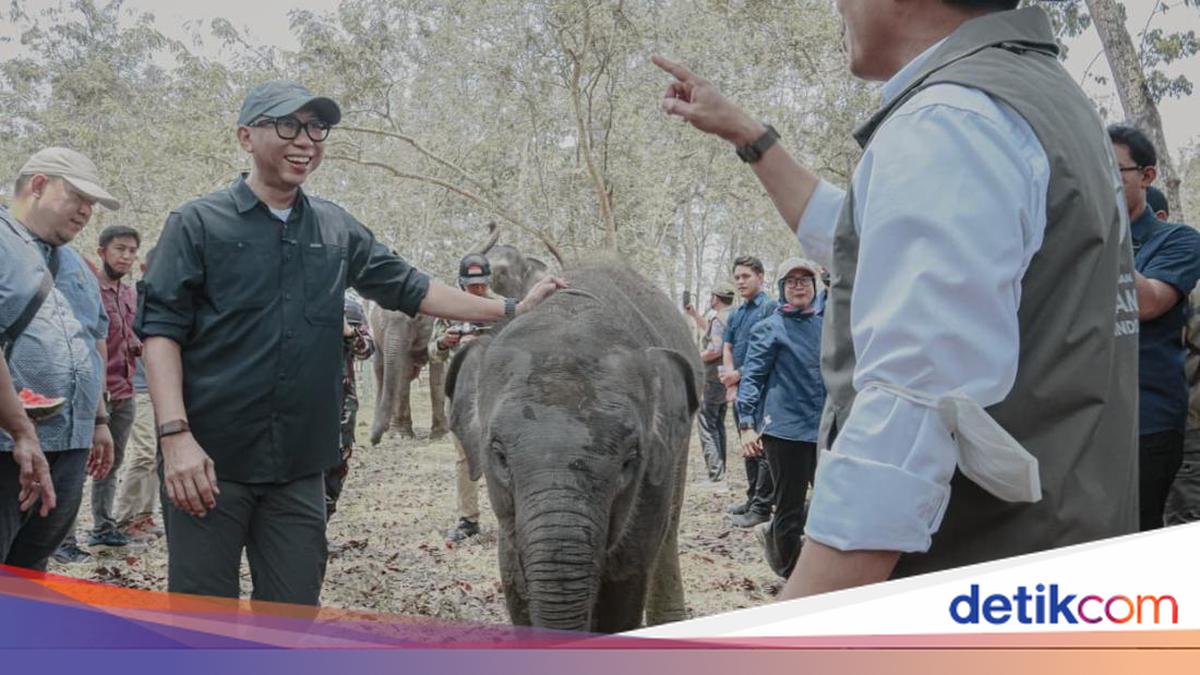
The Governor of Lampung, Rahmat Mirzani Djausal, accompanied the Indonesian Minister of Forestry, Raja Juli Antoni, to inspect the progress of mitigation activities regarding negative interactions with Sumatran elephants in Way Kambas National Park (TNWK), East Lampung.
The inspection was part of Raja Juli’s working visit to Lampung Province to directly observe the development and facilities being prepared to support the management of interactions between wild elephants and the communities surrounding the conservation area.
The visit began upon the arrival of Raja Juli and his delegation at Raden Inten II Airport in Lampung. From the airport, the group travelled approximately 2 hours and 21 minutes by road to the TNWK area.
Upon arrival at TNWK, Mirza and Raja Juli participated in a discussion regarding the development of Sumatran elephant interaction mitigation. Brigadier General TNI Sriyanto, Chairman of the Joint Committee for the Mitigation and Handling of Negative Sumatran Elephant Interactions in Way Kambas National Park, presented the progress of construction at TNWK, ensuring that the development of mitigation facilities can support more planned elephant interaction management.
The activities continued with Mirza and Raja Juli inspecting several facilities related to elephant management and mitigation. The inspection included a holding room, command centre, playground, and a symbolic elephant release area.
The delegation also viewed the ceremonial main area, observation towers, and a suspension bridge. From these vantage points, the central and regional governments directly assessed the readiness of supporting infrastructure for area management, as well as efforts to strengthen Sumatran elephant education and conservation.
After inspecting the primary facilities, Mirza and Raja Juli proceeded to an MSME (Micro, Small, and Medium Enterprises) area within the TNWK area. This visit was part of a series of inspections to observe the link between conservation activities and the economic activities of the community.
TNWK is a vital conservation area in Lampung, featuring a lowland forest ecosystem and serving as a habitat for wildlife, including Sumatran elephants. Ministry of Forestry documents note TN Way Kambas as a key location for mitigation actions in Lampung Province that requires continuous monitoring and evaluation.
Efforts to manage human-wildlife interactions are crucial, as the presence of elephants involves not only wildlife protection but also the safety of communities living and working around the forest areas.
The Lampung Provincial Government, together with the Ministry of Forestry, has previously developed various approaches to handling wildlife conflict, including monitoring animal movements and strengthening area management.
In documents from the Directorate General of Natural Resources and Ecosystem Conservation (Ditjen KSDAE) of the Ministry of Forestry, the installation of GPS collars is cited as a strategy to handle human-elephant conflicts while studying animal movement patterns.
During the visit, Mirza also ensured that the local government is actively involved in strengthening coordination with the central government regarding the management of conservation areas.
“This collaboration is necessary so that wildlife protection efforts can run alongside the interests of the communities surrounding the area,” said Mirza.
Ecologically, TNWK holds a significant position as a conservation area in Lampung. Ministry of Forestry data records TNWK as part of various conservation and ecosystem restoration programmes, including area management development and community involvement.
For Lampung, strengthening elephant interaction mitigation aims not only to maintain the Sumatran elephant population but also to reduce potential disturbances to the surrounding communities. Improved management is expected to create a balance between wildlife protection, forest sustainability, and the socio-economic activities of the residents.
The event was also attended by several officials from the Ministry of Forestry, including the Director General of KSDAE, Ministerial Experts, and various directors related to conservation and area management. Representatives from the Royal Norwegian Embassy were also present, including Ambassador Kaja Glomm and representatives from the climate and forestry sectors, Anja Lillegraven, Livia Costa Kramer, and Susilo Ady Kuncoro. Their presence highlights international attention to forestry, conservation, climate, and ecosystem management issues during the visit to Lampung.