
Lampung Plans 10,000-Hectare Cassava Bioethanol Project Across Five Regencies
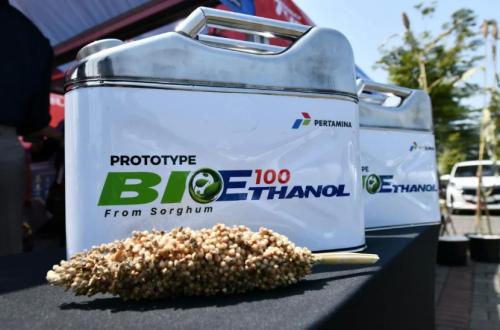
LAMPUNG — The Lampung Provincial Government is preparing a cassava-based bioethanol development project across five regencies, covering around 10,000 hectares. The project is part of efforts to strengthen downstream processing of agricultural commodities and increase the value of cassava as a raw material for the energy industry.
Tommi Effendi Parulian Sihaloho, an investment governance official at the Lampung Provincial Investment and One-Stop Integrated Services Agency (DPMPTSP), said the project was still at the permitting stage. Development is planned using the UJ3 and UJ5 cassava varieties.
“Investment development is directed towards downstream processing, labour-intensive projects, processing local commodities and increasing the added value of agricultural products,” Tommi said on Wednesday (25 November 2026).
He said Lampung had a number of leading commodities with potential to be developed into higher-value industrial products. Alongside cassava, these include pineapples, maize, coffee, pepper, cocoa, coconuts and livestock.
The regional government is also strengthening investment facilitation by mapping local potential, promoting investment and developing partnerships between large companies and micro, small and medium-sized enterprises (MSMEs). The effort includes assistance in resolving issues faced by investors.
Tommi said strategic investment realisation in Lampung in 2026 had reached around Rp8.9 trillion across 7,218 projects. This placed Lampung fifth in Sumatra and 22nd nationally.
“By September 2026, incoming investment had also created around 23,356 jobs,” he said.
The development of cassava-based bioethanol also requires support to improve agricultural productivity. The Faculty of Agriculture at the University of Lampung (Unila) said average cassava productivity currently stood at around 25 tonnes per hectare, well below its genetic potential of 60 to 80 tonnes per hectare.
Kuswanta Futas Hidayat, representing Unila’s Faculty of Agriculture, said the university had tested 19 cassava clones in Lampung. Seventeen of them recorded higher productivity than the UJ5 variety used as a benchmark.
“Development is also under way on early-maturing cassava clones with starch content of 23.2–26.2 per cent,” Kuswanta said.
Unila is also developing mechanisation technology to make cassava production more efficient. Innovations include Petokong, a cassava-stem cutter for producing planting cuttings with a capacity of around 11,000 cuttings an hour, as well as Rabipoli and Rabakong, which support the processing of cassava stems.
The work also includes turning cassava stems and shoots into animal feed. This innovation creates opportunities to use agricultural biomass and broaden farmers’ sources of income.
“These innovations are part of efforts to make Lampung a national centre for cassava development, or the National Cassava Center (NCC),” Kuswanta said.
At national level, the Ministry of Agriculture is strengthening investment support by simplifying licensing services and developing digital systems. Indra Zakariya Rayusman, head of the ministry’s Centre for Plant Variety Protection and Agricultural Licensing (PVTPP), said the services covered 113 Indonesian Standard Industrial Classification (KBLI) categories in the food-crop, horticulture, livestock and plantation subsectors.
“Licensing services are provided digitally through OSS and Agricultural Licensing. Procedures, requirements, service times and fees are also available to the public on the official agricultural licensing website,” Indra said.
The ministry provides 18 types of agricultural business licence. The government is also strengthening facilities for verifying product legality and testing plant variety protection, to provide certainty for businesses.
Licensing support, the development of improved varieties and agricultural technology innovation are important elements in preparing Lampung’s cassava bioethanol project. Coordination between the central and regional governments and universities is expected to strengthen the supply of raw materials and create investment opportunities in cassava processing.
Source: jawawa.id (https://jawawa.id/newsitem/lampung-plans-10-000-hectare-cassava-bioethanol-project-across-five-regencies-1795654292)
Originally published by Republika (https://ekonomi.republika.co.id/berita/tp31qw522/lampung-siapkan-proyek-bioetanol-singkong-seluas-10-ribu-hektare-di-lima-kabupaten), translated from Indonesian