
Lamongan Launches Coordinated Pest Control Across 19 Districts to Avert Harvest Failure
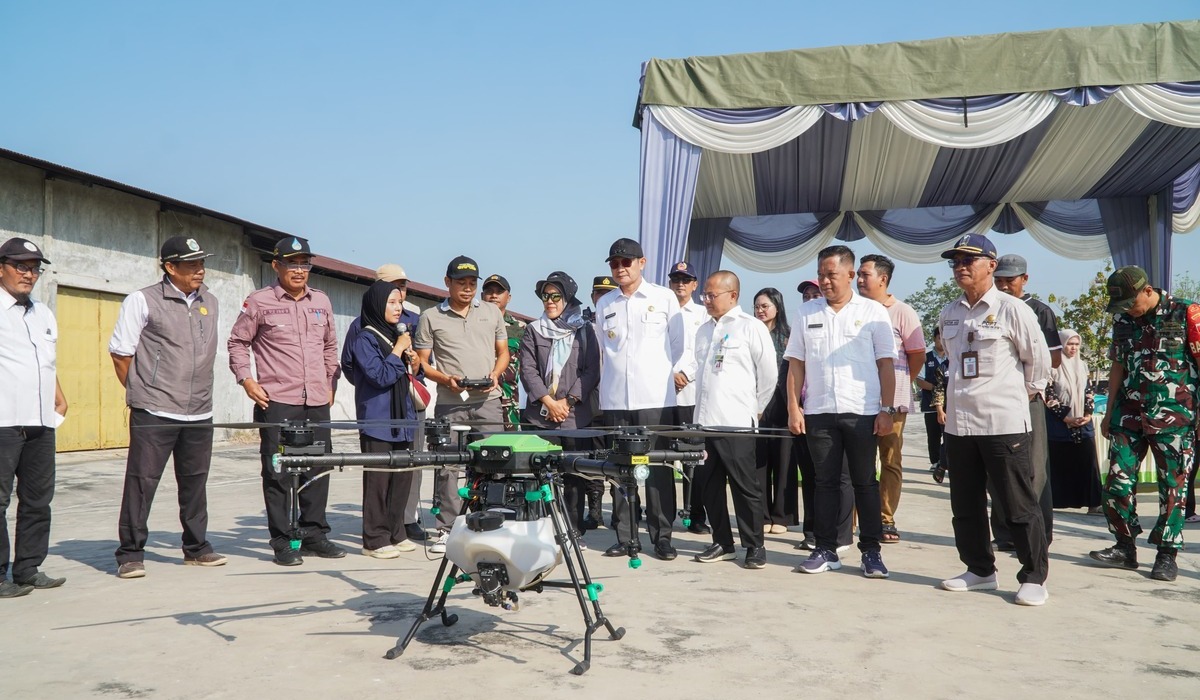
The Lamongan Regency Government in East Java has taken swift action to anticipate the threat of harvest failure by conducting a simultaneous Plant Pest Organism Control Movement (Gerdal OPT) against the Brown Planthopper (WBC) across 19 districts on Wednesday (8/7).
The pest control operation was centred in Banjarmadu Village, Karanggeneng District, utilising drone technology provided by the Ministry of Agriculture of the Republic of Indonesia. This strategic step was taken to safeguard rice production stability while maintaining Lamongan’s status as East Java’s primary food bowl.
Lamongan Regent Yuhronur Efendi affirmed that simultaneous action is the key to breaking the chain of brown planthopper spread, which has been identified as attacking farmland across those districts.
“Thank God, today we have carried out an integrated pest control movement simultaneously across nineteen districts in Lamongan. Since nineteen districts have already been affected by the brown planthopper, the control efforts must also be conducted together,” said the Regent, who is familiarly known as Pak Yes.
These efforts are crucial given the vital role of Lamongan’s agricultural sector in national food security. Lamongan Regency has a total agricultural land area of 103,483 hectares, comprising 95,745 hectares of rice fields (53,057 hectares of rain-fed paddies and 42,688 hectares of irrigated paddies), as well as 7,773 hectares of non-paddy land.
According to East Java BPS data for 2025, Lamongan is the number one rice producer in East Java, with production reaching 904,928 tonnes of Milled Dry Grain (GKG), equivalent to roughly 950,000 tonnes. However, this achievement is now overshadowed by the threat of pest infestation.
Field data from 1 June to 3 July 2026 shows the alert area for WBC attacks in Lamongan has reached 2,186.88 hectares. Planthopper populations have been observed at between 10 and 20 insects per rice hill. If not addressed promptly, the pest could develop through three generations within a single planting season, potentially triggering fatal crop damage.
The 19 districts targeted by the simultaneous Gerdal operation are: Sugio, Karangbinangun, Glagah, Sukodadi, Laren, Karanggeneng, Lamongan, Tikung, Kembangbahu, Sarirejo, Kedungpring, Sekaran, Pucuk, Babat, Modo, Maduran, Turi, Kalitengah, and Deket.
Also present at the event was Mujiburrahman, Expert Advisor to the Deputy Minister of Agriculture of the Republic of Indonesia. He stated that the central government is committed to continuing to intervene in the agricultural sector through modern facilities and infrastructure, such as drones, so that farmers can utilise them optimally in support of national food self-sufficiency.