
Lake Toba Water Level Decline Linked to Human Activity, BRIN Research Finds
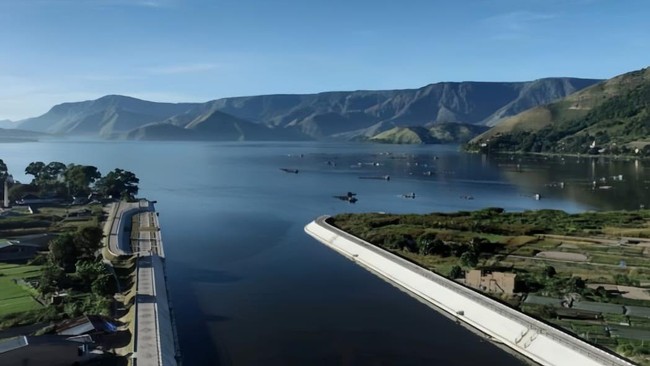
Jakarta, CNBC Indonesia – The decline in Lake Toba’s water level is not only influenced by climate change. Research by the National Research and Innovation Agency (BRIN) has found that human activity also affects the dynamics of the lake’s water level.
Hendri, a researcher at BRIN’s Centre for Climate and Atmosphere Research (PRIMA), analysed data on Lake Toba’s water level from 1957 to 2020. The research shows that the causes of the water level decline changed over time.
“The findings show that Lake Toba’s water level has indeed fallen, but the causes differ in each period,” Hendri said in a written statement quoted from BRIN’s official website on Friday (24/7/2026).
The research team identified a turning point in 1984, coinciding with the start of operations of the Sigura-gura dam and hydroelectric power plant (PLTA). The researchers therefore analysed the lake’s water level conditions before and after 1984 separately.
Between 1957 and 1984, Lake Toba’s water level fell by around 22 millimetres per year. The decline was mainly influenced by climate variability, particularly the El Niño phenomenon, which reduced rainfall in the lake’s catchment area.
After 1984, the average rate of decline slowed to around 2 millimetres per year, although the lake’s water level continued to fluctuate from year to year.
Hendri said extreme declines occurred in 1987, 1990, 1998 and 2016, linked to a combination of El Niño and a positive Indian Ocean Dipole (IOD).
Meanwhile, human activity became increasingly influential after 1984. Water use for the operation of the hydropower plant had a more dominant impact than domestic activity by local communities. Changes in land use within the catchment area also affected Lake Toba’s water reserves.
Satellite imagery analysis shows that natural forest cover in the Lake Toba area decreased by around 29% between 1988 and 2020. Over the same period, plantation forest expanded significantly, while settlement and agricultural areas also continued to grow.
“The loss of natural forest cover is thought to have reduced the catchment area’s ability to absorb and store rainwater, thereby contributing to fluctuations in the lake’s water level,” he said.
Hendri stressed that changes in Lake Toba’s water level result from the interaction of various factors. Climate variability still plays an important role, but the influence of human activity is increasingly evident.
“Efforts to safeguard the sustainability of Lake Toba cannot focus solely on adapting to climate change; they also require wiser management of land use and water resource utilisation,” he asserted.
Meanwhile, the Head of BRIN’s PRIMA, Albertus Sulaiman, said the research is important in providing a scientific basis for understanding the dynamics of Lake Toba.
“So far, the decline in Lake Toba’s water level has often been attributed to climate change. Yet the research shows the problem is more complex, involving the interaction between climate factors and human activity,” Albertus explained.
“These findings provide an important scientific basis for stakeholders to formulate more adaptive and sustainable measures for managing Lake Toba,” he added.